Clara’s Verdict
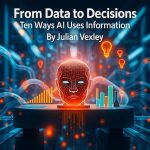
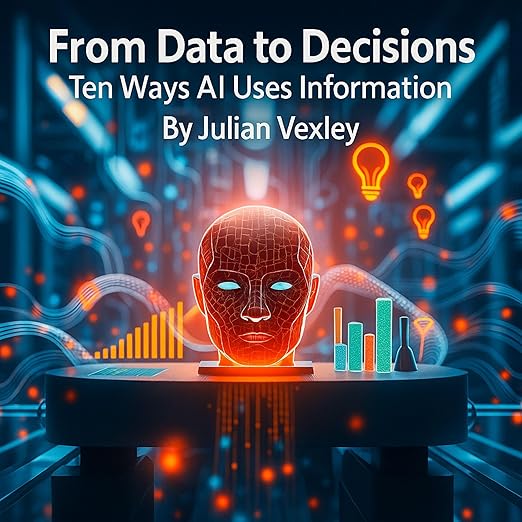
I have read a fair number of AI explainers in the past couple of years, and most of them fall into one of two traps: they drown you in jargon, or they oversimplify to the point of being useless. From Data to Decisions avoids both. Julian Vexley writes with genuine clarity and a real sense of wonder at the systems he is describing, and the result is one of the more accessible and honest introductions to artificial intelligence that I have encountered in the popular science space. He does not pretend the questions are simpler than they are, but he does the work of making them navigable for a reader with no technical background.
Part of the series The World of AI: Understanding Tomorrow, Today, this title delivers exactly what the series name promises. At a lean three and a half hours, it is one of those listens you can finish in a single sitting and come away feeling genuinely better informed. That is not as common as it should be in this category.
About the Audiobook
Ten chapters, each exploring a different dimension of how artificial intelligence transforms raw data into insight and action. Vexley covers machine learning, pattern recognition, language understanding, recommendation systems, fraud detection, logistics optimisation, generative art, medical diagnostics, climate modelling, and space exploration – a substantial sweep achieved without superficiality because each chapter has a genuine focus rather than a laundry list of applications.
The central argument – that AI is not replacing humanity but extending it – is made carefully and with real evidence, and Vexley is notably honest about the places where the technology is imperfect, ethically complicated, or operating beyond current understanding. He is particularly good at grounding abstract concepts in concrete, imaginable examples: not “algorithms analyse social media data” but rather the specific mechanism by which a recommendation engine infers that someone who bought one book might value another. These illustrations accumulate into a coherent picture of a genuinely transformative technological moment.
The book is written, Vexley states, for the curious listener – neither the specialist nor the sceptic, but the person who has been following the headlines and wants to understand what is actually happening beneath them. He earns that description. The final chapters, which address the ethical and social implications of AI decision-making, lift the book above the merely technical and give it a relevance that extends well beyond questions of how the systems work.
The book’s final argument – that AI is not about creating machines that think for us, but systems that think with us – is the kind of framing that sounds simple until you consider its implications. Vexley unpacks those implications seriously and without resort to either techno-utopianism or dystopian anxiety, which is the kind of clear-eyed balance that makes this worth your time.
The Narration
Michael Bridges narrates in a measured, professional register that suits non-fiction of this kind well. He carries authority without tipping into the dry monotone that plagues many audiobook productions of technical material, and his pacing is brisk without feeling rushed. Technical terminology is handled cleanly – neither stumbled over nor turned into performance pieces – and the transitions between chapters are smooth. For a three-and-a-half-hour listen of this density, the narration does exactly what it needs to do: it keeps you engaged and moving forward.
What Readers Say
As a newly released title, From Data to Decisions does not yet carry a public rating on the platform, which is entirely typical for specialist non-fiction in its early weeks. The clarity and accessibility of the material – and its genuine engagement with the ethical dimensions of AI, which sets it apart from purely technical overviews – suggests it is well-positioned for the kind of steady, word-of-mouth growth that tends to characterise the best popular science. Vexley writes with the seriousness of someone who wants readers to actually understand what they have encountered, rather than merely to feel briefly informed before returning to confusion.
Readers who have enjoyed titles like Max Tegmark’s Life 3.0 or Kai-Fu Lee’s AI Superpowers but found them somewhat dense are likely to find Vexley a more accessible and equally honest companion. The series context – The World of AI: Understanding Tomorrow, Today – suggests further volumes are planned, which would make this an appealing first entry into what could become a valuable popular series on the subject.
Who Should Listen?
Ideal for curious non-specialists: business professionals who want to understand the tools reshaping their industries without reading a textbook; students approaching AI for the first time from a humanities background; managers who need to make sense of AI proposals from their technical colleagues; and anyone who has been following the public conversation about large language models and wants a grounded, honest account of what is actually happening. If you have started an AI explainer before and abandoned it because it stopped making sense, give this one a try – it keeps faith with the reader throughout its ten chapters.