Clara’s Verdict
The AI business book has become its own genre in the past two years, and most entries divide neatly into two camps: breathless evangelism and paralysed anxiety. Austin Chen’s The AI Leader’s Renaissance belongs to neither. It is, at its core, a book about strategic discernment — about knowing what to delegate, what to protect, and what it means to lead in an environment where execution is increasingly cheap and judgement is increasingly valuable. That is a more useful frame than the typical “here are 47 AI tools” approach, and it deserves credit for it.
At under eight hours, this is a lean, purposeful listen. It will not transform your organisation overnight, but it may well reframe the question you are asking about AI — which is, in the end, the more valuable intervention.
About the Audiobook
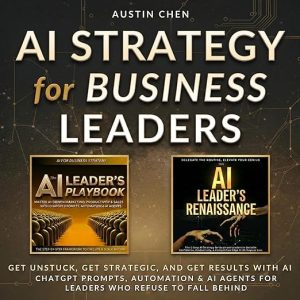
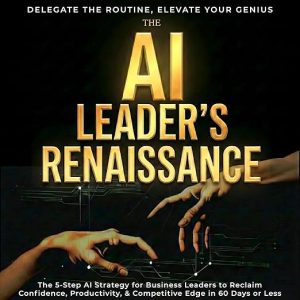
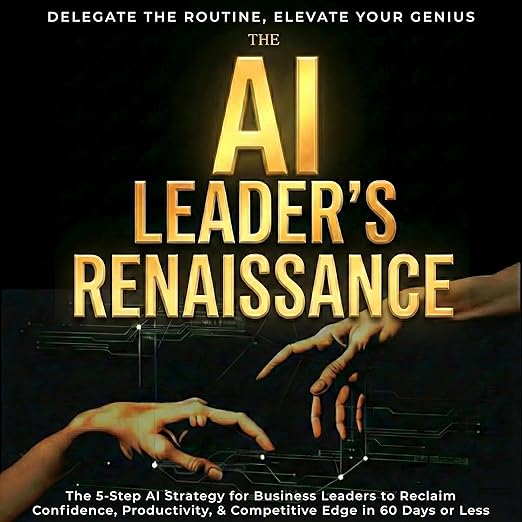
The AI Leader’s Renaissance by Austin Chen was published by Blackstone Publications in January 2026 and runs to 7 hours and 55 minutes. It is part of the AI for Business, Strategy, & Leadership series. The book is addressed directly to people responsible for outcomes rather than output — managers, directors, and executives who find themselves expected to direct AI-enabled teams without necessarily having deep technical knowledge themselves.
Chen’s central argument is built around a single distinction he calls Automate vs Amplify: some tasks should be handed to AI entirely (repetitive, low-judgement, time-consuming work), while others — specifically the work that requires genuine human judgement, relationship intelligence and strategic discernment — should be amplified by AI rather than replaced by it. The book provides a five-step framework (Release, Expand, Partner, Protect, Elevate) for putting this distinction into practice, and claims to help readers reclaim ten or more hours per week through deliberate task delegation. Chen is particularly sharp on what he terms the Commoditisation Trap: the risk that leaders who use AI only to execute faster end up doing higher volumes of lower-leverage work, becoming more efficient at things that matter less.
The Narration
Ted Kettler narrates, and his delivery is well-calibrated for the material. Business and leadership audiobooks require a voice that sounds authoritative without being hectoring, and Kettler finds that register consistently. The framework sections — where Chen lays out his five-step system in some detail — are handled with clarity and appropriate deliberateness, ensuring that listeners absorbing this aurally rather than reading it can follow the structure without losing track. At under eight hours, the runtime keeps the book focused; Kettler’s pacing helps sustain that focus throughout.
What Readers Say
The audiobook holds a rating of 5.0 out of 5 from 2 listeners on Audible. Reviewer Jim, writing from the United States, offered a pointed endorsement: “It’s for the VP or Director who realises that trying to outrun technology is a losing game and is ready to turn the machine into an engine for their own career.” Reviewer Waffle Lynn described the Automate vs Amplify distinction as “simple, practical, and immediately useful” and noted that the book does not require technical skills to apply — a point Chen makes explicitly and that the reviews confirm as a genuine rather than merely claimed quality.
Who Should Listen?
Mid-to-senior leaders who feel behind the AI curve and are uncertain how to engage with it strategically rather than reactively. It will particularly suit those in non-technical roles — marketing, HR, operations, finance — who are expected to have opinions about AI adoption without having been given a coherent framework for developing them. It is not for developers or data scientists looking for implementation guidance. If you want a tools guide, this is not it; if you want to think more clearly about where your value as a leader actually sits in an AI-augmented workplace, this makes a strong case.
Chen’s framework is explicit enough to be actionable but abstract enough to remain relevant as specific tools change — which is, frankly, the hardest trick to pull off in AI business writing, where books published eighteen months ago can already feel dated. By focusing on the underlying question of where human judgement actually creates value rather than which platforms are currently useful, Chen has written something with a longer shelf life than most of its genre. Whether the specific ten-hour-reclamation claim holds up in practice will depend on the individual, but the directional thinking is sound.
Listen to The AI Leader’s Renaissance on Audible UK and start leading AI rather than being led by it.