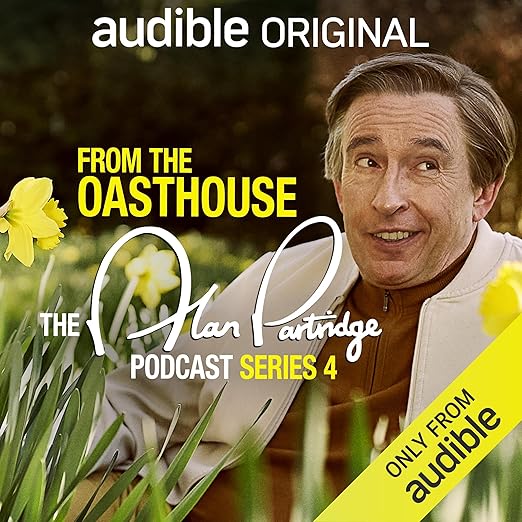
Clara’s Verdict
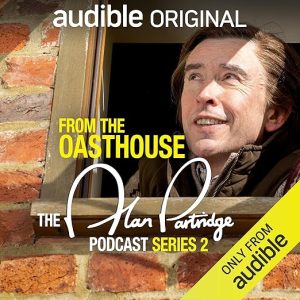
I should confess upfront that I listened to the first three series of From the Oasthouse with genuine and uncomplicated delight. The Alan Partridge Audible Original podcast is among the best things Steve Coogan has done with the character since the original television run – intimate, formally inventive, exploiting the podcast-within-a-podcast conceit to create something that Partridge could not convincingly inhabit during the television era. The format allows a solipsism and a self-narrating quality that the character’s inner life has always required. Series 4 arrives with the same architectural ambitions: eleven episodes, a running legal-jeopardy narrative built from a speeding violation that Alan treats as a constitutional crisis, and the usual catalogue of specifically minor British obsessions – stately homes, the year 1994 revisited with inappropriate nostalgia, the health of his long-suffering assistant Lynn, and the editorial offices of Partridge plc. But several listeners feel the execution is looser than the earlier series achieved, and I think that critical response is honest and worth acknowledging rather than dismissing as impossible-to-please fandom.
Rated 4.1 out of 5 from 11 Audible UK reviewers. Available in Dolby Atmos for listeners with compatible equipment, which adds a spatial audio dimension genuinely worth experiencing if you have the headphones for it.
About the Audiobook
Published as an Audible Original in June 2025, Series 4 runs to 3 hours and 57 minutes across eleven episodes. The Dolby Atmos design has been a consistent feature of the later Oasthouse series, and with appropriate headphones it adds a sense of room ambience and physical proximity to Alan’s narrated world that reinforces the podcast conceit’s immersive quality. The criminal case narrative – a speeding notice received, an implausible legal defence mounted, a day in court endured – is classically calibrated for the Partridge register. The stakes are deliberately small; Alan’s response is wildly disproportionate; the gap between those two things is where the comedy lives. The episode subjects across the series span the full range of the format’s strengths: the episode concerning Lynn’s possible illness, the Hampton Court Sound Bath Garden, the digital detox, the return to modelling for an in-ferry magazine. The structural absence of any continuation of the Michael plotline from earlier series, flagged by multiple reviewers, leaves the season feeling slightly unmoored from its own recent history.
The Narration
The question of narration here is accurately a question of performance. Steve Coogan has inhabited Partridge for so long that the distinction between performer and character has long since dissolved in anything practical. The series credits Alan Partridge as both author and voice. Coogan’s technical mastery of the character is entirely beyond question – every pause, every failed attempt at gravity, every self-satisfied non sequitur is calibrated with a comedian’s long-developed precision and timing. The self-narrated advertisement interludes, which multiple reviewers identify as particular highlights of this series, demonstrate that the instincts remain sharp. The uncertainty about Series 4 is not about craft; it is about whether the material at this point provides the character with sufficient resistance to generate his best comedy. The finest Partridge has always emerged from friction – between his self-image and reality, between his ambitions and his limitations. Whether Series 4 generates enough of that friction is the open question.
What Readers Say
Reviewer Ewart Hartley gave five stars and specifically identified the episode about Lynn’s possible illness as ‘especially memorable and touching’ – a moment where the comedy and the genuine oddly tender bond between Partridge and Lynn coexist with more emotional complexity than the format usually permits. Reviewer Audiolove, who was deeply enthusiastic about Series 1 to 3, found Series 4 ‘so dull’ and called it ‘easily the most forgettable season,’ while praising the self-narrated advertisements as consistently brilliant. Reviewer StevieB wrestled visibly with their rating before settling on four, noting the absence of a coherent narrative thread and wondering whether the creative team has run out of material. Reviewer Stu offered the most affectionately critical verdict: ‘Steve Coogan is a perfectionist and I know he can do better. Still worth buying if you are a big Partridge fan.’
One specific recommendation for listeners who have not encountered the Oasthouse format before: the podcast conceit is integral to the comedy, not incidental to it. Partridge narrates his own life in real time, often while things are happening to him, and the gap between what he perceives and what is actually occurring is where most of the best humour lives. This is a very different listening experience from a conventional comedy performance or a scripted drama. The format rewards close attention and patience with the character’s digressions – those digressions are not filler but the actual content. Approach it as you would approach spending time with a very funny, very deluded acquaintance, and the experience becomes considerably more rewarding than treating it as a show to be evaluated scene by scene.
Who Should Listen?
If you have not listened to the earlier Oasthouse series, go back and start at Series 1. The format is inventive enough, and the earlier material strong enough, to justify the time even before reaching this point. Come to Series 4 as a committed fan of the character and the earlier series rather than as a new listener. If you have never found Partridge funny, this will not change your view – the comedy is too idiosyncratic for that. For everyone who loves the character: this is imperfect Partridge, which remains considerably more worthwhile than most comedy audiobooks on the market. Listen on Audible UK.