Clara’s Verdict
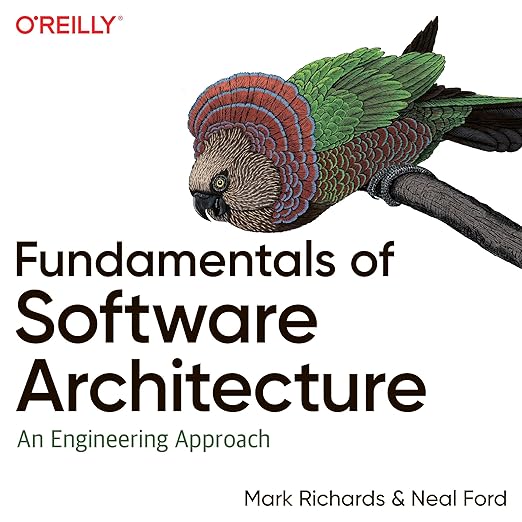
I should be upfront: software architecture is not my usual editorial territory. My background is in literary fiction and narrative non-fiction, and I approach this book as a well-read generalist rather than a technical practitioner. But I have read enough across disciplines to recognise when a complex subject has been handled with genuine pedagogical care, and Fundamentals of Software Architecture by Mark Richards and Neal Ford is an unusually well-constructed professional resource. The authors are hands-on practitioners who teach architecture professionally, and the text has the quality of hard-won practical wisdom rather than synthesised theory. At 13 hours and 10 minutes, narrated by Benjamin Lange, this is a serious professional audiobook for people who take their craft seriously.
About the Audiobook
The book’s central premise – that no real guide existed to help experienced developers become architects – was accurate when it was published, and the ambition to provide the first comprehensive overview of software architecture’s many aspects is largely fulfilled. Richards and Ford cover architectural characteristics, architectural patterns, component determination, diagramming and presenting architecture, and evolutionary architecture, drawing on innovations of the past decade rather than treating the field as a settled discipline.
A distinctive feature throughout is the consistent emphasis on trade-offs rather than definitive answers. The recurring theme – “there are no clear right or wrong answers, only trade-offs” – is the correct position for a discipline that is necessarily contextual. It means the book is more useful for developing professional judgement than for extracting reusable rules, which some readers find frustrating but which reflects the genuine nature of the work. The soft skills chapters – covering team management, meetings, negotiation, and presenting architecture to stakeholders – address aspects of the architect’s role that purely technical books invariably overlook. Architecture as an engineering discipline, with repeatable results and concrete valuations, is treated throughout with the seriousness it deserves.
One aspect that distinguishes this from competing titles is the explicit treatment of architecture as a career path rather than simply a technical discipline. Richards and Ford address questions about how to develop as an architect, how to communicate architectural decisions to non-technical stakeholders, how to navigate organisational politics, and how to build credibility within engineering teams. These are questions that technical books almost universally ignore, and their inclusion here reflects the authors’ practical orientation. An architect who cannot explain their decisions to a CEO or negotiate effectively within a large engineering organisation is technically skilled but professionally incomplete, and the book takes that seriously.
The Narration
Benjamin Lange narrates with clarity and appropriate professional gravity. Technical audiobooks present specific challenges: the listener cannot refer back to a diagram, re-read a complex passage, or annotate in the margins. Lange compensates through pacing and emphasis, slowing down for complex frameworks and maintaining enough variation in delivery to prevent the material from becoming monotonous. One reviewer purchased the paper copy after listening to the audiobook specifically because they found the content worth having in both formats – which is a strong practical endorsement of the audiobook’s effectiveness as an introduction. The 13-hour runtime is substantial, and some passages are better served by print than audio.
What Readers Say
Rated 4.6 out of 5 from a small but engaged technical readership. The most detailed review praises the book’s ability to “create a great distinction between architecture and design” and to provide “excellent references to other material if you require more depth.” A second reviewer notes it works as “a useful reference covering a mixture of patterns and working practices” with a deliberate emphasis on breadth over depth. The less enthusiastic reviews wish for more prescriptive guidance – a legitimate preference, but one that rather misses the authors’ central point about the nature of architectural thinking.
Who Should Listen?
Senior developers moving into architecture roles, and existing architects looking to structure their accumulated experience into a more coherent framework. The breadth of coverage makes it a strong foundation rather than a deep dive into any specific pattern or technology stack. Those seeking prescriptive design advice for a particular technical context may find it insufficiently specific – but for developing the conceptual vocabulary and professional judgement that good architecture requires, this is a sound investment of 13 hours. Listen on Audible UK: get Fundamentals of Software Architecture on Audible UK. The book is also usefully paired with hands-on project experience: the frameworks it provides become significantly more meaningful once you have encountered the trade-offs they describe in practice. Available on Audible UK and Kobo. The book is often recommended alongside Neal Ford’s other writing and Martin Fowler’s architecture essays for listeners building a comprehensive understanding of the field. It is available on Audible UK, Kobo, and Scribd. It is worth noting that the O’Reilly print edition includes diagrams that are obviously better experienced visually than described verbally, and for very diagram-heavy sections the print version may be a useful complement to the audio. That said, the core arguments and frameworks are fully accessible in audio form and are conveyed clearly by Lange throughout.