Clara’s Verdict
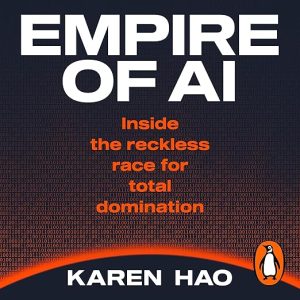
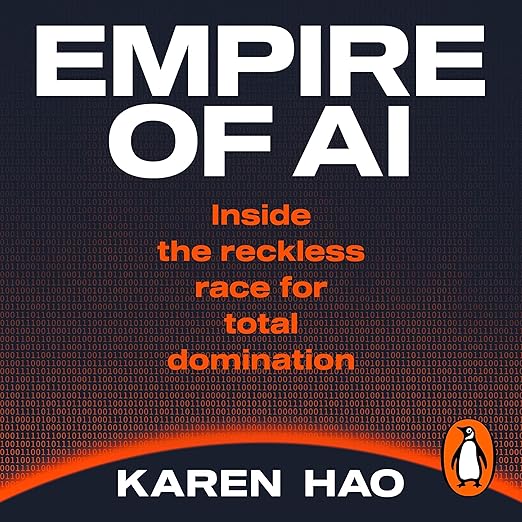
I’ll admit I approached Empire of AI with a degree of wariness. Books about Silicon Valley and its discontents have become a genre unto themselves, and many of them combine righteous indignation with a frustrating thinness of actual reporting. Karen Hao is not that kind of writer. She spent years covering OpenAI as a journalist, built genuine relationships with the people closest to Sam Altman, and clearly did the kind of primary-source journalism that most writers in this space skip entirely – including travelling to Nairobi slums and Colombian cities to interview the data labellers doing the invisible work that makes AI systems function. The result, at seventeen hours and fifty minutes, is the most substantial and credible account of the OpenAI story I’ve yet encountered in audio form. Rated 4.4, with listeners calling it “far better than most books about well-known corporations.”
About the Audiobook
Hao’s central argument is that AI development – and OpenAI’s in particular – represents a new form of empire: one that requires unprecedented concentrations of compute power, data, cheap labour in the Global South, and energy resources on a scale that should alarm anyone paying attention. She traces the history of the term “artificial intelligence” itself, examines the technological paths not taken in earlier decades, and places the current boom in its long historical context before zeroing in on OpenAI’s specific trajectory: the nonprofit founding, the gradual transformation into a for-profit entity, the cult of personality that formed around Altman, and the specific human costs paid by workers whose labour the industry prefers not to discuss.
What distinguishes this from a polemic is the quality of Hao’s access and her willingness to present complexity. She went in, by her own account, thinking OpenAI were the good guys. The book is, in part, an honest account of how she revised that view, and it is considerably more intellectually honest about that revision than most first-person journalism manages to be. The result is a narrative that is critical without being reductive, and that gives its subjects enough space to be complicated.
The Narration
Hao narrates her own book, which is always a gamble. In this case it pays off handsomely. Her voice is composed and precise, with the cadence of someone who has spent years presenting complicated information clearly – she trained as an engineer before becoming a journalist, and that precision of mind comes through in the delivery. She handles the technical material without condescension and the more emotionally loaded passages without melodrama. At nearly eighteen hours, a weaker narrator would be a serious liability; Hao’s measured pace and evident conviction in the material carry the listener through even the most technically dense sections.
What Readers Say
Reviews are strong and specific. Stephen Kinsella calls it “an excellent book in a classic beat-reporter way,” praising its historical context alongside the insider material: “you’ll learn where the phrase Artificial Intelligence came from.” Andy Hayler is particularly struck by the primary research: “The level of detail regarding the inner workings and machinations of OpenAI is impressive, and to top that, the author can write very well indeed. Her book almost reads like a thriller – far better than most books about well-known corporations.” Paula Boddington is more direct: “Really goes into detail and reveals the extent of the machinations and character flaws of those few people pushing this stuff onto the rest of the world. Give this woman a prize.” One dissenting voice from Garrett McQuaid notes the book’s critical framing as a limitation for readers seeking balance, which is a fair point about perspective if not about quality.
Who Should Listen?
This is essential listening for anyone who wants to understand what is actually happening in the AI industry rather than what its architects want us to believe. It suits technologists, business readers, policymakers, journalists, and anyone who has found themselves unsettled by the pace and scale of recent AI development without quite having the vocabulary or the factual grounding to explain why. The nearly eighteen-hour runtime is a real commitment, but Hao earns every minute of it, and the material is genuinely important. Listen to Empire of AI on Audible UK – this is the account that will define how a generation understands this particular historical moment.