Clara’s Verdict
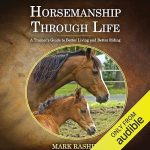
Books that genuinely earn the label “life-changing” are rare enough that I use the phrase carefully. Horsemanship Through Life is one of them. Mark Rashid writes about horses the way the best essayists write about anything – with quiet precision, an absence of sentimentality, and the kind of attentiveness to small details that reveals large truths. I’ve recommended this book to people with absolutely no interest in horses, and without exception they’ve come back grateful. It is not, despite the title, a book about horses. It is a book about how to be present, how to communicate honestly, and how to take genuine responsibility for the quality of your relationships.
At just over seven hours, it is also – and this matters – a short listen. There is no padding here. Every story, every observation, every principle is earning its place. That kind of restraint is itself a form of respect for the reader, and it is notably rare in reflective non-fiction.
About the Audiobook
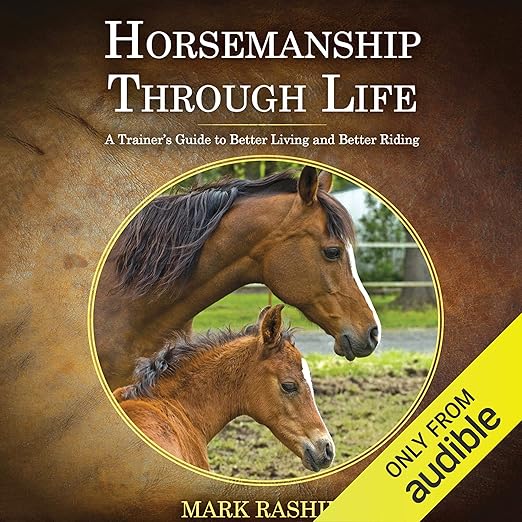
Produced by Audible Studios, this is a philosophical meditation on the principles that govern good relationships – between humans and horses, certainly, but more fundamentally between any two living creatures attempting to understand each other. Rashid, who trained under an old-time buckaroo he knew only as the Old Man, draws on decades of working with horses to illuminate ideas about awareness, patience, honesty, integrity, and the particular kind of clarity that comes from taking genuine responsibility for your own part in any situation.
The book does not offer techniques in the conventional instructional sense. There are no training sequences, no step-by-step protocols to follow. Instead, Rashid circles back repeatedly to a handful of core principles: that true partnership requires genuine and sustained attention to the other being involved; that most conflict arises from miscommunication and misread signals rather than from malice or stupidity; that the impulse to force a result through escalating pressure almost always produces the opposite of what you want. These ideas sound simple when stated directly. Rashid’s particular gift is demonstrating, through story after story from his working life with horses and people, why they are anything but easy to implement consistently, and why the attempt to do so changes you.
The horses in these pages are not metaphors or props – they are real animals with genuine agency, and Rashid’s respect for that agency is what makes his observations transferable. When he describes a horse that shuts down under pressure but opens up under curiosity, you know exactly what he means about certain people too, and you probably already know someone who would benefit from being read about that way.
There is a story Rashid tells more than once in different forms about the Old Man he trained under – a horseman who had spent a lifetime working with difficult horses and had arrived at a place of such deep quietness and attention that the horses around him settled almost immediately. That quality of presence is what Rashid is trying to teach, and trying to describe, and it is genuinely difficult to put into words. The fact that he mostly succeeds is a testament to his skill as a writer.
The Narration
Mike Chamberlain narrates, and he is an excellent match for Rashid’s prose. His voice has a quiet, unhurried quality that mirrors the pace of the writing – neither performative nor flat, but genuinely present. The reflective sections particularly benefit from his delivery; he never over-emotes passages that are doing their work through restraint. He lets the stories do what stories do without signalling to the listener how to feel about them. Rated 4.8 from 182 listeners, the combination of Rashid’s writing and Chamberlain’s narration clearly achieves its effect consistently across a wide audience.
What Readers Say
UK reviewers are consistently and sometimes unexpectedly effusive. One called it “possibly the best book I have ever read,” and noted that it pulls together ideas from multiple areas of life into something more coherent than any single source. A leadership coach who picked it up at his wife’s suggestion described the relevance to human relationships as “remarkable” – the horse content became almost incidental to what he was getting from it. Another reviewer describes being moved to “spend more time with people” after finishing, which is not a response you typically get from a book ostensibly about equine training. Multiple readers note the same experience: they expected to read about horses and found themselves thinking about their own relationships, their own patterns of response under pressure, their own habits of perception.
Who Should Listen?
Equestrians will find specific insight here, and the horse content is not window-dressing. But this is more accurately a book for anyone interested in the nature of trust, communication, and genuine partnership. It is particularly well suited to those in roles that involve leading, teaching, or caring for others – coaches, managers, parents, therapists, teachers. Also strongly recommended for readers who have found the self-help genre either too abstract or too prescriptive: Rashid’s approach is grounded in lived experience and resists easy formulas entirely.
Listen to Horsemanship Through Life on Audible UK – also available on Kobo, Scribd, and Storytel.