Clara’s Verdict
I approached How to Date a Prince with the particular scepticism of a British reader watching an American author write the British royal family as a benign, somewhat hapless institution that would willingly broadcast its Crown Prince’s sexuality on a reality television programme. That scepticism is, I think, entirely appropriate and the book earns no credit for constitutional realism. What it does earn, and earns genuinely, is credit for warmth, pace, and a central romance that works considerably better than it has any right to given the implausibility of its premise.
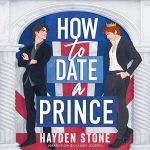
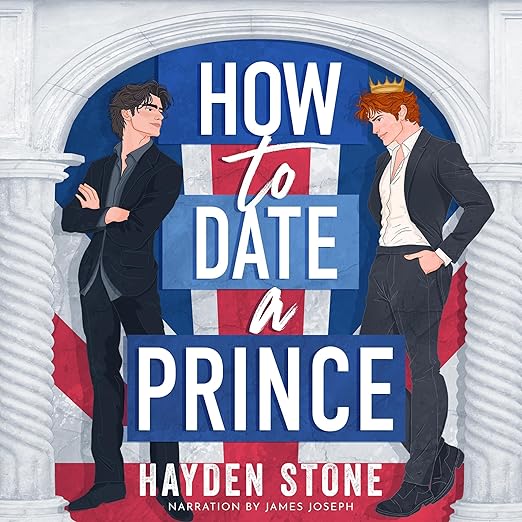
Hayden Stone’s first novel in the Being Royal series (Book 1 of what promises to be an ongoing world) delivers exactly what the cover promises: enemies-to-lovers, a gay Crown Prince navigating a deeply unwanted public platform, an ideologically awkward love interest whose family wants to abolish the monarchy, and a lot of stolen moments on a reality television set in the English countryside. If that is your kind of thing, you will have a thoroughly good time with this.
About the Audiobook
Prince Auggie is secretly gay, privately bookish, and conspicuously unsuited to the performative requirements of royal public life. His father, King James, has enrolled him in a reality television talent competition, designed, nominally, to help find Auggie a bride, which is the last thing Auggie wants. His co-star is Thomas Golden: charismatic, American-British, breathtakingly inconvenient, and the heir to a hotel empire whose family has long and publicly campaigned to abolish the monarchy. Their initial meeting in a London nightclub did not go well. Their forced proximity on the set in the English countryside goes worse, and then considerably better, and then more complicated again.
The novel operates firmly within the “opposites attract” and “forced proximity” traditions of contemporary romance, with the added texture of a class and ideological divide, republican versus royalist, that gives the central conflict more substance than the average enemies-to-lovers premise. Stone is also writing queerness into a space, the British monarchy, that has historically been aggressively hostile to it, and there is something quietly pleasurable about that subversion, however fantastical the framing required to make it plausible.
The second act has pacing issues. Several reviewers noted that conversations in the middle section feel slightly underwritten, as though Stone accelerated through scenes that needed more room to breathe and develop. The political stakes, what it would actually mean for a gay Crown Prince to exist publicly in the current climate, are gestured at rather than fully interrogated, which is a missed opportunity for a story with this premise. But for a romance novel, these are reservations rather than failures. The emotional beats land when they need to, and the ending delivers the resolution the genre promises.
The book runs to 10 hours and 41 minutes, which is a comfortable length for the story it is telling, long enough to build genuine attachment to both protagonists, short enough to be consumed in a weekend without fatigue.
The Narration
James Joseph narrates, and he carries the novel with considerable skill. He captures Auggie’s combination of duty, suppressed longing, and wry self-awareness without ever making the character seem either weak or irritating, a balance that requires real craft in a protagonist so thoroughly constrained by circumstance. His Thomas Golden has enough charisma to justify Auggie’s obsession, which is the fundamental narrative requirement. Joseph handles the comic moments with a light touch and the romantic tension scenes with appropriate restraint. It is confident, well-calibrated work in a genre that punishes narrators who misjudge the register.
What Readers Say
The 107 Audible reviews average 4.2 stars, and UK readers express a consistent and rather endearing internal divide: the “British reader” in them struggled with the portrayal of the monarchy as somewhat too benign and too pragmatic for suspension of disbelief, while the romance reader in them found the book “thoroughly charmed” and “breezy, bingeable.” One reviewer who received an ARC flagged some grammatical issues in the pre-publication text, though noted these did not significantly disrupt enjoyment. Fans of Hayden Stone’s earlier MM romances, An Unexpected Kind of Love and When London Snow Falls, have responded to this new world with real enthusiasm. Comparisons to Red, White and Royal Blue by Casey McQuiston are consistent throughout the reviews and are probably the most useful frame for potential listeners trying to calibrate expectations.
Who Should Listen?
If Red, White and Royal Blue is a benchmark for you, or if you love MM romance with a political edge and a guaranteed happy ending, this delivers reliably and with real warmth. British readers should actively bracket their constitutional knowledge before pressing play, treating this as a parallel-universe Britain rather than a realistic one makes the experience considerably more enjoyable. Readers who want their royal narratives to engage seriously with the real mechanics of succession, duty, and institutional homophobia may find the fantastical framing frustrating. Everyone else should simply settle in for ten hours of genuine warmth.