Clara’s Verdict
Clare Mackintosh has built an enviable and well-deserved reputation with the twist. I Let You Go, I See You, After the End, Hostage – each has demonstrated a novelist in complete command of the machinery of psychological suspense, deploying misdirection not as a parlour trick but as a structural argument about how incompletely we know the people we’re closest to. It’s Not What You Think is, by the consensus of multiple readers who’ve reached the final chapters, the best she has written. That is a strong claim. It appears, based on the response, to be justified.
Richard Armitage narrating a Clare Mackintosh thriller is, frankly, an embarrassment of riches in the best possible sense. The combination works at every level.
About the Audiobook
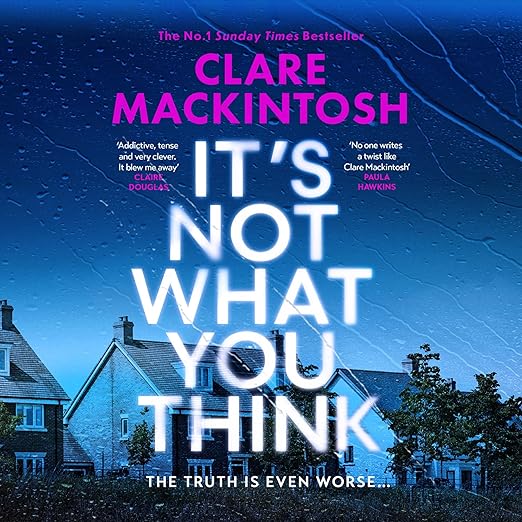
Nadeeka is convinced her partner Jamie is having an affair. She is not imagining it – she knows the signs, because she has been through this before. She follows him. She watches him. She plans to catch him. She arrives home determined to confront him, and finds him dead instead.
What unfolds from that premise is told from four interweaving perspectives: Nadeeka, attempting to reconstruct what she thought she knew about the man she loved; DCI Lauren, leading the murder investigation with characteristic thoroughness; DS Fraser, Lauren’s detective sergeant and her fiancé, whose position at the intersection of professional and personal creates its own mounting pressure; and Jamie himself, in retrospective chapters that trace the weeks leading up to his death with gradually increasing clarity and dread. The four-strand structure gives Mackintosh her maximum working space for the technique she has refined across her career: each perspective reveals information that reframes what has come before, and the title functions less as a marketing line than as a continuous and reliable instruction to the reader about the reliability of what they think they’re understanding.
The novel’s underlying and serious subject is immigration – the legal precariousness, the bureaucratic complexity, and the moral weight that immigration status imposes on individuals, families, and relationships in contemporary Britain. Mackintosh handles this material with intelligence and care, and it gives the thriller a social dimension and a genuine ethical weight that distinguishes it from the psychological suspense genre’s tendency towards purely domestic, interior claustrophobia. The immigration theme is not decorative; it is structural.
At just over eleven hours, the audiobook pacing is exactly right for the material. HarperCollins released it in March 2026 to pre-publication endorsements from Lee Child (“I always see the twists coming – but not this time”), Lisa Jewell, Shari Lapena, and a considerable number of other crime fiction practitioners whose collective praise, while predictably effusive, accurately reflects what the book delivers.
The Narration
Richard Armitage narrates this edition, and his is one of the most technically accomplished and tonally intelligent voices currently working in British audiobook production. His range allows him to move between four distinct narrative perspectives – Nadeeka, Lauren, Fraser, and Jamie – without losing the thread of each character’s individual interiority, and his instinct for pacing in suspense sequences is impeccable. The Jamie chapters, which are retrospective, increasingly ominous, and gradually accumulating the quality of something inevitable, are particularly well handled; Armitage pitches them at exactly the register that allows their eventual revelations to land properly when they arrive.
For a novel built structurally on the premise of not being what it appears to be, a narrator who can sustain genuine ambiguity without inadvertently tipping the reader’s hand is essential and difficult to find. Armitage is that narrator, and his commitment to each of the four voices as distinct and worthy of full inhabitation – not merely signposted – elevates the listening experience considerably beyond what the text alone would produce on a silent page.
What Readers Say
The audiobook carries a 4.8 rating from 58 Audible UK listeners – high for a very recent release and strongly suggestive of genuine word-of-mouth rather than promotional positioning. Reviews consistently describe the experience as “unputdownable,” which for a thriller is the most reliable single indicator of success. Several reviewers explicitly mention the central twist as the best or most surprising they’ve encountered in recent years of crime fiction reading, uniformly without specifying its nature – a form of praise that is both genuinely effusive and impressively disciplined. Readers who approached with high expectations based on Mackintosh’s previous work report those expectations met and in several cases exceeded. Readers new to her work report being immediately converted to the back catalogue.
Who Should Listen?
Readers of psychological crime fiction – Mackintosh’s own previous work most obviously, but also Liane Moriarty, Lisa Jewell, Harriet Tyce, and the broader tradition of British domestic thriller that has dominated the genre for the past decade. If you’ve read and loved I Let You Go, this is essential and non-negotiable. If you’re new to Mackintosh, starting here is entirely defensible – the novel stands alone – but the earlier books will reward you afterwards.
For Armitage fans: this is among the finest narration work he has produced. For audiobook listeners who want a thriller that will absolutely prevent them from doing anything else until it’s finished: here, without reservation, is your next listen.
Listen on Audible UK: Get It’s Not What You Think by Clare Mackintosh on Audible UK. Also available on Kobo, Scribd, and Storytel.