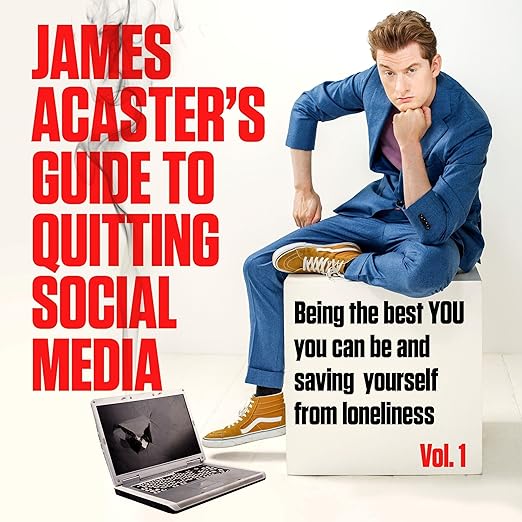
Clara’s Verdict
James Acaster has built a career on the careful cultivation of absurdity – the kind that looks chaotic from a distance but reveals, at closer inspection, a very precise mechanism underneath. James Acaster’s Guide to Quitting Social Media is the logical book for him to write, given that he did in fact quit all social media in 2019 and has been conspicuously, ostentatiously offline ever since. What he has produced is not a memoir, not quite a comedy book, not quite a self-help title, and emphatically all three at once. It runs to just under seven hours in audio, narrated by Acaster himself, and holds a rating of 4.0 out of 5 from 497 Audible listeners.
One reader laughed so hard they nearly choked to death on a Jacobs cream cracker. I consider that a reliable metric.
About the audiobook
The premise is straightforward: Acaster quit social media, found it immediately reduced the quantity of stress and comparison in his life, and decided to help others do the same. The mechanism he proposes is less straightforward – he will identify everything social media used to provide and replace it with real-world equivalents. Want to anonymously bully strangers? He has a system. Want to see photos of everyone’s dogs? There is a chapter on that. Want to immediately know about celebrity deaths, get public figures fired, or argue with absolutely everyone about absolutely everything? Solutions are forthcoming, none of them sensible.
The full title gives you some warning: James Acaster’s Guide to Quitting Social Media, Being the Best You You Can Be and Saving Yourself from Loneliness Vol. 1. It is a book that simultaneously skewers the self-help genre, satirises online culture, and offers a genuine if deeply eccentric argument for the value of physical presence over digital performance. The satirical message, as one reviewer observed, is real – it is just delivered through a lunatic world of Acaster’s own construction. There is a joke near the end about promoting the audiobook by tweeting about it that earns its punchline after six hours of careful setup.
The narration
James Acaster reading his own book is not a luxury – it is a structural requirement. His comedy depends on timing, on the slight pause before the escalation, on the deadpan delivery that makes the most outrageous sentences land as if they were entirely reasonable. No other narrator could do this. His voice has the quality of someone explaining something he genuinely believes to be both obvious and important, which is exactly the register absurdist comedy needs. The audiobook format suits his writing perfectly: the experience of listening to it feels like attending one of his stand-up sets, but longer and considerably weirder.
What readers say
Listeners who came already converted to Acaster’s particular brand of comedy were rewarded. The reviews mention laughter in public places, spontaneous giggling at remembered passages, the difficulty of explaining to bystanders what was so funny. Those less familiar with his work sometimes find the register unsettling – several reviewers note it is “a bit weird,” which is accurate and perhaps the point. A thoughtful three-star review suggests the book is at its best when it sticks to the social media premise and less effective when it wanders into other territory – a fair criticism of work that deliberately resists staying on topic. The audiobook holds a solid 4.0 out of 5.
Who should listen?
Anyone who has ever found themselves spending forty-five minutes scrolling through content they actively dislike should probably hear this book. It is particularly recommended for fans of British absurdist comedy – fans of Acaster’s stand-up specials will not be disappointed – and for people curious about the growing genre of genuinely funny books about technology and its discontents. If you work in digital media and have begun to feel a creeping discomfort about that, this book will not help you but will make you laugh about it, which is a reasonable consolation. Listen to James Acaster’s Guide to Quitting Social Media on Audible UK and discover what it might feel like to leave – or at least to find the whole situation very funny.