Clara’s Verdict
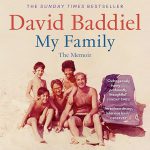
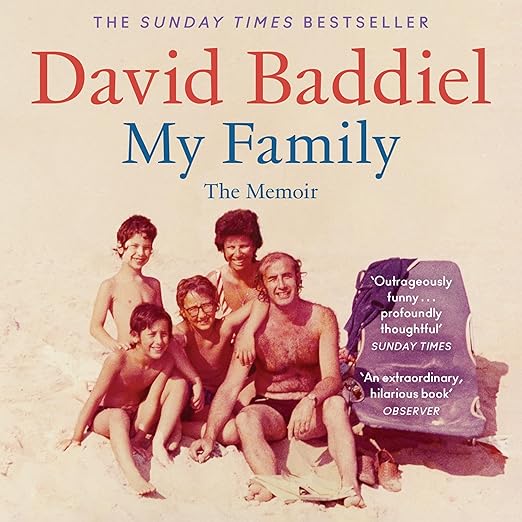
David Baddiel has written one of the most genuinely funny and quietly devastating memoirs I’ve encountered in years. My Family is not what you’d expect from a celebrity memoir – it’s barely about David Baddiel at all. It’s about his mother, who fled Nazi Germany as a child and spent the better part of three decades conducting a passionate, sustained affair with a golfing memorabilia salesman. And it’s about his father, whose dementia is steadily erasing the man his family knew, leaving something rawer and less controlled in its place. It is by turns hilarious and heartbreaking, and I mean both of those things simultaneously, sometimes in the same paragraph. What Baddiel has achieved here is genuinely difficult: to write about his parents with total honesty – their failings, their peculiarities, their often catastrophic parenting choices – and with enormous affection, without the affection blunting the honesty or the honesty undercutting the love. The result is a more complex self-portrait than most celebrity memoirs attempt, and a more rewarding one.
About the Audiobook
Sarah Baddiel, David’s mother, emerges from these pages as a woman of formidable and unconventional energy: shaped by survival, by the particular determination of someone who has looked into the abyss and decided to make her life count at any cost, including the cost to her family’s domestic normality. The golf memorabilia that colonised the family home is funny. The decades-long affair with the memorabilia salesman is funny and complicated and strangely moving all at once. The cache of erotic writing that David discovers is the funniest sequence in the book, and also the moment that most clearly reveals how fully his mother was living a private life that had very little to do with her official role as someone’s wife and mother. His father, meanwhile, provides the emotional centre of the book’s second half: dementia is stripping away the social inhibitions and the careful performance of respectable normality, leaving something more obscene, more unpredictable – but also, sometimes, more nakedly himself than he ever was before. Baddiel finds the comedy in this without being cruel, which is harder to achieve than it sounds and requires genuine love to sustain across an entire book. The memoir is honest about what it was like to grow up in this household – the specific ways his formation was shaped by parents who were extraordinary people and inconsistent carers – and the result is richer and more honest than most people would dare. At seven and a half hours, this is precisely the right length.
The Narration
The publisher does not list a separate narrator, suggesting Baddiel may read his own work – which would be entirely the right choice for material this personal and this dependent on comic timing. A memoir that requires such precise calibration between farce and tenderness benefits from the author’s own sense of where each moment should land. Baddiel is a skilled and experienced performer with natural timing, and by all accounts the audio version achieves the tonal balance that the material demands.
What Readers Say
With 895 ratings averaging 4.3 stars, this has genuinely connected with a wide audience. Reviewer J. Drew, who picked up the book specifically because their own mother has dementia and wanted “to find a book that could help me see the funny side of it,” reports that it delivers: “this book does an incredible job.” Mr Sean C. Alexander writes that Baddiel has “circumvented” the standard memoir problem – tedious biographical scene-setting before we reach the interesting part – by making the autobiography “essentially a testimony to his mother and father, two contrasting and equally vexing individuals for whom parenting never came naturally.” Reviewer El notes that it’s “a refreshingly different format for a memoir,” which is not a criticism. Caitlin Moran, on the cover, says she “lost count of how many times I gasped,” which for Moran is specifically high praise.
A Word on What Makes This Different
It’s worth being precise about what distinguishes this from the standard celebrity memoir, because the genre is saturated with books that promise candour and deliver something considerably more guarded. Baddiel is not guarded here. He exposes his parents – their failings, their cruelties, their love – with a directness that might be uncomfortable if it weren’t so clearly coming from a place of genuine understanding rather than score-settling. He also exposes himself: the ways he was shaped by parents who were exceptional and inconsistent in equal measure, and the parts of that formation he’s still working through. That quality of mutual exposure is rare and it’s what makes the book feel alive rather than performed.
Who Should Listen?
Anyone with complicated parents – which is most of us. Anyone who needs their memoir to do something more than catalogue famous names and career milestones. Anyone who has sat with a parent whose memory is failing and needed to find the absurdity in it to make it through another week. Listen to My Family by David Baddiel on Audible UK – bring a tissue, but be fully prepared to laugh.