Clara’s Verdict
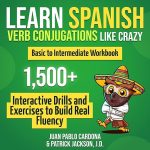
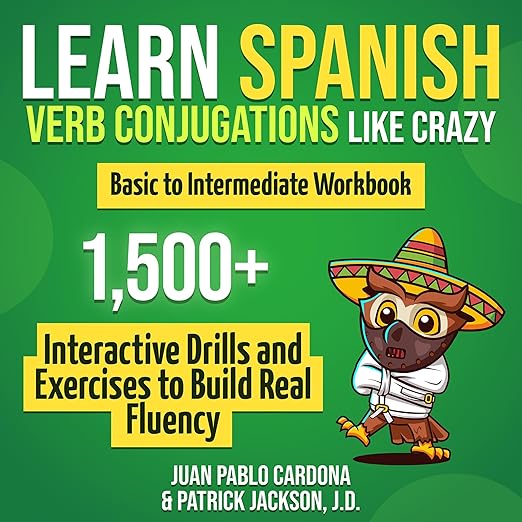
Most language-learning audiobooks leave me cold. They tend to be padded with theory that evaporates the moment you close the app, or so relentlessly cheerful that you feel lectured at rather than taught. Learn Spanish Verb Conjugations Like Crazy is a different beast altogether. Juan Pablo Cardona – known in language-learning circles as “The Voice of Real Latin American Spanish” – has co-created something that actually does what it says on the tin. The sheer volume of structured drilling here is formidable: over 1,500 exercises designed not to explain verb conjugation to you, but to make it automatic. For anyone who has spent months, possibly years, studying Spanish and still freezes when they try to speak, this is worth serious attention. The format is demanding and the runtime of over 41 hours reflects that – this is not a casual listen. But it’s one of the few language programmes I’ve encountered where the pedagogy matches the promise.
About the Audiobook
The central premise is refreshingly honest about how language actually sticks: charts and tables don’t teach you to speak – repetition does. Co-developed with Patrick Jackson, whose Learning Spanish Like Crazy system has reached hundreds of thousands of learners globally, this workbook concentrates exclusively on the verbs you actually need in conversation. The curriculum is sequenced sensibly, moving through present-tense regulars and irregulars, stem-changing verbs, reflexive constructions, the perennially confusing ser versus estar distinction, gustar and similar verbs, and the present progressive – all delivered through sentence-building exercises rather than abstract grammatical explanation.
Every example is voiced by native Latin American Spanish speakers, which means you’re absorbing authentic rhythm and pronunciation alongside the grammar. This is a meaningful distinction: the careful, slightly slowed-down diction of most language course recordings can create habits that are difficult to unlearn when you encounter real speakers. Here you’re drilling against natural speech from the beginning. The accompanying PDF, available in your Audible library, provides the visual frameworks that support the audio content – a sensible inclusion for learners who benefit from seeing a pattern at the same time as hearing it.
The Narration
Cardona narrates the instructional portions himself, and his delivery is measured and clear – exactly what you need when you’re pausing, repeating, and drilling alongside the audio. He doesn’t rush, and he doesn’t condescend. There is a patience in his pacing that communicates genuine investment in whether the listener actually learns, rather than simply whether they complete the programme. The native-speaker examples woven throughout are well-recorded and genuinely useful; you’ll hear real Latin American Spanish at natural pace, which is considerably different from the careful diction of most language recordings. The overall listening experience is functional rather than theatrical, which suits the material perfectly – nobody expects a verb-drilling workout to be gripping radio. The goal is automaticity, and the production serves that goal.
What Readers Say
This title is new enough that the review pool is still small – a single five-star rating at time of writing. That lone reviewer, who identified themselves as an already-conversant Spanish speaker, was unambiguous in their praise. “Verb charts don’t teach you Spanish – reps do,” they wrote, noting that the programme “leans hard into practice with 1,500-plus drills that actually force recall, not passive reading.” They highlighted the focus on high-frequency verbs and real sentence construction as the elements that make the most difference in actual spoken Spanish. The one caveat offered was that some sections feel intense – which, given the volume of material and the rigour of the approach, seems entirely reasonable rather than a genuine criticism. The verdict was “structured, repetitive in a good way, and effective.”
Who Should Listen?
This is squarely aimed at learners who have tried the usual routes – language apps, phrasebooks, evening classes – and still can’t conjugate a verb without mentally reaching for a table. If you’re at beginner-to-intermediate level and your goal is genuine conversational fluency rather than a passing grade in an exam, the drilling approach here will serve you considerably better than most alternatives. It also works well as a refresher for lapsed Spanish speakers who want to shake the rust off quickly. It is emphatically not for complete beginners with no Spanish exposure whatsoever – you’ll need a basic foundation before the drills make sense – nor for those who want a light, entertaining listen on a commute. Think of it as a gym session for your grammatical reflexes. The commitment is real, and so are the results. Find it on Audible UK and start building those automatic responses today.
One detail worth noting for prospective listeners: the programme is structured as a workbook, which means passive listening while driving or doing something else will deliver only a fraction of its potential value. You’ll get the most from it by sitting with the audio actively, pausing when the exercises prompt repetition, and using the written PDF alongside the sound. Some learners find it helpful to listen to a section twice: once to hear the pattern demonstrated, once to drill with it. The investment in active engagement is precisely what the programme is designed to reward.