Clara’s Verdict
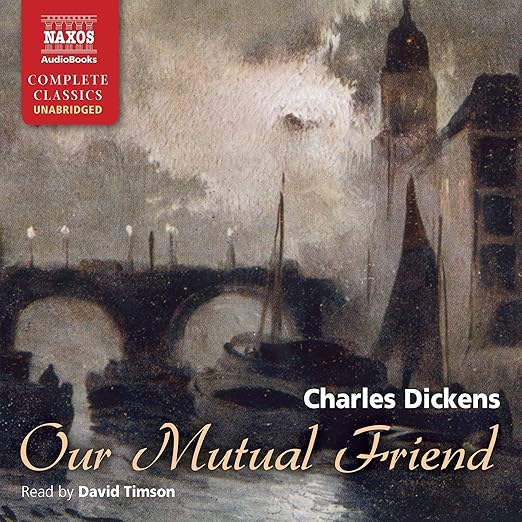
Dickens’s last completed novel is, I would argue, his most unsettling and his most modern – and David Timson’s performance for Naxos AudioBooks is one of the finest recordings of Victorian literature I have encountered in twenty years of reviewing. Thirty-six hours and thirty-three minutes sounds daunting, but Our Mutual Friend earns every hour. The Thames, the dustheaps, the drowning man, the social pretensions of nouveau-riche Victorians clawing their way into respectability – Dickens observes all of it with a cold eye that sits uneasily beside his reputation for warmth and sentiment. This is the work of a writer who has stopped pretending that things will necessarily be all right, and who has replaced the comfort of his earlier novels with something more difficult and more honest. The 4.2 rating from listeners reflects the challenge the novel presents as much as anything else.
About the Audiobook
Published in serial form between 1864 and 1865, Our Mutual Friend opens with one of Dickens’s great scenes: Gaffer Hexham, a Thames waterman from Rotherhithe, rowing through the dark river with his daughter Lizzie, scavenging corpses for the coins in their pockets. The body they find this night belongs – or is supposed to belong – to John Harmon, heir to a vast fortune built from London’s rubbish heaps, who was required by his father’s will to marry a woman he had never met.
From this lurid premise, Dickens constructs a novel of extraordinary complexity. The fifty-eight named characters include the Veneerings, whose dinner parties are a devastating satire on social aspiration; the Wilfer family, comically burdened by an absurdly theatrical mother; the villainous Headstone, whose repressed passion for Lizzie Hexham gives the novel its most psychologically acute subplot; and the magnificent Boffin, a dustman who inherits the Harmon fortune and finds himself transformed by it in ways that are either tragic or wonderfully shrewd, depending on how you read the ending.
The novel’s central preoccupation is money – specifically, what it does to people who do not have it and desperately want it, and what it does to people who have it and do not understand why. Dickens is at his most savage here, and simultaneously at his most compassionate. The two impulses coexist in every chapter without resolving neatly, which is what makes Our Mutual Friend feel so alive to readers a century and a half after its publication.
The Narration
David Timson’s management of fifty-eight distinct characters is a genuine technical achievement. Naxos rightly advertises this as a particular strength of the production, and it deserves every word of that praise. Timson does not resort to exaggerated accents or theatrical mugging; each character is differentiated through subtle modulations of pitch, rhythm, and register. His Lizzie Hexham has a quiet dignity that makes her scenes with the predatory Headstone genuinely uncomfortable, while his Silas Wegg is perfectly pitched – comic but never quite harmless.
The thirty-six-hour length requires a narrator who can sustain concentration and characterisation across the full arc without flagging, and Timson manages it with apparent ease throughout. Naxos AudioBooks has a long tradition of serious literary narration, and this production of Our Mutual Friend belongs in the best company they have produced. It is the kind of recording that makes you genuinely grateful for the audiobook format: a skilled narrator can do things with a text this dense that silent reading simply cannot replicate.
What Readers Say
Rated 4.2 from listeners, with reviews that reflect the novel’s reputation as simultaneously one of Dickens’s greatest achievements and one of his most challenging. Several reviewers describe it as heavy going in the best possible sense – a book that asks something of you and repays the effort generously. One listener who had been working through all of Dickens in order described it as one of the most disturbing but in the same breath one of the most brilliant. The comparison to Bleak House is inevitable, and most readers find Our Mutual Friend the darker and more complex of the two. A family who were reading it together as a bonding exercise described it as classic British literature at its finest – which is exactly right and not in the least condescending.
Who Should Listen?
This is for committed listeners who want to spend serious time with one of the great novels of the English language. It is not a casual listen – the plot is dense, the cast is enormous, and the themes demand sustained attention. But for anyone who has loved Bleak House or Great Expectations and wants to go deeper into Dickens, this is the natural next step, and Timson’s narration makes the journey as comfortable as thirty-six hours can reasonably be. Available on Audible UK – set aside a fortnight and let it unfold properly.