Clara’s Verdict
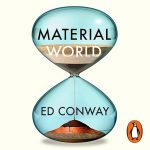
Ed Conway’s Material World is one of those books that genuinely changes how you see things – not metaphorically, but literally. Every computer screen, every building, every battery, every road after reading this becomes an object of different significance: a product of extraordinary supply chains and geopolitical contests that most of us never think about. A Sunday Times bestseller, praised by Tim Marshall and Peter Frankopan, shortlisted for numerous awards, this is narrative non-fiction at a high level – ambitious in scope, grounded in direct reportage, and capable of making the industrial chemistry of silicon wafer fabrication feel genuinely fascinating. That is not a sentence I expected to write.
About the Audiobook
The six substances at the centre of Conway’s investigation – sand, salt, iron, copper, oil, and lithium – are chosen because they represent the foundational materials of everything we build, power, communicate with, and depend upon. Conway traces each from its geological origins through the extraordinary industrial processes that transform raw material into the components of modern life, and he does his research in person: descending into the deepest mine in Europe, visiting spotless silicon chip factories in Taiwan, standing at the eerie green pools where lithium originates in South America. The result is writing with the texture of lived experience rather than library research.
The sand chapter deserves particular mention: the specific grade of silica sand required for semiconductor manufacture is vanishingly rare, and the geopolitical consequences of this scarcity – Taiwan’s extraordinary centrality to global technology, the fragility of the entire digital infrastructure – are explored with a clarity that makes subsequent news coverage easier to understand. The sections on lithium and copper are equally essential for anyone trying to think seriously about the realities and constraints of the energy transition. Conway is never polemical; he presents the complexity and lets readers sit with the implications, but the cumulative argument – that our comfortable civilisation rests on a fragile, contested physical foundation that most of us are entirely unaware of – lands with considerable force.
The Narration
Conway reads his own work, and like Macintyre he benefits from the authority of authorial narration. He is not a trained voice actor – there are occasional moments where the delivery is slightly flat – but the knowledge behind every sentence is palpable, and his evident enthusiasm for the material carries the 15-hour runtime well. He doesn’t rush the complex technical sections, which is the right call; the book rewards careful listening. The global travelogue structure gives the book natural variety, and the transitions between fieldwork accounts and broader analysis are handled smoothly in the reading.
What Readers Say
Five reviews, all between four and five stars, with consistent enthusiasm. “Information about how the world works. Indispensable,” wrote one listener with admirable economy. Another offered a fuller response, calling it “easily one of the best non-fiction books I’ve come across in a long time” and identifying the sand and silicon section as a particular favourite: “I had no idea just how dependent our entire technological world is on this fragile resource.” One reviewer flagged that it’s long and occasionally dense, but concluded it was “worth persevering with” for the density of new information per page – a fair characterisation. This is a book that rewards patience and returns the investment handsomely.
Who Should Listen?
Readers of Tim Marshall’s Prisoners of Geography, Peter Frankopan’s The Silk Roads, or Vaclav Smil’s energy writing will find this immediately congenial. It also works well for anyone with a serious interest in geopolitics, energy policy, technology supply chains, or the economic geography of the modern world – fields that are increasingly impossible to understand without the kind of material-world perspective Conway provides. This is the sort of book that makes you a considerably more informed reader of news. Listen on Audible UK – it will change how you look at everything around you.
One aspect of Conway’s approach that distinguishes this from similarly ambitious science books is the human element: he doesn’t just explain systems, he follows people. The miners, engineers, chemists, and logistics workers who actually extract and transform these materials appear as individuals with particular expertise and perspectives, which keeps the book anchored in experience rather than abstraction. The geopolitics of sand, copper, and lithium are genuinely urgent topics as the world navigates energy transition and technological supply chains, and Conway is one of the most lucid guides available to those complexities.
For listeners who find the economic and geopolitical sections most compelling, Conway’s journalism background – he is Sky News’s economics editor – means he is particularly strong on the contemporary implications of the material history he is tracing. The chapters on lithium and the constraints on battery technology are among the most useful single-source introductions to the energy transition’s physical realities currently available in audio format.