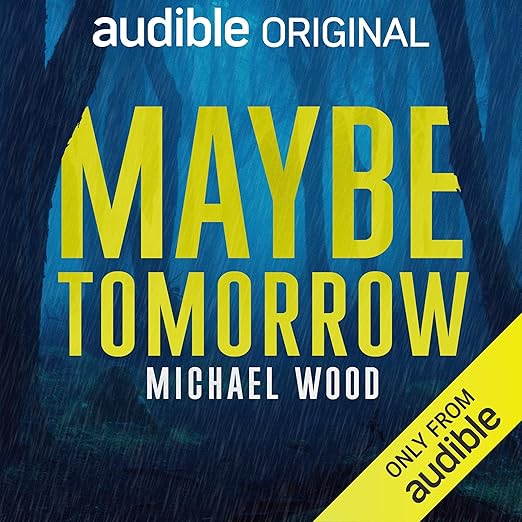
Clara’s Verdict
Michael Wood is a craftsman. His DCI Matilda Darke series has been building a loyal following for years, and when he began releasing original work directly through Audible, I was curious how the format would suit him. Maybe Tomorrow is an Audible Original – and in many respects it plays to the platform’s strengths. It’s a psychological thriller built around miscarriage of justice, set against the specific atmosphere of 1980s England, and it rattles along at the kind of pace that suits a long commute or an evening walk. The reviews are honest enough to note a significant plot inconsistency that careful listeners have flagged, and I don’t intend to paper over it. But the storytelling itself – the atmosphere, the characters, the period texture, the emotional weight of its central injustice – is compelling enough that it remains worth your time.
About the Audiobook
After a fierce storm, the body of a vulnerable teenage girl is found in woodland. The police investigation, hamstrung by thin evidence and absent witnesses, eventually produces a confession from an outsider with no alibi. Case closed – officially. But two women refuse to accept the verdict. Suspicious of how the investigation was conducted and the ease with which a convenient suspect was secured, they dedicate years of their lives to uncovering what actually happened to the girl and who is truly responsible for her death.
Wood’s story is loosely inspired by a real case – a detail disclosed upfront, with the clarification that all characters are fictitious. That real-world shadow gives Maybe Tomorrow a weight that pure invention sometimes struggles to achieve. The 1980s setting is rendered with affection and considerable detail; one reviewer specifically praised the period references and the DNA-era resolution as a satisfying structural choice that echoes real cold-case investigations. The thriller structure – two women working against official indifference, pursuing truth through sheer determination across decades – is deeply satisfying in the way that only well-executed wrongful conviction narratives can be.
Worth noting as well: the structure of two women investigating over a long span of years – running from the 1980s through to the DNA era – gives Wood room to explore how evidence, memory, and official indifference interact differently in different decades. The procedural contrast between what was possible in 1980s policing and what DNA forensics can accomplish thirty years later is one of the story’s genuine pleasures, and Wood uses it as more than a plot device; it becomes a comment on how justice works (and fails to work) across time. The central relationship between the two women is also well-drawn, with each bringing a different kind of determination and a different relationship to the original case.
I should address the plot inconsistency that multiple reviewers have identified: a piece of forensic evidence noted as absent early in the story reappears as a key element of the climax without explanation. It’s the kind of editorial error that shouldn’t make it to a finished production, and it genuinely disrupts the ending for careful listeners. I mention it plainly rather than pretending it isn’t there. That said, the overall experience – the atmosphere, the central characters, the emotional arc – holds up. Running time: 8 hours and 55 minutes.
The Narration
Annabel Scholey takes on the narration and handles it very well. She brings warmth to the two central women and communicates the mounting frustration of fighting a system that is determined to treat a solved case as permanently closed. Her voice suits the emotional register of the story – measured in the procedural sections, quietly urgent when the women are finally closing in on the truth. The 1980s setting could easily feel stilted with the wrong narrator; Scholey grounds it in something recognisably human rather than nostalgic. The period details land as texture rather than costume, which is the right balance for a story whose real subject is injustice rather than nostalgia.
What Readers Say
Reactions have been genuinely mixed, and the average rating of 3.8 from 8 listeners reflects that honestly. Long-time Wood fans are enthusiastic – one called it “brilliant” while crediting the author with having introduced them to audiobooks through his Audible Originals. Others specifically praised the 1980s atmosphere and the DNA-driven cold-case resolution as satisfying narrative choices. The criticism is focused: the plot hole involving the forensic evidence is mentioned by multiple reviewers with varying degrees of frustration, from mild annoyance to “this spoiled the whole experience.” There are also reported continuity errors around a character’s age at the story’s conclusion. The most useful summary from the audience: strong writing and atmosphere, imperfect production quality.
Who Should Listen?
Fans of Michael Wood’s established work will want to hear this regardless of its imperfections. Listeners who enjoy miscarriage-of-justice crime fiction – Stuart MacBride, Mark Billingham, Val McDermid are the obvious reference points the book itself offers – will find the premise absorbing and the emotional stakes real. If you’re already a true crime podcast listener, as one reviewer neatly observed, this plays like an eight-hour narrative podcast with a strong fictional shape. The plot inconsistency is irritating but not fatal to the experience. Go in knowing it exists, and the ride is still worth taking.
Listen to Maybe Tomorrow on Audible UK: Find it on Audible UK. Also available via Kobo, Scribd, and Storytel.