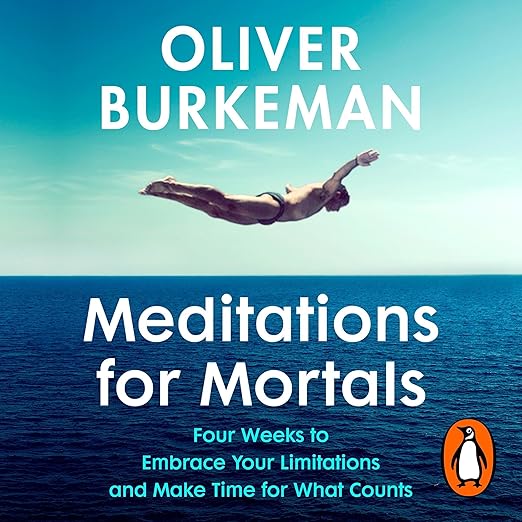
Clara’s Verdict
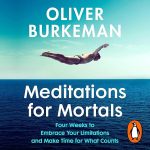
I finished Meditations for Mortals on a Sunday morning, one chapter per day across four weeks as Burkeman suggests, and I found it quietly radical in the way that only the most honest self-help writing ever manages. Oliver Burkeman’s Four Thousand Weeks established him as a writer willing to say things the productivity-industrial complex actively suppresses: that you will never be on top of things, that finite time is the permanent condition rather than a temporary inconvenience, and that accepting this is the beginning of freedom rather than its end. Meditations for Mortals extends that argument into a format that is deliberately daily and devotional in its structure.
Self-narrated, published by Vintage Digital in September 2024, and rated 4.6 from 2 listeners, this runs to 4 hours and 5 minutes. The brevity is intentional and, as I will explain, essential to what the book is attempting.
About the Audiobook
Published on 12 September 2024, Meditations for Mortals is structured as 28 short chapters, one for each day of four weeks, and each chapter addresses a specific facet of what Burkeman calls imperfectionism: the practice of acting on what matters rather than waiting until conditions are ideal. The book takes direct aim at several familiar self-help nostrums. It argues that to-do lists are a category error rather than a productivity tool. It suggests that completion is not the point. It offers the concept of doing things imperfectly now as a more honest and more productive orientation than striving for a perfect version that never actually arrives.
Structurally, the decision to format the book as 28 daily chapters is itself an argument. The format enacts the book’s content: rather than offering a theory of imperfectionism to be absorbed in a single sitting, it asks the reader to practice imperfectionism in the act of reading, returning each day to a single small portion without demanding that the whole be grasped at once. It is a book that trusts the accretion of small things rather than the impact of large ones.
The philosophical sources are drawn from across traditions: Buddhism, Stoicism, Christian contemplative practice, existentialism. Burkeman wears this lightly. He is not making a scholarly argument; he is drawing on whatever illuminates the specific problem at hand. The result is practical without being reductive, philosophical without being intimidating. The chapter on enchantment, about recovering a sense of aliveness in ordinary moments, is one of the finest pieces of short-form self-help writing I have encountered in a long time. It does not overstay its welcome, which is itself a kind of argument.
The Narration
Burkeman’s self-narration is exceptionally well suited to this material. His voice is measured and slightly wry, with a quality of genuine reflection rather than performed authority. He sounds like a person thinking through these ideas alongside you rather than delivering pronouncements from a lectern. For a book explicitly designed to be read in small doses and returned to over time, that quality of companionable seriousness is exactly right.
The 4-hour runtime at one chapter per day means this is a month-long listening project rather than a single-session book. That is unusual for audio, and it shapes the listening experience fundamentally. One reviewer noted that she credited this book with helping her return to the habit of reading altogether, which suggests the format is working as Burkeman intended: not as a binge, but as a daily practice that itself becomes part of the texture of the life the book is describing.
What Readers Say
The listener response, though small in number, is unusually heartfelt. One wrote that the book provided genuine relief that many of the struggles we wrestle with every day are in fact shared, and that it made life feel more settled and enjoyable. Another described the short chapters as easily and joyfully consumable for the overwhelmed perfectionist, which captures the book’s self-aware humour about its own intended audience with considerable accuracy. A third simply wrote: read it and then go back to the beginning and start again, indefinitely.
The endorsements on the cover include Cal Newport, who called it a must-read, and Mark Manson, who praised Burkeman’s unexpected productivity advice. These are meaningful endorsements from within the field. Chris Van Tulleken’s description as full of wisdom and comfort captures the broader emotional register for a non-specialist audience.
Who Should Listen?
Strongly recommended for anyone who read Four Thousand Weeks and wants more Burkeman, but also for those who found that book either too conceptual or too long. Meditations for Mortals is more immediately practical and more accessible in its structure. It will also suit listeners who are drawn to daily practice formats in the manner of Marcus Aurelius’s Meditations or the Daily Stoic. Those who want actionable productivity systems with measurable outputs will find Burkeman’s gentle subversion of that entire mode frustrating rather than liberating. For everyone else, this is a book that does what the best self-help writing promises and rarely delivers.
Meditations for Mortals is available on Audible UK. Listen on Audible UK