Clara’s Verdict
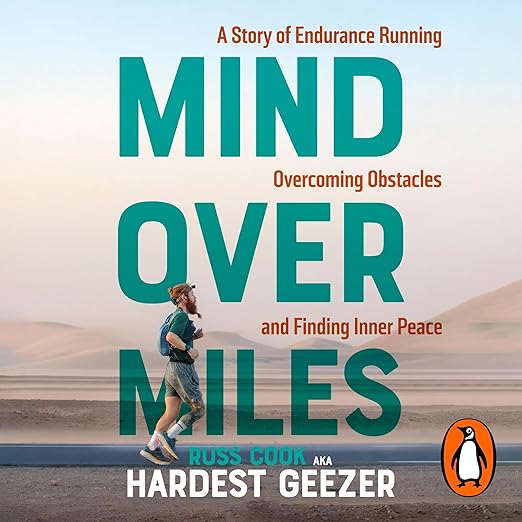
Russ Cook ran the entire length of Africa. Ten thousand miles. Sixteen countries. Three hundred and fifty-two days. He was held at gunpoint. He was nearly kidnapped. He spent weeks negotiating a border crossing through Algeria when the country refused to let him through, his entire challenge left in the balance. And he did this with no corporate salary, no guarantee of completion, and no proof it was even physically possible. Mind over Miles – also known as Hardest Geezer: Running Africa – is Cook’s account of that journey, read in his own unadorned voice, and it is one of the most straightforwardly compelling audiobooks I have listened to this year. Cook is not a polished literary narrator. He is something considerably more useful: completely, uncomplicatedly himself. And at a 4.6 rating from 788 Audible UK listeners, the audience has clearly agreed.
About the Audiobook
Cook’s story does not begin at Cape Agulhas, the southernmost tip of Africa where the run started. It begins earlier – with a young man whose life was not going particularly well, and who found in extreme physical challenge a way to metabolise chaos and uncertainty into purpose and forward momentum. The Africa run was his largest undertaking, but it followed a record-breaking car-pulling marathon and a week buried alive with nothing but water and a camera. The man has a talent for catastrophic, life-affirming commitment.
The audiobook follows the Africa run in roughly chronological order, taking us through South Africa, Mozambique, Tanzania, Kenya, Ethiopia, Sudan, Egypt, and then across the Sahara to the Tunisian coast. Cook writes with disarming honesty about fear, physical breakdown, the long stretches when motivation collapsed entirely, and the extraordinary generosity he encountered from strangers across the continent. He is also honest about the moments he nearly stopped – when Algeria denied him entry and the entire project seemed to be over – and about the psychological cost of continuing when the logical choice was to give up.
At five and a half hours, the pacing is brisk and kinetic – this is not a long meditative memoir but a punchy, direct account of a journey that refused to be anything other than difficult. The line “You get one chance at life. Go and have a stab at it” is, in context, entirely earned.
The Narration
Cook reads his own book, and this is unambiguously the right choice. He has a natural, unaffected delivery – South East English, warm, with occasional flashes of real emotion breaking through a matter-of-fact exterior – that makes the more harrowing passages feel immediate rather than dramatised. He does not perform the fear; he simply describes it, and the understatement does more work than any production technique could. The moments of genuine comedy are delivered with the timing of someone who has learned to laugh at difficulty as a primary coping mechanism. If you have watched his YouTube channel documenting the Africa run, you will hear exactly the same voice: frank, self-deprecating, and occasionally baffled by his own life choices.
One of the less discussed aspects of the book is how honestly Cook writes about the support crew around him – the people who drove ahead, sourced food, managed logistics, and kept the operation alive. He acknowledges freely that the run would have been impossible without them, and his gratitude feels earned rather than performative. This generosity of spirit, more than the physical feats themselves, is what makes the book linger.
What Readers Say
Rated 4.6 from 788 Audible UK listeners, with strong and consistent praise. One reviewer gave it four and a half stars and noted it was “absolutely phenomenal what he achieved,” while wishing the team around him had been given more narrative space. Two reviewers called it simply “inspiring” and “motivational – one of the best books I have read.” The dissenting notes – a small minority – pointed to the writing as occasionally “self-indulgent” and suggested some generalisations about the countries he passed through. The overwhelming majority view is that this is exceptional, honest non-fiction about genuine human endurance at a scale very few people have attempted.
Who Should Listen?
Anyone who followed Cook’s Africa run on YouTube will want this – it fills in the internal experience the camera could not quite capture. Beyond his existing audience, it will appeal strongly to readers of adventure memoirs, endurance sports biographies, and anyone who needs a genuine reminder that extraordinary things are possible with ordinary raw materials and enough refusal to stop. It is also practically useful for anyone struggling with motivation or self-belief: not preachy, not formulaic, just an account of what it looks like when someone decides not to stop, over and over again, for nearly a year. At five and a half hours, it fits easily into a long weekend.