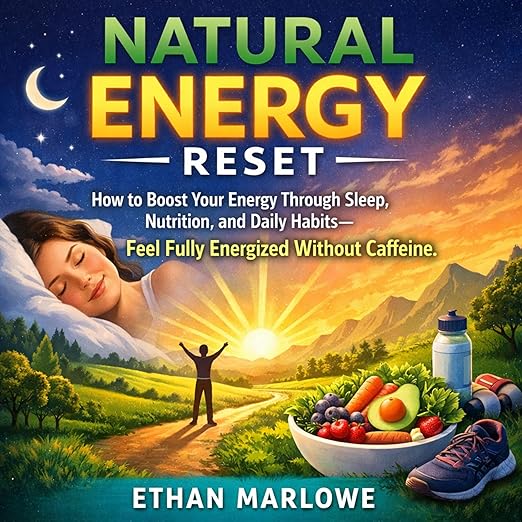
I have read a substantial number of books about fatigue and energy, and most of them share a structural irony: they are written for people who are too tired to implement their recommendations. The opening chapters tend to be spent diagnosing, in satisfying detail, exactly why you feel the way you feel, and then the practical sections arrive with a density that requires more executive function than you currently possess. Natural Energy Reset by Ethan Marlowe, published in March 2026, appears to be aware of this problem and has designed around it – or at least, that is what the synopsis promises.
At 3 hours and 50 minutes, this is deliberately brief. The stated aim is not comprehensive coverage of the science of fatigue but a practical framework of ‘gentle strategies’ that do not require an overnight transformation. Whether the book delivers on that modest promise is something I cannot confirm with certainty, because there are no listener reviews yet, but the design intention is more honest than many wellness titles in the same space.
Clara’s Verdict
The core framework covers the five pillars of natural energy management: sleep, nutrition, movement, hydration, and stress. This is not a novel combination – Matthew Walker’s Why We Sleep, James Clear’s Atomic Habits, and a dozen other major wellness titles have covered each of these domains in depth. What Marlowe is offering is an integrated approach rather than depth in any single area: the argument that these five systems work together as a single energy architecture, and that intervention in any one of them without attention to the others produces the temporary effects most people experience from, say, starting a gym routine or switching to decaf. The concept of a ‘personalised energy routine’ in the final section is where the book either justifies its existence or reveals itself as a repackaging of generic advice – and without listener feedback, that remains an open question.
The publisher is listed as Melissa Tieslau, which indicates independent publishing rather than a major wellness imprint. This is not a quality signal in itself; some of the most honest wellness writing comes from independent authors without the commercial pressure to inflate claims. But it does mean the book lacks the editorial infrastructure that larger publishers bring to nonfiction, including fact-checking of physiological claims. I would approach anything relating to hormone regulation, circadian biology, or specific nutritional claims with a measure of scepticism and cross-reference against NHS guidance or peer-reviewed sources before acting on them.
About the Audiobook
Published in March 2026 with no rating or review count. Runtime of 3 hours and 50 minutes. Narrator is B Fike. The short runtime positions this as an entry point rather than a comprehensive guide. The Audible catalogue in the health and wellbeing space ranges from rigorous long-form science writing to short motivational content with thin evidential backing, and the absence of any external validation for this title – no publisher endorsements, no independent reviews, no associated credentials for the author – means the sample chapter is your best filter before committing to the full listen.
The Narration
B Fike is a professional audiobook narrator with a substantial portfolio in the self-help and business category. His delivery is warm and calibrated for instruction – the kind of voice that does not demand effort from the listener, which is appropriate for material that is supposed to lower your cortisol rather than raise it. Wellness audiobooks can suffer when narrators push too hard for inspirational affect, building emotional crescendos that the written content cannot actually support. Fike’s track record in this genre suggests he holds back from that register, which suits the measured tone that Marlowe’s synopsis is pitching for. For a 3-hour 50-minute listen, the narration quality is particularly determinative – there is not enough runtime for a mediocre narrator to get out of the way.
What Readers Say
No listener reviews at present. For a book released in March 2026, this is expected rather than concerning. The health and wellbeing category tends to attract reviews from listeners who have actually tried implementing the advice – which takes time – rather than immediate post-listen responses. If you find this title early and give it a proper run for six to eight weeks, a substantive review of whether the ‘step-by-step plan’ delivers meaningful results would be a genuine contribution to the catalogue entry and helpful to future buyers.
Who Should Listen?
Those who are already aware that their fatigue has lifestyle roots and are looking for a short, audio-friendly framework to begin making changes. This is an orientation, not a comprehensive programme. If you want the science behind sleep and energy in depth, Why We Sleep by Matthew Walker is the benchmark. If you want a habit-formation framework, Atomic Habits is more rigorous. Natural Energy Reset appears to sit between these as a practical integration guide – useful if you already understand the basics and want a structured starting point for change, but not the right first book if you want to understand why these recommendations work.