Clara’s Verdict
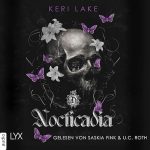
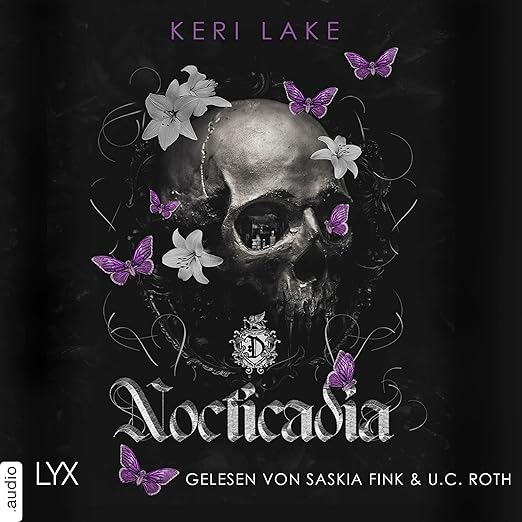
The description hands you the motto before it hands you the plot, and it is in Latin: “Mortui vivos docent. The dead teach the living.” Consider that fair warning about the kind of audiobook you are approaching. Nocticadia is gothic dark academia with a romance at its centre, and Keri Lake commits to the register completely rather than borrowing its furniture for atmosphere.
The numbers suggest that commitment has found its audience: a rating pool of more than fifty-two thousand, which is a striking figure for a book whose publisher field carries nothing but the author’s own name. Set against that, the listing is unusually bare. No narrator, no running time, no series, and a description that gives out before its final sentence does. A book this well liked on a page this thin is worth approaching with your eyes open.
About the Audiobook
Nothing is wasted in the opening. A mother dies of a mysterious illness, and her child makes two promises: to find the cure, and to get out of the city she had abandoned them in. Four years later an acceptance letter arrives from Dracadia University, an old and prestigious institution on a secluded island off the Maine coast, said to be haunted by patients exiled there centuries earlier. Their bones, the story goes, are what the pale shoreline is made of.
Then the other half of the equation. Devryck Bramwell, known around campus as Doctor Death, runs what the copy calls the midnight lab. He is brilliant, apparently contemptuous of first-years, and the student’s professor. The imbalance of power is not an accident of plot. The description makes a selling point of it, right down to a couplet that lays out the terms of the whole book: “I crave his authority. He aches for redemption.” Whether that reads as delicious or as a warning decides whether this is your book.
Two things the entry does not do. It names no series and no volume number, so nothing on this page asks you to have read anything else first. And the description stops partway through a line about the pair being delicious fodder for something, so the final beat of the pitch is simply absent. I will not guess at what it was building towards.
What the reviews add is texture the copy lacks: the gothic apparatus rests on real reading. One reviewer singles out the research-driven worldbuilding and praises “the way historical texts, medical theories, and early scientific development are woven into the narrative”, while another notes the sheer volume of scientific terminology and the depth of research behind it.
The Narration
Here I have to be blunt, because the alternative is invention. This entry credits no narrator and gives no running time, and nothing in the visible text of the three attached reviews mentions a voice, a pace or a performance. Two of them break off before they finish, so I cannot tell you what the rest covered. I have nothing to assess here, and anything I told you about how it sounds would be decoration.
What I can do is set out what the material demands. The first is stamina: the description is written in the student’s own voice, in character, and if the novel keeps that close perspective then whoever reads it has to carry grief, obsession and dread across the whole length without letting longing curdle into breathiness. Dark romance is unforgiving there. The line between charged and faintly silly is thin, and the reading draws it, not the prose.
The second is Doctor Death himself. A professor who has to be both repellent and magnetic cannot let either quality swamp the other, and the standard failure is playing the menace too broadly, which turns a gothic figure into a pantomime villain by chapter four. Third, the clinical vocabulary: a book this steeped in pathology needs a reader who moves through the terminology without hesitating, because one stumble over a technical word breaks the spell faster than any hole in the plot. Even the Latin motto needs somebody unembarrassed to say it at all. The sample is the whole audition here, and the running time is not on the page either.
What Readers Say
Behind the headline 4.4 out of five sit 52,760 ratings. Underneath that pool sit three written reviews, all British, all posted since the April 2023 release, and all positive: two at five stars, one at four. That is what the visible sample shows, not what the whole pool contains.
The most recent, from January 2026, states the appeal plainly:
Keri Lake is an author I trust when I want gothic, dark romance done properly, and Nocticadia delivers squarely in that lane.
That same review calls the premise “richly researched, unsettling”, and lists what the story is steeped in: “shadow, academia, obsession, and moral rot”. It is then cut off in the listing before it finishes the thought.
Tammy’s four-star review is the most physical about what the book does to a reader: shivers most of the way through, a film comparison that the review says brought nightmares for a while, and a stated reluctance to look at worms. That review also reports that “The Romance is off the charts” and, notably for a book steeped in that island’s history of exiled patients, that it offers “Great rep for mental health”.
The earliest of the three, from June 2023, comes from a reader trying a teacher and student romance for the first time, and credits the author as the reason for taking the chance, calling the writing style “enchanting and captivating” and the book “full of plot twists that I’ve come to expect”. That review stops short as well.
Who Should Listen?
Listen if dark academia is your territory: old institutions, deadly secrets, a forbidden romance with a morally compromised professor, and an island the description will not let you forget. It will suit readers who want their gothic romance researched rather than merely decorated, and who like a story with one foot in the mortuary. Readers new to the teacher and student setup have a way in, on the evidence of the reviewer who came to the subgenre for the first time with this book and gave it five stars.
Some content notes, all drawn from the description and the reviews rather than from me: a relationship between a first-year student and a professor, with the imbalance treated as part of the appeal; pathology, human remains and the business of the dead as ordinary scenery; hauntings; and imagery one reviewer found genuinely unsettling. That same reviewer praises the handling of mental health, so the darkness is not indiscriminate, but this is no gentle campus romance.
The entry itself is the only real reason to hesitate: no reader named, no running time, nothing but a premise to commit to. The teacher and student dynamic will stop some readers cold as well. Past those two, this is a book that knows exactly what it is and delivers it without apology.