Clara’s Verdict
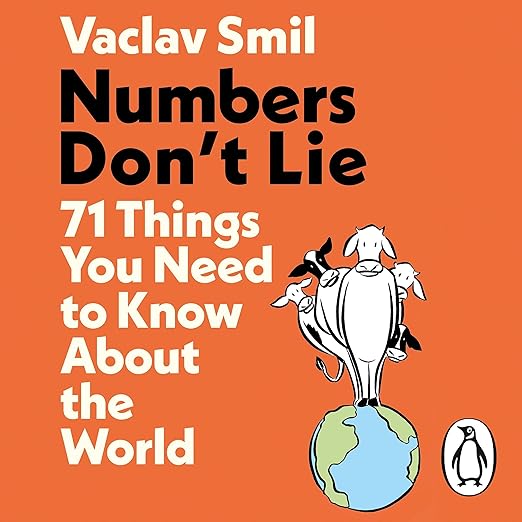
I came to Vaclav Smil’s Numbers Don’t Lie with the habitual scepticism I bring to popular data books – a genre with a way of flattening complexity into smug infographics while making the reader feel informed rather than actually informing them. What I found was something considerably more honest and more useful. Smil is the rare academic who writes like someone who actually wants to be understood, and his willingness to go beyond the headline figure and ask what does this number actually mean sets him apart from the trend-chasers. Bill Gates has called him his favourite author, which is either a recommendation or a warning depending on your disposition, but I think the book earns the praise on its own merits. Stephen Perring’s narration, clocking in at five hours and forty-five minutes, keeps things brisk without sacrificing rigour. The 4.2 rating from listeners reflects a book that is genuinely excellent and very occasionally overreaches.
About the Audiobook
Smil, a Czech-Canadian scientist and policy researcher, has spent decades producing data-heavy analyses of energy, food, population, and technology. Numbers Don’t Lie collects seventy-one short essays that range across the full breadth of human civilisation – from how many people it took to build the Great Pyramid to why electric cars are not yet the solution we have been sold to what vaccination yields as a return on investment per pound spent.
The book is structured in thematic clusters: people and their numbers, countries and their fates, food and energy, the environment, transport and technology. Each chapter is deliberately brief – two to three minutes in audio form – which makes this a superb listen for commutes, or for anyone who likes to absorb information in concentrated doses rather than through sustained argument. The trade-off is that individual chapters can feel like extended footnotes rather than fully developed essays, but Smil’s gift for framing ensures that almost every one lands at least one genuinely surprising insight.
The title is a provocation rather than a boast. Numbers, Smil argues, don’t lie – but they can be selected, framed, and presented in ways that mislead perfectly honestly. His mission is to give readers the tools to think more clearly about data, not merely to accumulate more of it. This is a mission that feels genuinely urgent in a media environment that has learned to weaponise statistics while pretending to defer to them.
The Narration
Stephen Perring is a reliable choice for non-fiction of this kind – authoritative without being pompous, clear without being condescending. The episodic structure of the book suits audio particularly well: each short chapter functions almost like a podcast segment, with Perring’s measured delivery providing a consistent thread through the considerable variety of subject matter. He handles the technical vocabulary confidently, which matters when you are moving between discussions of nitrogen cycles, container shipping, and demographic transitions within the same listening session.
What Readers Say
Rated 4.2 out of 5 from listeners on Audible UK, the book has attracted a thoughtful range of responses. Several reviewers describe it as essential reading for anyone who wants to understand how the modern world actually functions. A recurring note of qualification comes from listeners who found that the book’s strength – its data-grounded empiricism – occasionally curdles into overconfidence when Smil ventures further into prediction. One reviewer with an economics background called the future-facing chapters more questionable while still rating the book highly. The Guardian’s description of Smil as the nerd’s nerd is both accurate and entirely meant as a compliment, and it captures something true about the particular pleasure this book offers to readers who have always suspected that the interesting questions lie in the numbers rather than around them.
Who Should Listen?
Anyone who reads the news and wants to understand it more clearly. Anyone who has been told something is true because the numbers show it and wanted the tools to push back. Students of economics, environmental science, history, and public policy will find this a valuable companion. It is not a long or demanding listen – five hours and forty-five minutes across seventy-one chapters – which makes it genuinely accessible to listeners who would not normally tackle a work of this analytical density.
It also works well as a companion to more argumentative non-fiction. Where Hans Rosling’s Factfulness makes a sustained optimistic argument about global progress, Smil is more agnostic and more interested in accuracy than in a thesis. The two sit well together in the same month of listening, and together they make a stronger case for data literacy than either does alone. Find it on Audible UK and give yourself something to think about on your next commute.
Listeners on Scribd and Storytel will also find it an excellent companion to a news-heavy month, providing the statistical literacy that helps separate genuine insight from well-packaged noise.