Clara’s Verdict
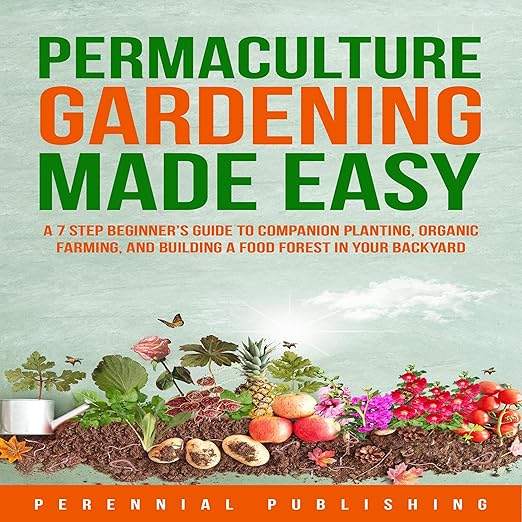
The overlap between audiobook listeners and gardening enthusiasts is larger than the audiobook industry often acknowledges. The commute, the lunch break, the evening walk – with a good gardening audiobook in your ears, these become planning sessions for the plot or the allotment. Permaculture Gardening Made Easy is a practical, thoughtfully structured introduction to a subject that can seem forbiddingly complex to the uninitiated: permaculture has its own extensive vocabulary, its own philosophical inheritance, and its own sometimes intimidating practitioner community. Warren Sandwell’s measured narration carries the content clearly, and the nearly five-hour runtime covers substantial ground without feeling rushed or padded. If you are curious about permaculture but uncertain where to begin, this is a sensible and well-executed first listen.
About the Audiobook
Perennial Publishing has structured this as a genuine beginner’s guide, and the structure is itself an expression of permaculture’s central principles: care for the earth, care for people, return surplus to the system. The book works through those principles from their origins – a brief history of permaculture as a movement, the key figures and texts that shaped it – before moving into their practical application. The five permaculture zones provide the central organising framework, and the book works through them methodically: how each zone functions, how it relates to its neighbours, how to assess which zone corresponds to which part of your available space.
The practical content is substantial: plant selection strategies, water system development, soil management, the construction of garden beds. The seven-step guide to planning, designing, planting, and maintaining a permaculture garden is the section most frequently praised by listeners – it demystifies a design process that can otherwise feel overwhelming. The coverage of companion planting, guilds, and the logic of arrangement is particularly useful for those moving from conventional garden beds to more integrated systems. The chapters on food storage and ongoing garden care round out a genuinely comprehensive overview.
It is also worth noting what this book does not try to do: it does not cover advanced polyculture design, it does not go deeply into permaculture’s more philosophical or political dimensions, and it does not provide the site-specific guidance that a permaculture design course would offer. What it does is give the listener the conceptual vocabulary and the practical starting points needed to begin making changes immediately and to pursue more advanced study with a solid foundation. That is the right scope for the audience it is designed to serve.
The book is written for the absolute beginner, which is both its strength and its natural boundary. Experienced permaculture practitioners will find the depth insufficient for their needs. For those who are new, however – including those, as one reviewer noted, working in suburban spaces rather than rural landholdings – the scope and clarity are well-calibrated to the audience.
The Narration
Warren Sandwell brings a calm, knowledgeable presence to the material that suits both the subject and the audience. There is a meaningful difference between a narrator who reads about companion planting and one who communicates why companion planting works; Sandwell occupies the more valuable position. His pacing is unhurried without being soporific, which is the right register for content that requires the listener to visualise and process spatial relationships. One reviewer noted that the content could benefit from shorter sections for easier reference listening – a fair structural observation, though primarily relevant to those revisiting specific sections rather than listening linearly.
What Readers Say
UK listeners are broadly and warmly enthusiastic, particularly those who came to the book as complete beginners. Chrissie Howard (★★★★★) wrote with evident delight: “I have been stumbling around in the dark, but this book has been like flicking the light switch on – and despite my living in suburbia, I realise just how much I can apply this lifestyle to my own very modest space.” sarah brouard (★★★★★) praised the depth of the author’s evident expertise alongside the practical applicability. Amian (★★★★★) described it as “a friend speaking with you step by step on how to start permaculture.” Carol (★★★★★) valued the combination of history and method. The audiobook holds a strong 4.7-star rating across 88 ratings – a meaningfully large sample for a specialist non-fiction title.
Who Should Listen?
Gardeners at any scale – from a suburban back garden to a small holding – who are curious about more sustainable and ecologically aware growing practices. People approaching self-sufficiency who want a grounded philosophical framework alongside the practical how-to. Those interested in sustainable living more broadly who want to understand how permaculture principles translate into everyday growing decisions. And anyone who is tired of the exhausting cycle of conventional gardening and wants a different relationship with their soil. Find Permaculture Gardening Made Easy on Audible UK – and then, ideally, go outside and start looking at your garden differently.