Clara’s Verdict
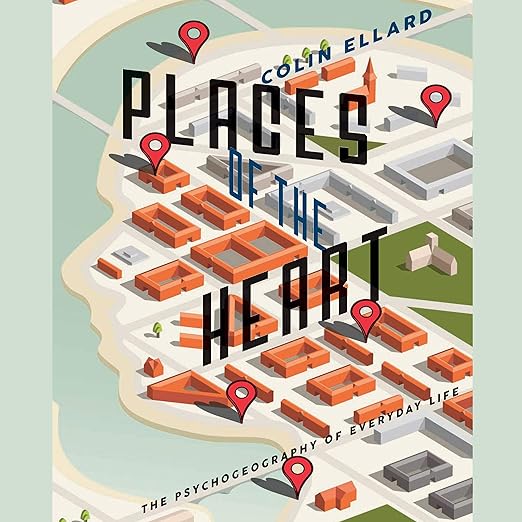
I came to Places of the Heart expecting a reasonably interesting popular science book about urban design and left thinking rather differently about nearly every room I inhabit. Colin Ellard is a cognitive neuroscientist at the University of Waterloo who runs an urban realities laboratory, and his subject – how the spaces we move through shape our thoughts, emotions, and bodies – turns out to be vastly more interesting than its summary suggests. This is psychogeography for people who like their insights backed by actual empirical research, executed with the clarity and pace of the best popular science writing. At just over eight hours it is an ideal length: enough to develop its ideas properly without becoming encyclopaedic.
The most striking thing about this book is how it reorganises the mundane. After listening, a featureless office corridor is not simply dull – it is actively hostile to the nervous system, and you now know why. A park is not simply pleasant – it is measurably restorative in ways that can be quantified. That shift in perception is the mark of genuinely good popular science.
About the Audiobook
Ellard’s argument begins from an observation that is obvious once stated but routinely underexamined: human beings are extraordinarily sensitive to their physical environments, and that sensitivity is not merely aesthetic. We feel awe in cathedrals and at canyon edges. We feel anxiety in crowds and unease in featureless corridors. We feel comfort in parks and genuine stress in casinos – where the design, Ellard explains with some detail, is deliberately engineered to disorient the visitor and lower the inhibitory signals that govern rational decision-making. None of this is arbitrary; all of it is measurable.
The book moves through different categories of space – home, workplace, city, nature, virtual – examining what neuroscience and environmental psychology have revealed about our responses to each. Ellard writes with particular clarity about the distinction between the spaces we choose and the spaces we cannot escape: the open-plan office nobody asked for, the housing estate with no green space, the hospital ward designed for efficient care rather than human comfort. His treatment of urban design carries a quiet urgency that feels increasingly timely as cities expand and housing becomes ever more compressed.
He also writes well about his own research, including field experiments that exposed participants to dramatically different environments and measured their physiological responses in real time. The contrast between a desolate urban streetscape and a strip of greenery, measured in cortisol levels and reported emotional state, is striking. The book was updated and the audio edition published in 2018, drawing on a growing body of research from his urban realities laboratory.
The Narration
John Fleming narrates with a steady, unhurried quality that suits the reflective tone of Ellard’s prose well. He does not oversell the drama – which is the right instinct for this kind of popular science, where the insights are best absorbed thoughtfully rather than announced. The technical passages about neuroscience are handled with clarity without becoming flat, and the personal anecdotes from Ellard’s own research are given appropriate warmth. Some listeners may find the pace slightly leisurely in the opening chapters; it settles into a rhythm that serves the material very well once established.
What Readers Say
The audiobook holds 4.5 stars from 92 ratings. One reviewer was so affected by the book that they contacted Ellard directly afterwards to thank him – an unusual response that speaks to the book’s capacity for genuine impact. Martin C. described it as “psychogeography for beginners” – meant approvingly – noting how Ellard makes complex themes genuinely accessible without condescension. Philip Copland wrote that it “changed the way I viewed the everyday places and objects we interact with.” US reviewer JF noted being “fascinated on almost every page with a field of science I had never before explored,” particularly praising Ellard’s method of mixing personal anecdote with scientific rigour without losing the narrative thread.
Who Should Listen?
Essential for anyone interested in how cities and built environments shape human behaviour – urban planners, architects, designers, and environmental psychologists will find both validation and challenge here. Also highly recommended for listeners who have enjoyed Robert Macfarlane’s landscape writing, Bill Bryson’s popular science work, or the psychogeographic tradition represented by writers like Iain Sinclair, though Ellard’s approach is firmly empirical rather than literary.
Anyone who has ever wondered why certain spaces make them inexplicably anxious, or why a particular park feels more restorative than another, or why the open-plan office that was supposed to increase collaboration has instead increased stress, will find thorough and properly researched answers here. Ellard is not just describing effects; he is explaining mechanisms, and that explanatory depth is what separates this book from the popular psychogeography genre more broadly.
Available on Audible UK, Kobo, Scribd, and Storytel. Listen to Places of the Heart on Audible UK.