Clara’s Verdict
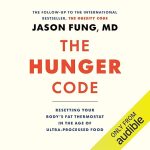
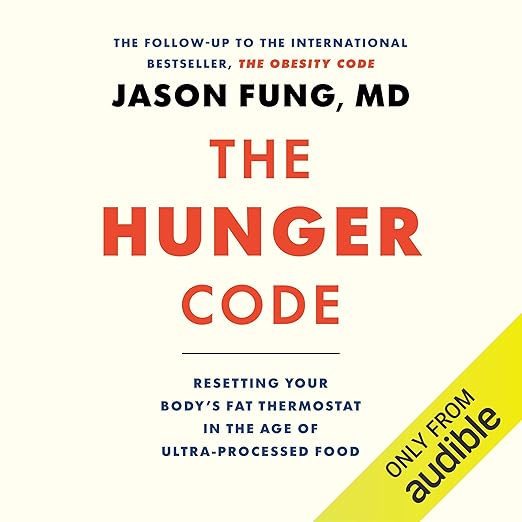
Dr Jason Fung has already changed the way many people think about weight and metabolism with The Obesity Code, which dismantled the calorie-counting orthodoxy with considerable force and a useful amount of righteous frustration at the medical establishment’s reluctance to revise its advice. The Hunger Code is the sequel – and it asks a more interesting question than its predecessor. Not just what drives weight gain, but why we eat when we do, and whether that can be changed through understanding rather than willpower. The answer involves genuinely novel thinking about hunger as a multi-dimensional phenomenon, and the practical framework that emerges is both well-evidenced and immediately usable. At eight hours and twenty-one minutes, this is substantive and dense listening.
About the Audiobook
Fung’s central contribution in The Hunger Code is the identification and rigorous examination of three distinct types of hunger. Physical hunger is the body’s genuine, physiologically-driven requirement for fuel. Emotional hunger is eating as a response to psychological states – stress, boredom, anxiety, reward-seeking – that have nothing to do with actual energy need. Social hunger is eating because the situation demands it: the office birthday cake, the dinner party, the drink at the pub where refusing feels more costly than indulging. Most weight management advice treats all three as variants of the same problem and attempts to address them with the same tools, which is a significant reason why so much of that advice fails to produce lasting results.
The book also introduces the concept of the body’s “fat thermostat” – the biological set point regulated by hormones and metabolism – and explains in accessible terms why this means willpower-based approaches to sustained weight loss are almost always temporary. The body will work against you until you address the underlying regulatory mechanisms, which is what the practical framework is designed to do. The 50 actionable tips and three Golden Rules that structure the second half of the book are specific enough to be genuinely useful rather than generically motivational – Fung is a clinician and it shows in the precision of the recommendations. The book also addresses the current moment in weight management directly, with serious consideration of how weight-loss drugs like Ozempic and Mounjaro interact with the hunger mechanisms he describes. A PDF companion document is included in the Audible library alongside the audiobook.
The Narration
Brian Nishii narrates with authority and clarity. Fung’s prose is accessible by medical-writing standards, but it still involves biochemistry, hormone function, and clinical terminology, all of which Nishii handles without the stumbling or awkward over-emphasis that can make scientific audiobooks feel laborious. His pacing is well-calibrated: quick enough to maintain momentum through the more technical sections, measured enough during the practical tips to allow the listener to register and retain them. A solid professional production from Audible Studios throughout.
What Readers Say
Listeners who came to The Hunger Code having previously read The Obesity Code are largely enthusiastic, praising it as a meaningful extension of the first book’s framework rather than a retread. The science-backed explanations attract particular commendation: one reviewer notes that Fung provides “clear information and explanations, without the jargon,” and the sentiment is echoed across multiple reviews. One reader describes reading both The Obesity Code and The Hunger Code in rapid succession after a Kindle sample persuaded them to start, then going on to Fung’s fasting book – the kind of virtuous reading spiral that speaks well of an author’s ability to sustain engagement across a body of work. The most critical voice in the sample gives four stars while noting some repetition and editorial inconsistency – fair observations for a book that clearly reached its deadline at pace. The audiobook holds a 4.6 out of 5 rating from 100 listeners on Audible UK.
The book also rewards re-listening: the density of the practical section means that a second pass through the specific tips and Golden Rules, after the theoretical framework has had time to settle, will yield more than the first. This is the kind of health audiobook that earns a place in a regular listening rotation rather than being consumed once and set aside.
The book also rewards a close second listen: the density of the practical material means that working through the specific tips and Golden Rules after the theoretical framework has had time to settle yields considerably more than the first pass. This is the kind of health audiobook that earns a place in a regular listening rotation rather than being experienced once and filed away.
Who Should Listen?
Anyone who read and valued The Obesity Code will want this sequel without needing further persuasion. Beyond that core audience: anyone who has struggled with yo-yo dieting, emotional eating, or the social pressures around food; anyone currently using or considering weight-loss medication and wanting to understand the underlying biology; and anyone who has found that understanding the mechanism of a problem is a prerequisite for doing anything effective about it. Listen to The Hunger Code on Audible UK and start understanding why you eat – which is the question that weight management advice has been deflecting for too long.