Clara’s Verdict
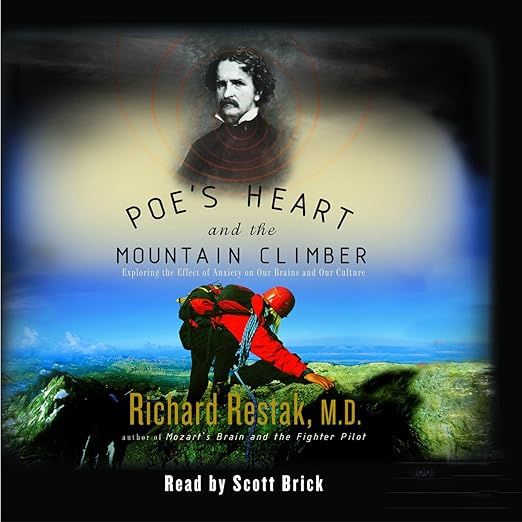
I tend to notice my own anxiety most on Sunday evenings, when the week ahead arranges itself into a series of imagined obstacles. It was during one of those evenings that I found myself listening to Dr Richard Restak’s Poe’s Heart and the Mountain Climber, and there was something almost perfectly calibrated about the timing. Restak, a clinical neurologist and neuropsychiatrist, is making an argument that I suspect many anxious people need to hear: anxiety is not a malfunction. It is a feature of human consciousness that served us well for most of our evolutionary history, and it only becomes a problem when it outgrows its function.
Published by Random House Audio in 2004 and carrying a 5.0 rating from three Audible UK reviewers, this book has not received the widespread attention its arguments deserve. That may be partly due to its age and partly due to its insistence on complexity at a moment when the anxiety conversation has been dominated by simpler solutions.
About the Audiobook
Restak’s central intervention is definitional. Anxiety, he argues, is not a mental illness requiring medication but a normal biological response to stress — one rooted in our capacity to imagine future possibilities, both good and bad. This capacity, unique to humans, is precisely what allows us to plan, to anticipate, to create. The cost is that we can also imagine catastrophe, and when that imagination operates without check, anxiety becomes debilitating. The solution, Restak suggests, is not elimination but education: understanding anxiety well enough to work with it rather than against it.
The title draws on two figures who illustrate the book’s argument. Edgar Allan Poe, whose cardiac arrhythmia was partly anxiety-driven, represents the dark end of the spectrum. The mountain climber represents the productive use of what might otherwise be paralysing fear — transformed, through training and understanding, into the focused attention that makes difficult things possible. Between these poles, Restak examines what anxiety is, where it comes from, and how it can be managed without being suppressed.
At six hours and twenty-four minutes, the audiobook is compact enough to be accessible without sacrificing the depth of argument. Restak draws on clinical experience, neuroscience, and a wide cultural range of examples to make his case.
The Narration
Scott Brick narrates, and his involvement is a significant asset. Brick is one of the most reliable voices in American audiobook production, bringing to medical and scientific non-fiction a clarity and authority that makes complex arguments accessible without simplifying them. He handles Restak’s blend of clinical detail and accessible prose with the assurance of a narrator who has read a great deal of similar material and knows precisely where to place his emphasis. The pacing is measured in the analytical sections and more expansive where the human stories are allowed to breathe.
What Readers Say
Three reviews, all five stars. The most illuminating comes from RU12HI5, who discovered Restak through a PBS interview and then bought three of his books: “Dr. Restak can write about complicated topics so anyone could understand and apply.” This is the central gift of a good medical communicator, and it is precisely what distinguishes Restak from writers who make the same subject either too simple or too specialist. The unanimously positive, if small, response suggests a readership that found the book genuinely useful rather than merely interesting.
Who Should Listen?
Poe’s Heart and the Mountain Climber is well suited to anyone who experiences anxiety and is dissatisfied with approaches that treat it primarily as a problem to eliminate. It is also a rewarding listen for those with an interest in neuroscience, the biology of emotion, or the cultural history of anxiety as a concept. Listeners who found Matthew Walker’s work on sleep or Daniel Levitin’s neuroscience writing useful will recognise the mode: expert knowledge made genuinely accessible. Listen on Audible UK for Scott Brick’s authoritative narration.