Clara’s Verdict
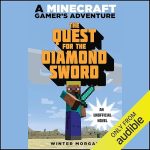
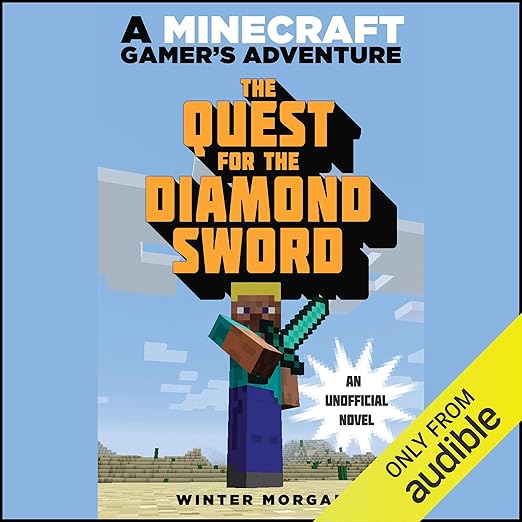
My nephew is nine years old and has spent the better part of two years trying to explain Minecraft to me with the patience of a very tired schoolteacher. I still do not fully understand the game, but I understand it considerably better having listened to Quest for the Diamond Sword, which is essentially a chapter book set faithfully inside the Minecraft world: its biomes, its hostile mobs, its crafting logic, the particular existential anxiety of nightfall when you have no shelter, the social dynamics of choosing between single-player independence and the risks and rewards of multiplayer cooperation. Winter Morgan writes for young readers who play the game, and the book’s plot maps closely onto the kinds of adventures Minecraft players actually pursue. That authenticity is the book’s chief virtue and the primary reason it has accumulated 444 ratings on Audible UK. It does not condescend, and it does not sanitise the game’s logic. It trusts its young readers to recognise their own world.
The audiobook runs to two hours and twenty-three minutes, making it a genuine one-session listen for most children. This is Book 1 in the Unofficial Gamers Adventure series, and it functions as a complete standalone story while clearly leaving room for the characters to continue into subsequent volumes.
About the Audiobook
Published by Audible Studios in November 2014, this title has found a sustained and enthusiastic audience over a decade of availability. The premise is simple and effective: Steve lives on a wheat farm in the Minecraft Overworld, trades at the nearby NPC village, and discovers one morning that Zombies have attacked and turned the village blacksmith. The only solution is a diamond sword, which requires mining forty diamonds, an ambitious quest that sets the plot in motion. Along the way Steve encounters three treasure hunters, Max, Lucy, and Henry, who become his companions, and the book turns into a story about cooperation, trust, and the relative merits of going it alone versus accepting help from people whose motives you cannot entirely verify. As an allegory for the game’s actual social dynamics, it is surprisingly apt. The book also contains a night-time sequence in a temple, a thunderstorm encounter, and a series of attacks from hostile mobs that provide genuine narrative tension appropriate to the age group.
The Narration
Luke Daniels narrates, and his track record in children’s and young adult fiction is well established across many series and many years. He brings energy and clear character differentiation to Max, Lucy, Henry, and Steve without mugging for effect or over-performing. Each character has a distinct voice without requiring the listener to work hard to tell them apart, which matters enormously for young listeners who are tracking multiple characters in a plot that moves quickly. Daniels understands the rhythm of chapter-book pacing: quick, clear, with enough variation in pace and register to maintain attention over a short runtime. For a book whose primary audience may well be listening while also doing something else, the narration is sufficiently clear to follow without requiring complete focus.
What Readers Say
Reviews are enthusiastic and come largely from parents reporting on young readers, which is appropriate for a book of this nature. One reviewer describes their nine-year-old as unable to put the book down, specifically noting that he tried walking along while reading it, which is both charming and a genuine endorsement of the pace. Another notes that their son could not stop reading it, which is the response the book is designed to produce. The responses from child readers who submitted their own reviews are some of the most characterful in the sample: one young reviewer provides a detailed tactical critique of the characters’ approach to the Ender Dragon in the book’s climax, specifically noting that they should have destroyed the healing crystals first, a level of game-knowledge and critical engagement that the book successfully activated and that many adult literary reviewers would be proud to produce.
The series has continued well beyond this first volume, which means that listeners who enjoy Quest for the Diamond Sword will find a considerable run of further books in the Unofficial Gamers Adventure series to work through. For children who have reached the end of a book they loved and immediately want more, that continuity is a significant practical advantage. The first book’s self-contained resolution means there is no pressure to continue, but the world and characters are engaging enough that most young readers will want to.
Who Should Listen?
Children aged roughly seven to twelve who play Minecraft or are interested in the game will get the most from this book. The in-game terminology is used throughout and explained in context, but a complete newcomer to Minecraft may find some of the world-logic opaque without that prior knowledge. At under two and a half hours, it is an ideal car journey audiobook, bedtime series, or single-session afternoon listen. Parents with no Minecraft knowledge will find it comprehensible as a quest adventure story; they may also, as I found, learn rather more about the game than they expected.