Clara’s Verdict
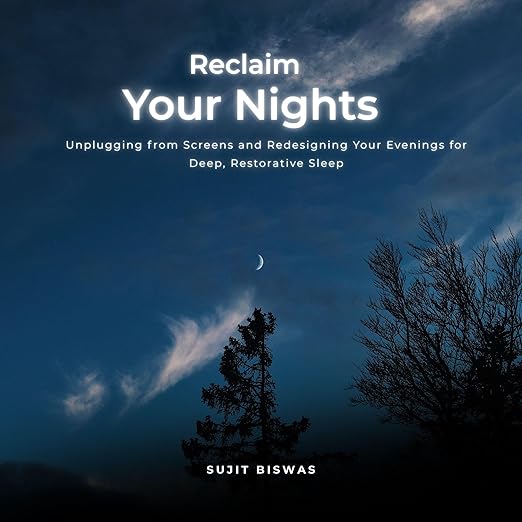
I picked this one up on a Tuesday evening, at the point in the week when the gap between what I’d planned to do and what I’d actually managed had become comically wide. Sleep had been a low priority for months. Not by choice, exactly, but by accumulation: the notifications, the blue light, the half-processed thoughts that had nowhere to go at eleven o’clock except straight into my pillow. So when Reclaim Your Nights by Sujit Biswas landed in the queue, it felt less like a reviewing assignment and more like a very pointed hint from the universe.
At just over an hour, this is a short listen, and that brevity is both its charm and its limitation. There is no padding here, no extended case studies or anecdote chains that eat forty minutes before getting to the point. Biswas takes a clear, calm position: sleep is not something that simply happens to you once you lie down, it is a biological process that must be actively prepared for. The modern evening – bright screens, background anxiety, the open-ended scroll – actively works against that preparation. The book’s project is to help you build what Biswas calls a deliberate transition, a kind of decompression chamber between your working self and your sleeping self.
About the Audiobook
The core argument here sits comfortably within the established science of sleep hygiene, and Biswas presents it clearly rather than trying to reinvent it. The nervous system, he explains, cannot shift from high alertness to restoration instantaneously. The problem with the modern lifestyle is not merely tiredness – it is that we treat the evening as an extension of the productive day, and then expect the body to switch off on demand. Reclaim Your Nights is structured around reversing that assumption.
The practical sections deal with the usual culprits: artificial lighting, the persistent dopamine cycle of digital devices, irregular rhythms that keep the body clock guessing. But Biswas also addresses the subtler texture of evening stress – the unfinished mental loops, the low-grade sense of obligation that keeps the nervous system on standby. His recommendations are sensible and genuinely actionable: structuring the two hours before bed as a wind-down ritual, reducing sensory load gradually, and – crucially – treating this not as an extra task but as the frame that makes everything else possible the following day.
It is worth noting that this title was published on 19 March 2026 by the author himself, which means it is entering a very crowded space. Titles like Matthew Walker’s Why We Sleep have set a high bar for sleep science literature. Biswas makes no claims to that scale of academic rigour, but he does not need to. This is practical, not comprehensive. It works best understood as a companion to your evening routine rather than a definitive text on neuroscience.
There is a brief but useful section on the paradox of effort in sleep: the harder you try to fall asleep, the less likely you are to succeed, because the act of trying is itself a form of arousal. Biswas addresses this through the concept of passive intention – creating conditions that favour sleep without treating the sleep itself as a task to be accomplished. This is behaviorally sound and more nuanced than most short sleep guides manage to be. He also touches on the social dimension of poor sleep habits: how late-evening screen use has become a form of connection and relaxation that is difficult to give up precisely because it feels restorative in the short term, even as it undermines restoration in the longer one.
The Narration
Myriam Berger narrates, and she is well-suited to this material. Her voice has a measured, unhurried quality that reinforces the content rather than working against it. There is an evenness in her delivery that feels appropriate for a guide about slowing down – she never rushes, never oversells a point, and brings a calm authority to even the more prescriptive sections. For an audiobook specifically designed to be consumed in the evening, this matters more than usual. You would not want an energetic, buoyant delivery pushing you further into alertness at ten o’clock. Berger’s performance understands its own context.
What Readers Say
This audiobook was released in March 2026 and carries no ratings or reviews at the time of writing. The absence of listener feedback is a limitation for any assessment, and with a self-published title in a saturated wellness category, it is worth approaching with measured expectations. That said, the content quality is not in doubt – the argument is coherent, the recommendations are practical, and the runtime keeps the commitment low. Sometimes a short, honest book is exactly what the moment requires.
Who Should Listen?
This is the right listen for anyone who has read the bigger sleep books and already knows they should be doing better, but keeps sliding back into the same late-night patterns. It is also a good entry point for someone new to sleep hygiene who wants a brief, accessible overview without committing to ten hours of content. If you are already sleeping well or are looking for deep physiological science, it will feel thin. But for the listener who needs a gentle, practical reset – this hour is well spent.