Clara’s Verdict
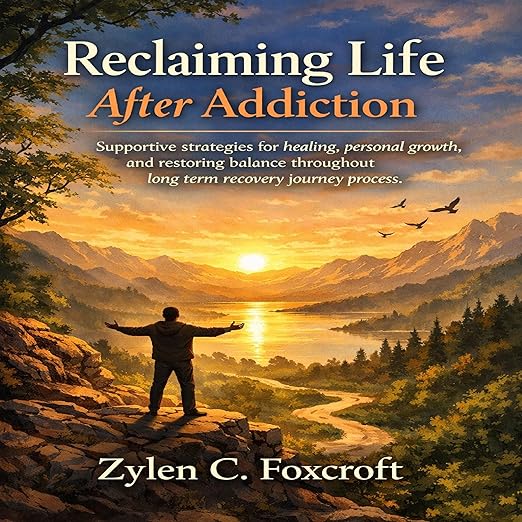
One of the more honest things about Reclaiming Life After Addiction is what it does not claim to be. It does not promise transformation through a proprietary system, it does not market a twelve-step framework under a new name, and it does not suggest that sobriety alone constitutes recovery. Zylen C. Foxcroft’s guide, narrated by Robyn Green and published in March 2026, is specifically about the period after substance use ends: the territory that most recovery literature either skips over or addresses only briefly. What do you do with yourself once the immediate crisis has passed? Who are you without the addiction that organised your days and your relationships? These are the questions the book takes seriously, and they are questions that deserve serious attention.
At 3 hours and 1 minute, this is a focused rather than comprehensive resource. The brevity is a considered choice. The book acknowledges that one-size-fits-all approaches often fail in recovery, and it does not pretend that three hours of listening will resolve what years of work are required to address. What it offers instead is orientation and a framework for thinking about the next phase, which is a genuinely useful contribution to a literature that tends to cluster around the moment of stopping rather than the long work of living differently.
About the Audiobook
Foxcroft frames recovery as a project of reclaiming identity, relationships, and direction, not merely achieving abstinence. The book works through a set of interconnected practical and emotional challenges: redefining oneself outside the context of addiction, addressing the shame that persists after sobriety, rebuilding self-confidence, and learning to navigate responsibilities with stability and intention. The balance between personal responsibility and self-compassion is deliberate and explicitly stated. This is a recognition that recovery literature sometimes tips too far in one direction, producing either harsh self-blame or an avoidance of agency, and Foxcroft attempts to hold both in tension throughout.
Key practical topics include restoring healthy routines, repairing relationships, setting boundaries, managing triggers, and developing meaningful goals. The book also addresses resilience and decision-making as skills that need active development rather than passive emergence. The explicit inclusion of counsellors, peer support workers, and family members as part of the intended audience is useful: this is not positioned as purely self-help but as a resource that works within professional support structures. That positioning distinguishes it from titles that implicitly suggest the listener should manage this alone.
Published by Ewan Calligan in March 2026, this is a modestly distributed title without an established Audible rating. The gap in the market it addresses is real, and the content as described suggests it fills that gap with appropriate care and specificity.
The Narration
Robyn Green narrates with a tone that is warm and unhurried, exactly the register this material needs. Recovery literature read with excessive urgency or clinical detachment fails the listener in different ways; Green finds a middle path that feels both grounded and supportive. The pacing allows the content to settle rather than rushing from point to point, which serves the book’s emphasis on sustained reflection rather than quick solutions. For sensitive material that listeners may be engaging with in moments of genuine personal difficulty, the quality of the narrator’s presence matters considerably, and Green delivers that quality with what sounds like genuine care for the subject matter.
What Readers Say
No listener reviews have been published on Audible UK at the time of writing. This is a relatively recent and modestly distributed title, and its intended audience, people in recovery, their support networks, and mental health professionals, may not be among the most active review-writing communities on audiobook platforms. The absence of reviews is not a reliable quality indicator here. Listeners who are specifically looking for guidance through the post-sobriety period of recovery rather than the process of achieving sobriety itself will find the content accurately described by the publisher’s notes, and the approach appears to be thoughtful and practically grounded.
Who Should Listen?
Most valuable for people who have already achieved sobriety and are working through the longer process of rebuilding a life around it. Also useful for those who support people in recovery, including family members, peer workers, and counsellors who want to understand what the post-abstinence landscape looks like from the inside. Less suited to listeners who are at the beginning of addressing substance use, for whom resources focused on the immediate process of achieving sobriety would be more appropriate. This sits in the gap that recovery literature often leaves unfilled, and for the right listener at the right moment, that is precisely its value and its distinction.