Clara’s Verdict
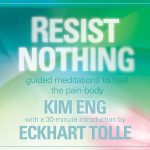
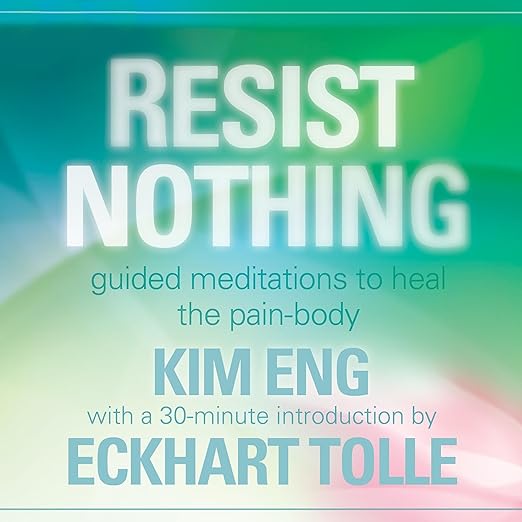
I first encountered Eckhart Tolle’s concept of the pain-body through A New Earth, and it struck me then as one of those ideas that is either profoundly liberating or slightly frustrating depending on how much patience you have for non-dualist spiritual frameworks. Resist Nothing, his collaborative programme with teaching partner Kim Eng, sits squarely in that territory. It is richly compassionate if you are already sympathetic to this way of thinking about consciousness and suffering, and possibly opaque if you are not. Understanding that going in will save you from a mismatch of expectations.
At two hours and twenty-two minutes, this is less a conventional audiobook than a guided practice collection designed for repeated, selective use rather than a single linear listen. The distinction matters enormously for how you approach it.
About the Audiobook
The programme opens with a thirty-minute exploration by Tolle on the nature of the pain-body, his term for the accumulated field of negative emotional energy that most people carry and that feeds, he argues, on toxic thought patterns. The pain-body, in Tolle’s framework, is not a metaphor. It is a semi-autonomous energetic field that perpetuates its own existence by generating the emotions and situations that sustain it. Liberation from it, crucially, is not achieved through repression or denial of negative experience. It is achieved through complete, non-judgmental receptiveness, accepting everything, resisting nothing, which is where the title comes from.
This opening section is recognisably Tolle in register: quiet, deliberate, and organised around the idea that presence, sustained, spacious, non-reactive awareness of the present moment, is the only real and lasting antidote to suffering. It is accessible to anyone who has engaged with his other books, though newcomers may find the framework requires more orientation than thirty minutes provides.
The majority of the recording then shifts to Kim Eng, who leads five guided meditations and on-the-spot practices. These include the Pointing Exercise, designed to dissolve identification with the pain-body by shifting attention to the awareness that perceives it, and practices aimed at healing at what Eng distinguishes as the physical, emotional, and subtle levels. The meditations are structured for actual use: they are not designed to be listened to straight through but to be returned to individually, as particular circumstances call for them. This is programme content, not narrative content, and its value is cumulative rather than immediate.
The philosophy is rooted in the insight that resistance itself perpetuates and amplifies suffering, that meeting every experience, however painful, with spacious acceptance rather than reactive resistance creates the conditions for genuine release. This is consistent with contemplative traditions from Buddhism to Stoic practice, and Tolle and Eng present it accessibly without simplifying it past the point where it retains useful meaning. Whether you receive it as psychology, spirituality, or practical self-regulation technique is largely a question of what you bring to it.
The Narration
Kim Eng narrates her own guided practices, which is non-negotiable for content of this kind. These meditations work precisely because they carry the authority of a practitioner who has moved through the territory she is describing, rather than the performed neutrality of a professional narrator. Her voice is genuinely slow in a way that respects the meditative context, not artificially slowed for effect, but naturally unhurried, which is different. Tolle’s thirty-minute opening section is in his own voice, which regular listeners will find familiar and orienting. The production quality from Macmillan Audio and Sounds True is clean and appropriately simple, without the atmospheric layering that can make some guided meditation audio feel overdone.
What Readers Say
No Audible UK reviews are available for this edition. Given the 2012 release date, this is most likely a catalogue migration issue rather than a signal of limited interest. Tolle and Eng’s work has a substantial and devoted international following, and this programme has circulated widely in other formats. Those familiar with Tolle’s broader body of work will have a clear sense from his other books of whether this approach speaks to them. Those unfamiliar would do well to begin with The Power of Now or A New Earth before approaching a practice programme this focused.
Who Should Listen?
This is for listeners already working within a contemplative or mindfulness framework who are looking for guided support specifically around emotional clearing and the management of the pain-body as Tolle describes it. It is not an entry point for sceptics or for those who find spiritual language alienating, the framework is assumed rather than argued for here. Equally, it is not a passive listen that delivers value in a single session: the value is almost entirely in returning to individual meditations over time, in specific circumstances, rather than absorbing it as a narrative or an argument. Approached correctly, it offers something genuinely useful. Approached as a conventional audiobook, it may frustrate.