Clara’s Verdict
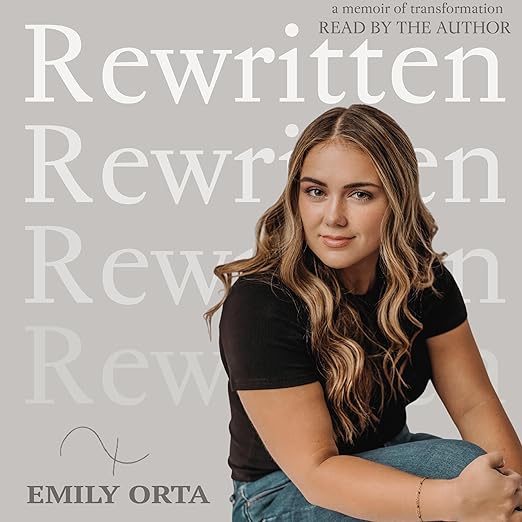
Emily Orta has built a substantial following on TikTok through poetry that speaks directly to the experience of leaving difficult relationships – not with anger or bitterness, but with a kind of precise, honest grief that readers find simultaneously devastating and validating. Rewritten extends that work into longer form: a combination of poetry, vulnerable storytelling, and practical frameworks for breaking the patterns that bring us back to the wrong people and the wrong versions of ourselves again and again. At three hours and fifty minutes, narrated by Orta herself, it is one of the most emotionally immediate listens I have encountered this year, and its rating of 4.9 out of 5 from 164 listeners is among the highest I have seen for a self-published debut.
That score is not an accident. This is a book that has found its readers, and it has found them at exactly the right moment.
About the Audiobook
Rewritten covers the territory between heartbreak and recovery with unusual specificity. Orta does not deal in generic uplift – she is not interested in telling you to love yourself more or believe in your worth. Instead, she names the specific patterns that keep people trapped: why we love the wrong people, why we feel unworthy even when we know intellectually that we are not, why we spiral, why we wait to “feel ready” before choosing ourselves, why we rebuild our identity around other people rather than from ourselves outward.
The book then offers practical tools for interrupting those patterns: not through willpower or positive thinking, but through the slower, more honest work of recognition and choice. The poetry scattered throughout serves a functional as well as a literary purpose – it captures emotional states precisely enough that readers feel genuinely recognised rather than described, which is the hardest thing good poetry can do and the reason it works where prose sometimes cannot reach.
Published by Emily Orta in March 2026, this is a self-published title that has found its audience through direct connection rather than conventional marketing – which is its own kind of recommendation. The people who needed it found it.
The Narration
Orta reading her own work makes this a different kind of listening experience from most in the personal development space. There is an intimacy to the narration that a professional voice actor could not replicate – the slight vulnerability in the delivery of the more exposed passages, the warmth in the sections directed outward toward the listener. The poetry lands differently when read by the person who lived through what it describes; there is no performance required because there is no distance to bridge. At three hours and fifty minutes, the pacing is unhurried and feels deliberately structured to give each section room to settle before moving to the next.
What Readers Say
With 164 listeners and a rating of 4.9 out of 5, this is a book that its readers have clearly found at a pivotal moment. Reviews describe it as “the words you need to hear,” with one reader saying Orta’s writing made her feel “more heard than ever.” Several listeners report crying during the audiobook. One writes: “Best buy of the year. I cried, I smiled, I felt validated.” Another: “This book has gotten me through some rough times believe it or not.” A third followed Orta on TikTok for some time before the book arrived and describes the experience of listening as cathartic.
The recurring theme across all reviews is recognition – the sense that someone has articulated something that previously felt beyond language. That is rare. It is what distinguishes writing that changes people from writing that merely resonates with them.
Who Should Listen?
Anyone in the process of leaving, recovering from, or making sense of a relationship that took more from them than it gave. People who have found conventional self-help too impersonal – too focused on generic strategies rather than the specific texture of grief and reconstruction. Those who follow Orta on social media and want to spend longer in her company and with her ideas than a short-form video allows. And, perhaps most specifically, anyone who has a tendency to rebuild their identity around another person and wants language for why that happens and how to stop – not because the book lectures, but because it shows the way through with honesty, gentleness, and the hard-won authority of someone who did it herself.
The decision to self-publish is also notable in the context of how the book was found. Orta built her readership directly, through social media, through the kind of sustained relationship between an author and an audience that traditional publishing rarely produces and often struggles to replicate. Rewritten is the book that grew out of that relationship – written for people who already trusted her, and now reaching people who are discovering her through it. The publishing model and the content are of a piece: both are about direct connection, without intermediaries, without the smoothing-over of difficult edges that institutions tend to apply.
Listen to Rewritten on Audible UK – begin here.