Clara’s Verdict
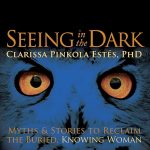
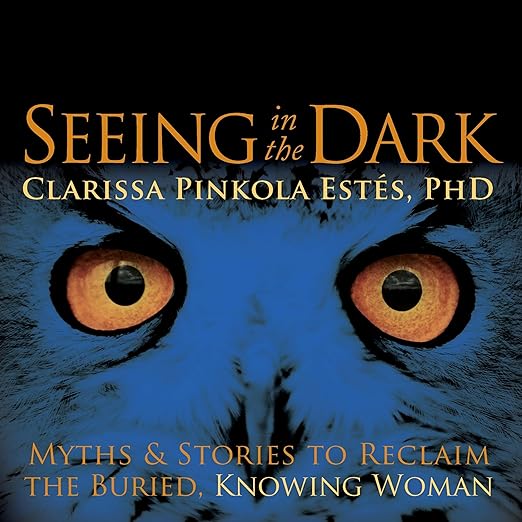
I first encountered Clarissa Pinkola Estes through Women Who Run With the Wolves, that remarkable 1992 work on the wild feminine archetype that arrived at exactly the right cultural moment and has never quite gone away. I have returned to her voice at various intervals since, always finding something useful in the density of the material even when the mystical framing tests my patience. Seeing in the Dark is a shorter, more concentrated offering, running at just under two and a half hours, but it carries the characteristic Estes texture: allegorical storytelling woven through Jungian psychology, delivered with the conviction of someone who genuinely inhabits the world-view she is presenting rather than selling it.
The central argument is that within all of us lives what Estes calls the one who knows, an instinctive, intuitive nature that lies beneath conscious awareness. She teaches a dual way of seeing: through the ego’s practical eyes and simultaneously through the soul’s deeper perception. The framing is explicitly mystical, drawing on the Jungian tradition of shadow, dream, and archetype, but the application she reaches for is practical in a way that distinguishes her from the more abstract strands of Jungian commentary. She is interested in what you do with this material, not merely in what it theoretically means.
The programme includes original stories told here for the first time, including The Fire Owl, about reclaiming the fire of enthusiasm when others try to steal it, and The Corpse Bride, which deals with redemption and the hope that cannot die. There is also material from The Rebbe in Prison, The Man Who Sought Treasure Afar, and The Erl Konig. For listeners who have worked through the longer Mother Night programme, some threads will feel familiar; Estes acknowledges the connection in the sleeve notes.
About the Audiobook
Published by Sounds True in October 2010, Seeing in the Dark runs for 2 hours and 39 minutes and carries a rating of 4.6 from 83 listeners on Audible UK. That is a strong result for a relatively short, specialist title in the spiritual psychology category. The format is not a conventional narrative audiobook: it functions more as a programme, with stories interspersed with blessing prayers, reflections, and practical exhortations. Listeners expecting a conventional self-help structure with numbered steps and summarised takeaways will find it more fluid and associative than that model.
The programme also functions as a gateway into the broader body of Estes’s work. Sounds True has published a number of her longer courses, including the full Mother Night programme from which portions of this recording are drawn. Listeners who find Seeing in the Dark resonant will likely want to pursue those extended resources, which develop the same themes across considerably more time. The brevity here is both a feature and a limitation: it offers an accessible entry into a rich body of thought without requiring the commitment of the longer works, but it necessarily compresses material that rewards slower, more extended engagement.
This is emphatically not a passive listening experience. Estes makes demands on the listener’s attention and imagination simultaneously. The brevity of the programme also means it rewards repetition more than a single listen; several reviewers have noted returning to it multiple times, which is characteristic of material that works associatively rather than informationally.
The Narration
Estes narrates her own work, and this is entirely non-negotiable as a feature of the experience rather than a peripheral detail of production. Her voice is warm, unhurried, and inflected with the cadences of a natural storyteller rather than a broadcaster or academic. One reviewer described her as a marvellous author who reads these stories herself, and that observation identifies something real: the gap between writer and narrator simply does not exist here, and the stories gain enormously from the intimacy and authority she brings. A professional narrator reading the same material would inevitably lose the sense that the teller believes absolutely in what she is telling. That belief is structural, not decorative.
What Readers Say
The five UK reviews available are uniformly positive, with four five-star ratings and one four-star. Ms W J McInnes described it as inspiring for anyone wanting to tap into inner creativity through writing or art. JA Burnett praised the stories as allegorical and mystical in nature, worth listening to over and over again, and called Estes a marvellous author. Aconite described it as a treasury to nourish the soul and gain insight into the inner knowing woman, and noted it as essential for anyone who knows Estes’s magical work. The single four-star response was measured: one listener acknowledged the programme was not for her personally, while noting excellent service. No substantive critical dissent appears in the review record.
Who Should Listen?
This is a recording for listeners already sympathetic to Jungian psychology and the tradition of archetypal storytelling. If Women Who Run With the Wolves changed how you think about instinct and the unconscious, Seeing in the Dark offers a concentrated version of the same world-view in under three hours. It works particularly well for anyone in a creatively blocked period who responds to story rather than prescription as a way through. Those who prefer evidence-based secular psychology, structured methodology, or quantifiable techniques will find the mystical register genuinely difficult to engage with. The 4.6 rating from 83 listeners is an honest reflection of an experience that lands deeply for its intended audience. Listen on Audible UK