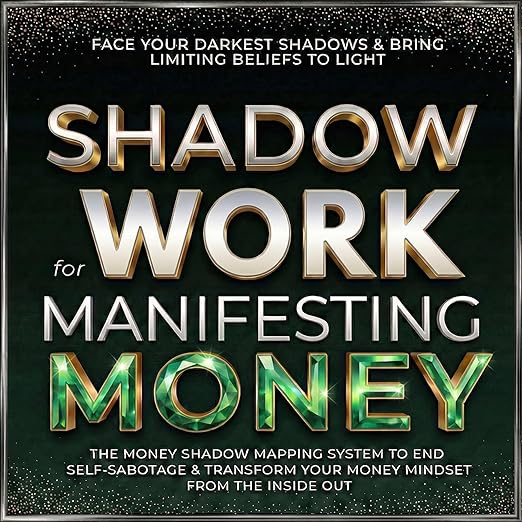
Clara’s Verdict
The intersection of Jungian shadow work and personal finance is, on the face of it, an odd pairing. But Shadow Work for Manifesting Money by Isabelle Grey makes a compelling case that our financial behaviour is driven far less by rational decision-making than by patterns absorbed in childhood – patterns that no budget spreadsheet or savings app will ever touch. The book’s Money Shadow Mapping System is a structured framework rather than a vague invitation to “do the inner work,” which is a real distinction. At just over four hours, it’s brief and focussed enough to be genuinely usable.
I’d place this closer to the Jungian self-help tradition – think Shadow Work by Connie Zweig – than the positive-thinking manifestation genre, which is a mark in its favour.
About the Audiobook
Grey begins from a concrete and recognisable set of scenarios: the paycheck that’s half gone by the weekend with no clear memory of spending it; income that stays flat regardless of effort; the compulsion to blow a windfall on something inexplicable. Her argument is that these aren’t discipline failures but patterns – specifically, six “money shadows” that form the architecture of the book: Scarcity, Receiving, Visibility, Deserving, Keeping, and Inherited.
Each shadow maps to a distinct emotional and behavioural pattern, and Grey traces each to its probable origins in childhood experience: financial tension in the home, things never discussed, shame absorbed before it could be named. The Money Shadow Map is a personal diagnostic tool for identifying which patterns dominate your own financial life. The practices are concrete – including body-based techniques for working with anxiety in the nervous system, which reflects the book’s engagement with contemporary trauma-informed thinking.
The concluding argument – “You can’t budget your way out of a money shadow” – is sharp and memorable.
The Narration
Francesca Harrall narrates this four-hour fifteen-minute listen, and she’s a considered choice for the material. Her voice is warm without being soft, and she brings the right quality of gentle directness to content that asks the listener to examine things they may have spent years not examining. The exercises and reflection prompts land well in her delivery – they feel like invitations rather than instructions. For a book in the shadow work tradition, the narration needs to carry both intellectual authority and emotional safety, and Harrall manages both.
What Readers Say
Released in February 2026, Shadow Work for Manifesting Money is a recent enough title that listener reviews haven’t yet accumulated in substantial numbers. What distinguishes it from the wider “manifestation” category, however, is the specificity of the framework: six named shadows, each with its own map and practice set, rather than the generic affirmation-and-visualisation approach that dominates much of the genre. For listeners frustrated by positive-thinking approaches that don’t address the underlying patterns, this structural rigour is likely to be its most significant selling point.
Who Should Listen?
Anyone with a persistent, confusing relationship with money – people who earn reasonably well but can’t seem to hold onto it, those who self-sabotage financial opportunities, or those who grew up in financially anxious households and feel that history in their spending decisions. Also useful for therapists and coaches working with clients on financial behaviour, who want a framework that bridges the psychological and the practical. Less suited to listeners looking for conventional financial advice – this is not a book about ISAs or investment portfolios.
Listen to Shadow Work for Manifesting Money on Audible UK and begin mapping your money patterns.