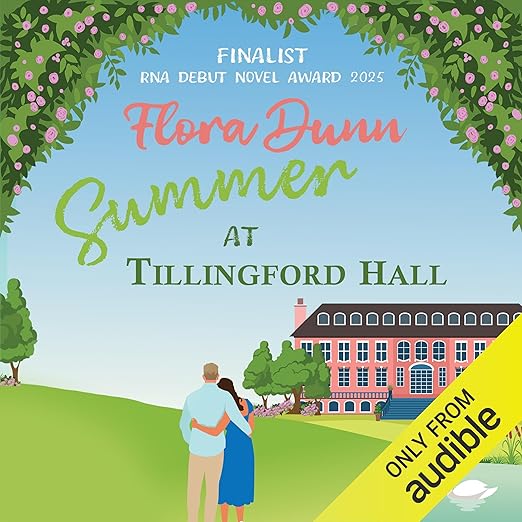
Clara’s Verdict
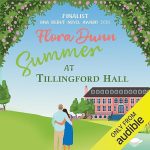
I listened to most of Summer at Tillingford Hall on a Saturday afternoon when I should have been doing something more improving. I have no regrets. Flora Dunn has written something that is genuinely difficult to categorise with any precision – it is not quite a country house romance, not quite a comic novel, not quite a mystery, and this refusal to settle into a single lane is what makes it work. The Tatler-eligible bachelor, the art history specialist cataloguing miniature portraits, the flamboyant boss who exists partly to provide comic relief and partly to drive the plot – all of this is set up with enough self-awareness that the genre machinery never feels mechanical or cynically deployed.
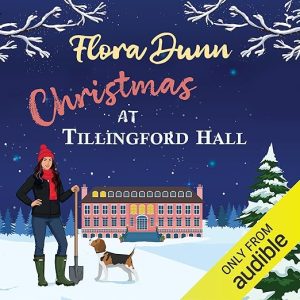
Book 1 of the Tillingford Hall series, published by Audible Studios in October 2025, and already commanding a 4.7 rating from 42 listeners. The sequel, Christmas at Tillingford Hall, is anticipated by name in several reviews – a reliable signal that the characters have done their job of making readers want to spend more time with them.
About the Audiobook
Alice Merrow is a studious divorcee with a seven-year-old daughter named Hatty. She arrives at Tillingford Hall in Hampshire on a professional secondment – she is there to catalogue Lord Tillingford’s unrivalled collection of miniature portraits, not to fall into anything. Guy Tillingford, the estate’s owner and twenty-ninth most eligible bachelor according to Tatler (after the Marquess of Granby and grime artist Tornado, which tells you immediately what kind of novel this is), is attempting to drag his ancestral property into the twenty-first century while managing the aftermath of a relationship with supermodel Sahara Seaton-Smyth. The name alone signals the comic register Dunn is working in.
When Alice and her flamboyant boss Desmond Kingston-Campbell begin to discover that things at Tillingford are not as they seem, the plot acquires a genuinely satisfying mystery dimension that sits alongside the romance without overwhelming it. The family secrets are appropriately layered, the revelations land with enough weight to matter, and the resolution ties the two plot threads together in a way that feels earned rather than convenient. At 9 hours and 9 minutes, the pacing is comfortable – long enough to develop a full ensemble, short enough that nothing is padded.
The miniature portrait collection that brings Alice to Tillingford Hall is not mere window dressing. Dunn uses the art history framework deliberately – Alice’s professional eye for what is genuine, what is misdated, and what has been misattributed gives her both a practical and a metaphorical relationship to the family secrets she gradually uncovers. The parallels between cataloguing artworks and cataloguing people are never laboured, but they are there, and they give the mystery subplot a more integrated feel than the country house romance genre usually manages. Guy Tillingford’s own relationship to his family’s collection – pride combined with a realistic awareness of the restoration costs – is handled with a lightness that keeps the social comedy functioning without producing the anxiety of a heritage property drama.
The Narration
Nathalie Buscombe narrates, and her delivery captures the novel’s comic register without tipping into farce. The distinction matters: Dunn’s humour is dry and situational rather than broad, and Buscombe’s timing is calibrated accordingly. She handles the ensemble – the imperious Desmond, the various Tillingford family members, the absent supermodel who never quite leaves the story’s emotional atmosphere – with clean voice differentiation. Her Alice is warm without being wet, and she brings a particular lightness to the scenes between Alice and her daughter Hatty that ground the romance in something real.
What Readers Say
Liz Murphy described the book as “a modern romantic with comedy and a whodunit twist – it literally has everything,” adding that as a divorcee herself she prays “a Guy will walk into our lives,” which is perhaps the most honest testimonial the novel could receive. Catherine Bailey compared the reading experience to “a giant bag of Maltesers – you reach out for one but then find yourself unable to resist another” – a description that captures precisely the compulsive quality the book has at its best. Elisabeth Slater’s 4-star review mentioned being “gripped to the very last page” and specifically named the Christmas sequel as something she was looking forward to. Two further reviewers used the word “escapism” independently, which is probably the fairest summary of what Dunn is delivering: competent, enjoyable escapism that happens to be better-crafted than the genre usually demands.
Who Should Listen?
Readers who want romantic fiction with actual comic intelligence and a subplot that requires some attention. Good for fans of Sophie Kinsella’s more grounded work, or Jilly Cooper without the excesses. The country house setting and Hampshire backdrop will appeal particularly to listeners who enjoy their romance with some architectural and social texture. Start here; the Christmas sequel follows. The series format suits this kind of character-driven comfort listening well.