Clara’s Verdict
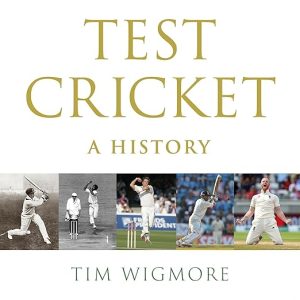
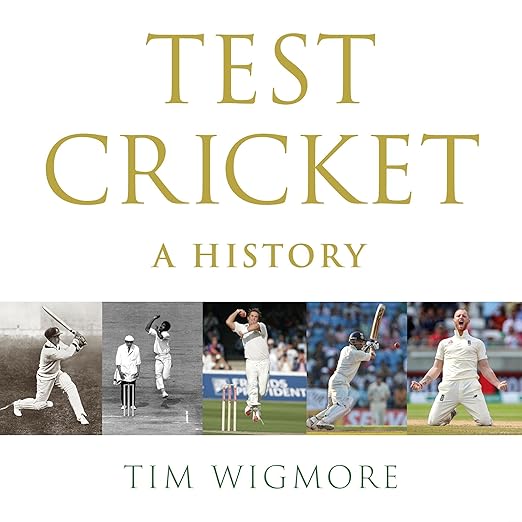
Tim Wigmore’s Test Cricket: A History is not the compendium of statistics and match summaries its title might imply. It is something rarer and considerably more ambitious: a genuine attempt to understand Test cricket as a cultural and social phenomenon across 150 years of its existence, from its Victorian origins through to Bazball and the existential anxiety about the format’s commercial viability in the age of T20. Shortlisted for the William Hill Sports Book of the Year 2025 and the Cricket Society/MCC Book of the Year 2026, endorsed by Jonathan Agnew, Peter Frankopan, and Mike Atherton, and drawing on exclusive interviews with some of the greatest players in the game’s history, this is the most ambitious cricket book in a generation. It is also, for a listener who came to it knowing little about the game, genuinely illuminating about why Test cricket matters in a way that shorter formats do not.
About the Audiobook
Wigmore’s structure is neither purely chronological nor purely thematic, but a combination that allows the game’s history to unfold while specific chapters illuminate particular aspects of how Test cricket operates and why it endures. The Bodyline series, the long dominance of West Indian cricket and its social context, the rise of subcontinental cricket as a global force, Shane Warne’s transformation of what spin bowling could mean, Kevin Pietersen’s era, and the Bazball experiment under Brendon McCullum and Ben Stokes are all examined with the writer’s characteristic combination of historical sweep and granular analytical intelligence.
The interview subjects are extraordinary: Sachin Tendulkar, Pat Cummins, Michael Holding, Muttiah Muralitharan, Kevin Pietersen, Rahul Dravid, Dale Steyn, Ian Chappell among many others. These voices are woven into Wigmore’s own analysis rather than simply quoted in sequence, which gives the book texture and authority that pure authorial commentary alone could not achieve. There is also genuine analytical substance on the technical evolution of the game – the section on DRS and its effects on how umpires and batters think about LBW is the kind of insight that makes you see every subsequent delivery differently. At over 22 hours, this is a substantial commitment, but cricket books have always rewarded length, and Wigmore earns every minute.
The Narration
Richard Atlee narrates, and his performance is assured and well-calibrated to the material. He brings warmth to the anecdotal and historical passages and clarity to the analytical and technical ones, managing the transition between direct interview quotation and Wigmore’s own prose without confusion. Cricket writing often operates in a particular register – elegiac, precise, slightly antiquarian – and Atlee finds it naturally. The 22-hour length is not felt as a burden; the book’s variety of subject matter and geography ensures that the listening experience never settles into monotony.
What Readers Say
One hundred and fifty-two reviews average 4.8 stars – an exceptional result for a sports book by any measure. UK readers were consistently enthusiastic, with several noting that the book illuminated aspects of the game they thought they already understood. “I came to this as someone who likes cricket but is not obsessed with it,” wrote one listener, “and picked it up to put a summer series between England and India in wider context. It did that and far more.” Dedicated followers of the game praised the breadth of coverage: “Well researched and very interesting – grounds, players, batting, bowling, it is all in this book.” The lone critical note, from a reviewer who found it “slightly misleading as a title” for being more biographical in sections than a conventional history, was still accompanied by an excellent rating.
Who Should Listen?
Essential for cricket lovers of every variety, from the casual viewer who wants to understand why Test cricket occupies a different emotional register from white-ball formats, to the devoted follower who will find new perspectives on familiar history. Unusually for a cricket book, it is also accessible to sports readers with no prior knowledge of the game – Wigmore writes as a journalist as much as a cricket specialist, and the social history dimensions give it broader purchase than the sport’s sometimes parochial reputation suggests. Listen on Audible UK – and prepare to see Test cricket with fresh eyes.
Listeners who come to this book as interested observers rather than dedicated followers of the sport may find it helpful to know that Wigmore treats cricket as a lens for examining broader social and political history – questions of colonialism and post-colonial identity run throughout the chapters on West Indian, subcontinental, and Australian cricket. The book’s engagement with those questions is serious without being didactic, and it gives the history weight and texture that a purely sporting narrative would lack. This is one of the reasons it has attracted readers well outside the cricket audience.
Wigmore’s engagement with the question of Test cricket’s future – whether the format can sustain its audience and commercial viability against the competing attractions of T20 and the Hundred – is among the most thoughtful writing on the subject available. He neither dismisses the structural challenges nor concedes that the format is doomed; instead, he makes a careful case for why the particular qualities that Test cricket offers – patience, sustained narrative, the possibility of genuine reversal over five days – remain irreplaceable for a specific kind of sporting attention that no shorter format can satisfy.