Clara’s Verdict
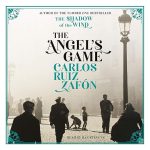
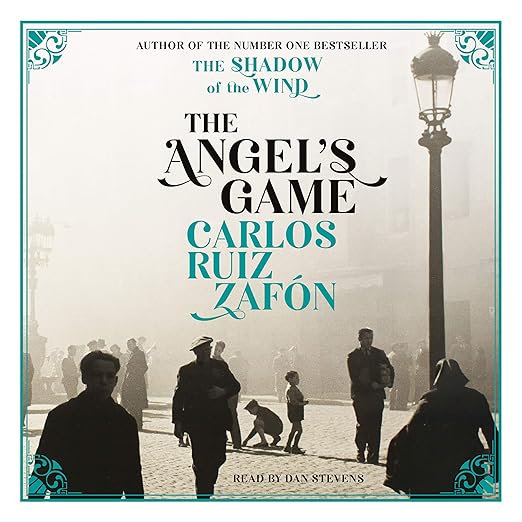
The second entry in Carlos Ruiz Zafón’s Cemetery of Forgotten Books sequence is, in my view, the most formally ambitious of the four – and the most divisive. Where The Shadow of the Wind won its enormous readership through the relatively direct pleasures of literary mystery and atmospheric nostalgia, The Angel’s Game is stranger, darker, and more concerned with the nature of storytelling itself – the ethics of it, the danger of it – than with delivering the comfort of resolution. Dan Stevens narrates with exactly the right blend of literary sensitivity and controlled menace. This is the audiobook I would put on for anyone who has grown complacent about what Gothic fiction can actually do when it is operating at its full ambition.
About the Audiobook
We are back in Barcelona, that city Zafón renders with such obsessive, architectural precision that it becomes a character in its own right – labyrinthine, secretive, capable of concealing things in plain sight. The narrator this time is David Martín, a young pulp novelist living in a mysterious abandoned mansion, haunted by the shadowy history of the previous owner and by an impossible love that seems to infect rather than sustain him. The plot turns on a proposition: a reclusive French editor named Andreas Corelli offers David a considerable fortune to write a book unlike any that has existed – one with the power to change how people think and feel. The commission sounds too good. It is, of course, far too good.
Set in the turbulent 1920s, the novel weaves together literary mystery, Gothic horror, a meditation on the corrupting power of ambition, and something approaching the metaphysical. Corelli is one of the most genuinely unsettling figures in modern literary fiction – not theatrical, not obviously monstrous, but quietly, pervasively wrong in ways that accumulate rather than announce themselves. The Cemetery of Forgotten Books reappears, as does the Sempere & Sons bookshop, connecting this novel to its predecessor in ways that reward attentive listeners. But The Angel’s Game is deliberately more opaque – Zafón is less interested in tying things together than in creating an atmosphere of mounting dread and moral complexity that lingers after the ending.
There is also a rich intertextual dimension to this novel that rewards readers familiar with literary history. The book engages seriously with questions about what stories are, what they do to the people who write them, and whether there is something inherently dangerous in the act of constructing worlds that feel more real than the actual one. These are structural rather than decorative themes.
The Narration
Dan Stevens brings extraordinary range to this performance. His David Martín begins the book as earnest and vulnerable – a young man who has survived a genuinely difficult childhood through the sanctuary of books – and Stevens traces his subsequent psychological deterioration with unsettling precision. The rendering of Corelli is perfectly judged: smooth, reasonable, never overtly threatening, which makes him considerably more frightening than theatrical villainy would. Running at fifteen hours and twenty-four minutes, this is a substantial investment of time, and Stevens sustains the atmosphere throughout without ever allowing the tension to dissipate. He understands instinctively that Gothic fiction depends on pacing above almost any other craft element, and he serves Zafón’s rhythms with genuine skill.
What Readers Say
With a 4.4 rating from listeners, The Angel’s Game elicits some of the most eloquent reader responses I have encountered in this genre. “It doesn’t fit into a given genre,” one UK reader observed with appreciation. “It is thrilling, sexy, frightening and spooky, in equal measure – pacey, with excellent and very memorable characters.” Another wrote: “His writing is beautiful, that is the only way to describe it. I haven’t read an author for years where I’ve wanted to re-read it again. You lose time, while you’re reading it.” A third described the experience as being “pulled into the story itself – poetic and enrapturing.” The consensus is of serious literary fiction that gives back exactly what you bring to it.
Who Should Listen?
Readers who loved The Shadow of the Wind should approach this as a companion and complication rather than a sequel that will reproduce their earlier experience. Those who can tolerate – and indeed welcome – genuine ambiguity and moral darkness in their literary fiction will find it extraordinary. If you have read Umberto Eco’s The Name of the Rose or Patrick Süskind’s Perfume and felt at home in those densely atmospheric, ethically complicated worlds, The Angel’s Game belongs in the same company.
Begin with The Shadow of the Wind – the Cemetery of Forgotten Books sequence rewards sequential reading, and the first novel provides essential orientation. Then listen to The Angel’s Game on Audible UK and prepare for something genuinely, memorably unsettling.