Clara’s Verdict
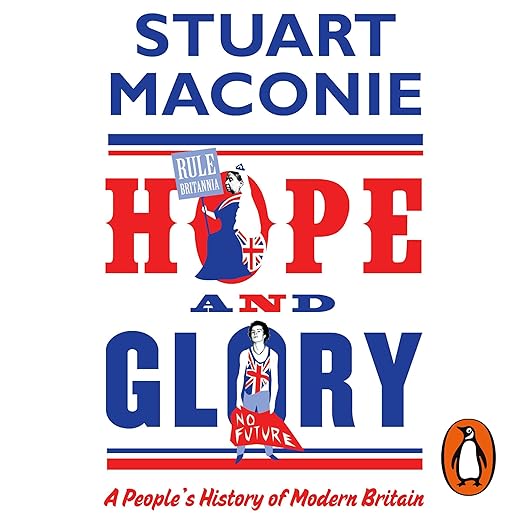
Stuart Maconie has carved out a very specific and very valuable niche in British writing: the intelligent, northern, warm-hearted chronicler of what it actually feels like to live here. His best books – and Hope and Glory is among them – achieve something that academic history rarely manages: they make you feel the texture of a century rather than merely understand its events. The concept here is elegant and deceptively simple. One event per decade of the twentieth century. One journey to find its legacy. And Maconie himself doing the reading, which is, as with all his audio work, rather the point.
At nearly thirteen hours this is a substantial commitment, but it rarely feels that way. Maconie is one of the great British conversationalists, and listening to him is like sitting across a pub table from someone who has done the reading but refuses to be a bore about it.
About the Audiobook
Hope and Glory runs to 12 hours and 44 minutes, published by Penguin Audio in July 2011. Maconie’s organising principle is both simple and inspired: he selects a single defining event from each decade of the twentieth century – from the death of Victoria in 1901 to Blair’s election landslide in 1997 – and travels to find what trace of it remains in the present landscape.
The events he chooses range from the expected to the revelatory: the Great War’s shadow on a generation, the General Strike of 1926, the arrival of the Empire Windrush in 1948, Edmund Hillary’s ascent of Everest in 1953, England’s World Cup victory in 1966, the Queen’s Silver Jubilee and punk rock in 1977, Live Aid in 1985. What connects them all, in Maconie’s telling, is a thread of national character – stubborn, eccentric, class-obsessed, occasionally magnificent, frequently deluded.
He is not neutral. His politics are legible, and some readers will find his treatment of certain events unbalanced. But he never pretends to be the impartial observer he isn’t, and his honesty about his own position is, in the end, more trustworthy than false objectivity would be.
The Narration
Maconie reads his own work and this is, categorically, the correct choice. His voice carries everything his writing implies – the wit, the affection, the occasional weariness, the genuine passion for the material. He reads as he writes: conversationally, never lecturing, with enough warmth to carry you through passages where the subject matter is heavy.
There is a pleasure in hearing an author read their own prose that no third-party narrator can fully replicate – particularly when the author is, as Maconie is, a trained broadcaster. This is audio at its most natural.
What Readers Say
Hope and Glory holds a 4.3-star rating from over 537 UK listeners – a substantial and genuinely representative sample. Poppy called it “beautifully written, compassionate, entertaining and magnificent” and compared it favourably to Maconie’s beloved Pies and Prejudice. G. Bell praised “an interesting concept, occupying a niche I’ve not seen filled before,” while andrew dainton admired Maconie’s ability to write with “an obvious love and affection for his mongrel nation.” Northern Brit UK noted the book’s sharper edge: “The finale, with Blair’s election in the 1990s, is a chilling reminder of where politics has ended up.”
The more critical voices – a few four-star reviews noting his “political leanings” – are reasonable, and worth knowing about in advance if you prefer your social history without a point of view.
Who Should Listen?
Fans of Bill Bryson’s travelogue style who’d like more political and social gristle in their bones. Anyone with an interest in twentieth-century British history who finds standard documentary treatment too dry. Listeners who have enjoyed Maconie’s radio work on 6 Music will find the audio format suits his voice perfectly.
Listen to Hope and Glory on Audible UK and let Maconie take you on an irreverent journey through the century that made modern Britain.