Clara’s Verdict
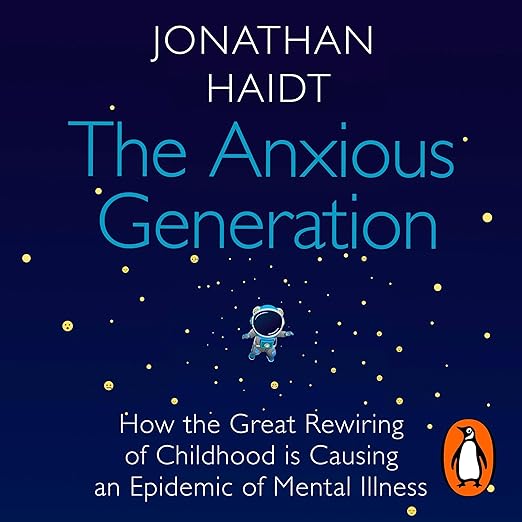
I was halfway through my morning commute when Jonathan Haidt’s argument about free play and smartphones stopped being an academic proposition and became something more uncomfortable and personal. My own childhood in the late 1980s had the particular texture he describes: unsupervised afternoons that required us to navigate social conflict without adult intervention, boredom that had to be solved by imagination rather than curated away by a device. The generation he is writing about did not have that, and the data he presents on what followed is, as the Evening Standard review quoted on the cover notes, some of the most terrifying statistics I have read in a while. I do not think Haidt is wrong. I think he may be right in a way that is going to take a generation to fully reckon with and respond to effectively.
The argument is cleaner than the data that surrounds it, which is both its strength and its limitation. Haidt identifies two transitions that happened roughly simultaneously from around 2010: the decline of unsupervised free play in childhood, and the rise of smartphone use with social media apps among adolescents. The combination produced something unprecedented in the pace of its spread and its effects. Sleep deprivation, addiction, anxiety, isolation, the constant comparison of curated identities: these are not new observations individually, but Haidt assembles them into a structural account that is harder to dismiss than individual studies allow. The book earned its number one international bestseller status by being a coherent argument that arrives at a time when the need for one is obvious.
About the Audiobook
Published by Penguin Audio in March 2024 and running 10 hours and 32 minutes, this was recognised by the Times, FT, Economist and Independent as a book of the year, which indicates it crossed successfully from a specialist public health audience into general readership. The 4.6 Audible rating from 11 UK reviews understates the book’s wider impact but is a consistent positive signal. Susan Cain, author of Quiet, calls Haidt a modern-day prophet disguised as a psychologist, and the Guardian describes it as urgent and essential. These are not the usual blurbs.
Reviewer SHIELDFAN’s four-star assessment is worth taking seriously as the most analytically developed response in the review pool: they rate the book at about 80 per cent achieved, noting that the diagnostic sections are more convincingly executed than the prescriptive ones. That is a fair reading. Haidt is more compelling as a diagnostician than as a policymaker, and the sections on what individuals, schools, and governments can do are somewhat thinner than the analytical sections that precede them. This is a book that defines the problem with more force than it solves it, which may be exactly the right use of a book.
The comparative section, in which Haidt looks at how girls and boys were differentially affected by the social media transition, is one of the most carefully argued in the book. He is not claiming that boys were unaffected but that the mechanisms through which social media harms manifest are meaningfully different by gender, and that policy interventions that treat the problem as uniform will miss important aspects of what the data shows.
The Narration
Sean Pratt is a narrator with a substantial track record in non-fiction and is well-suited to material that requires clarity, authority and the ability to make research feel accessible rather than academic. His delivery here is measured and unshowy, which is exactly what this material requires. Haidt’s prose is direct and built for a general audience, and Pratt does not impose a performance on top of it. The 10-hour runtime moves cleanly without the kind of pacing variations that can make long non-fiction feel uneven in audio. For evidence-heavy, argument-led non-fiction, Pratt represents a reliable standard of delivery.
What Readers Say
UK reviewers are uniformly engaged, with several noting the personal resonance of the argument alongside its analytical value. Mrs J Hetherington invokes a Goonies childhood of free-range kids who were seldom indoors, capturing the specific generational ache that runs through many responses to this book among adults who are old enough to have had unsupervised childhoods. Helen identifies parents, teachers and change-makers as the primary audience and notes that Haidt is informative without fear-mongering, a distinction that separates this book from more polemical treatments of the same material. Rufus, who describes himself as just about part of the generation discussed, finds it a fascinating and personally illuminating insight into changes that happened within his own lifetime and conscious experience.
Who Should Listen?
For parents of children currently navigating adolescence, this is probably the most relevant non-fiction audiobook of the past two years. For teachers and those making policy around children’s technology use, similarly. For adults who want to understand the social and psychological dynamics of the generation younger than themselves, it provides a structured, evidenced framework that goes beyond the usual commentary. Those looking for reassurance that smartphones are fine will not find it here. Those who want more practical individual guidance may find the final sections less developed than the analytical sections. Consider pairing it with Cal Newport’s work on attention and focus for a broader framework.