Clara’s Verdict
I picked up The Circular Home on a January evening when I had spent the previous hour sorting through a bin bag of packaging that seemed to have materialised from nowhere. There is a particular guilt that comes with modern domestic life: a low-grade awareness that the house is quietly consuming the planet, one carrier bag and one obsolete appliance at a time. Sean Ray does not open with finger-wagging. He opens with a simple, clarifying idea: the home as an ecosystem, and most of ours are broken ones. That reframe is the whole book in miniature, and it is more energising than anything in the standard sustainability canon.
What I found genuinely refreshing about this audiobook is its refusal to treat sustainability as an identity position. There is no judgment of listeners who have not already converted their kitchen to a zero-waste operation, and no implication that environmental awareness requires radical self-denial. The argument is structural rather than moral, which makes it considerably more useful and considerably less exhausting than most content in this space. Ray is interested in systems and how they can be improved, not in making you feel bad about the carrier bag you used last Tuesday.
At just over an hour, this is a tightly focused listen rather than a comprehensive treatise. Within that compact runtime, it manages to reframe the conversation about sustainable living away from sacrifice and towards design thinking. The language of circular economics has largely lived in corporate boardrooms and academic journals. Bringing it into the kitchen and the bathroom cupboard is genuinely useful work, and Ray does it with accessibility and precision.
About the Audiobook
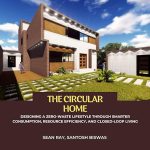
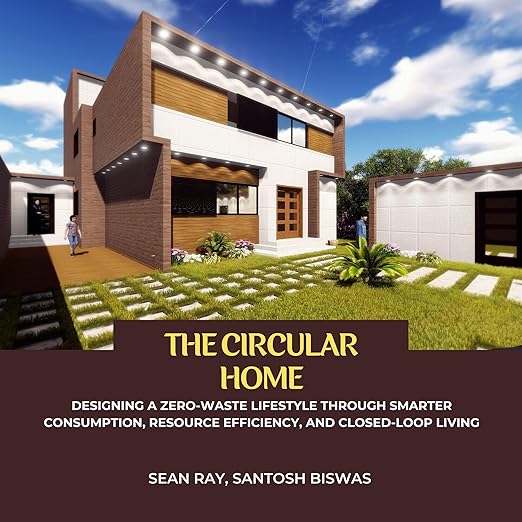
The central argument of The Circular Home is both simple and quietly radical. Most of what we call domestic life follows a linear path: buy, use, discard. This path is neither inevitable nor efficient. Published in March 2026 by Sean Ray and Santosh Biswas, the audiobook draws on the principles of circular economics and regenerative design to propose an alternative: a household that behaves more like a natural system, where waste is designed out from the start rather than managed after the fact.
Ray guides listeners through a practical audit of household resource flows. How much energy is lost? How much water wasted? How do textile turnover and kitchen habits accumulate into genuine environmental strain? There is real intelligence in the way he structures this. Rather than overwhelming the listener with statistics, he focuses on understanding the lifecycle of what enters the home, and where the most impactful interventions lie. From kitchen consumption patterns to bathroom plastics, from energy leakage to the short lifespan of cheap electronics, the audiobook maps the hidden inefficiencies of domestic life before suggesting how to address them.
The book covers the concept of the take-make-waste model and how it applies at the domestic scale, which is something that often gets lost in sustainability discourse that focuses on industrial production rather than individual households. Ray makes the connection explicit: the home is a node in a larger system, and the choices made within it aggregate into something consequential. The framing is regenerative rather than restrictive: the goal is to design a home that generates as little waste as possible rather than simply managing the waste it produces.
The tone is deliberately non-prescriptive throughout. This is not a minimalism manifesto, and it is not asking anyone to give anything up. It is asking listeners to think differently about systems, to notice the hidden inefficiencies before deciding what to change. That restrained, systems-first approach gives the content unusual staying power and makes it accessible to listeners who are curious but not already converted to any particular strand of environmental practice.
The Narration
B Fike delivers the narration in a measured, thoughtful register that suits the material well. This is explanatory, idea-led content rather than narrative or memoir, and Fike treats it accordingly: clear diction, unhurried pacing, and a tone that feels engaged without being evangelical. There is no performative enthusiasm, which is exactly right for a book that asks you to slow down and think. The voice carries authority without condescension. For a sixty-five-minute listen focused on practical frameworks, that quality matters considerably, and the production is clean and professional throughout.
What Readers Say
As of publication, The Circular Home has not yet accumulated public ratings on Audible UK. That is not unusual for a short-form release from an independent publisher in early 2026, and it should not put you off. The content stands on its own merits: focused, well-structured, and uncommonly clear-headed on a topic that often descends into either moralising or mystification. Independent releases in the sustainability space tend to find their audience gradually rather than with a burst of early reviews. This one deserves to reach its readers.
Who Should Listen?
This audiobook will resonate most with listeners who are already environmentally conscious but frustrated by the gap between good intentions and practical change. It is particularly useful for anyone who finds the zero-waste movement too prescriptive, or who wants a structural framework for thinking about household sustainability rather than a shopping list of product swaps. Homeowners thinking about renovation or significant changes to their domestic setup will find the systems-audit approach especially applicable. At just over an hour, it is genuinely accessible: the sort of listen you can finish on a long walk and still be thinking about a week later. Those looking for deep academic treatment of circular economics will want something more substantial, but as an intelligent introduction to applying these ideas at home, it does the job admirably. Listen on Audible UK