Clara’s Verdict
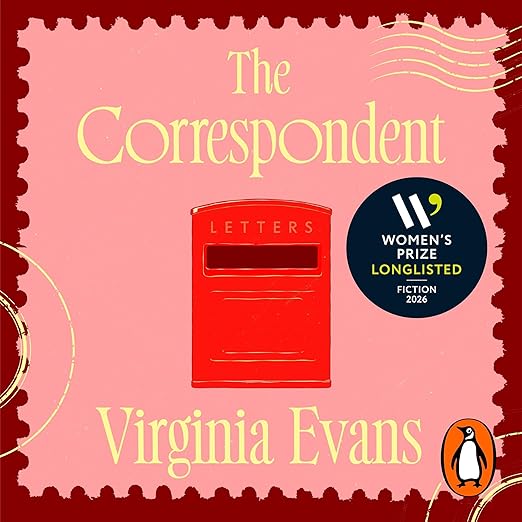
I came to The Correspondent on a grey Sunday afternoon with a mug of tea going cold on the desk, half-expecting something gentle and a little slight. What I got was a book that made me put the mug down and forget it entirely. Virginia Evans has constructed an epistolary novel, built from letters and emails, formal notes and hastily dashed-off replies, around one of the most vividly realised characters I have encountered in recent fiction: Sybil Van Antwerp, retired lawyer, cantankerous correspondent, grudging romantic, and keeper of a decades-old grief she has never allowed herself to name. The novel is longlisted for the Women’s Prize for Fiction 2026, and the recognition feels entirely warranted.
Maggi-Meg Reed’s narration delivers Sybil with a dry, precise warmth that makes you feel as though you are reading someone else’s letters over their shoulder. At just over eight and a half hours, this is a beautifully weighted listen: long enough to sink into, short enough to finish in a weekend.
About the Audiobook
Evans’s masterstroke is the epistolary form itself. We never meet Sybil directly; we only ever see her through what she writes and what she receives in return. It is a technique with deep roots in Richardson, Laclos, and Austen’s early juvenilia, but Evans makes it feel urgent and contemporary because Sybil’s correspondence spans mediums: formal typed letters to authors she admires, sharp emails to her solicitor, tender notes to a friend from her working life. The mix of registers gives the novel an unusual texture, comic and melancholy by turns.
The plot accumulates slowly and then with gathering force. There is a fractured relationship with her children that she does not quite know how to repair. A late-life romantic possibility that she approaches with characteristic scepticism and, beneath it, something like hope. An old legal case that has resurfaced with uncomfortable implications. And, woven through everything, a loss she has carried for thirty years — the exact nature of which Evans withholds until the novel is ready to give it to you, and when she does, the effect is considerable.
Ann Patchett’s blurb, “a portrait of a small life expanding,” is exactly right, and the word “small” here is not a diminishment. Evans is interested in the dailiness of a life: the letters dashed off to complain about a neighbour, the apology drafted and redrafted, the thank-you note that turns into something else entirely. The novel trusts that the particular is the route to the universal, and it earns that trust.
The Narration
Maggi-Meg Reed does something genuinely difficult here: she voices not just Sybil but the full cast of correspondents, each with their own register and rhythm. Sybil herself gets a measured, slightly formal cadence that relaxes, almost imperceptibly, as the novel progresses — a subtle performance choice that mirrors the emotional arc. Reed never overplays the comedy or the pathos, which is exactly right for material this finely calibrated. This is the kind of narration that disappears into the text rather than sitting on top of it, and for an epistolary novel, where the voice is everything, that quality is essential.
What Readers Say
The UK response has been warmly enthusiastic. Pamela called it “a gem,” struck by how Evans balances the formidable and the charming in Sybil’s character. Steph gave it four and a half stars, describing it as “an emotional glimpse into the life of an older lady” and noting how rewarding it is to watch Sybil grow despite her age. A M Flynn found it “utterly delightful,” particularly the way Sybil’s unresolved matters are addressed with gentleness rather than melodrama. Welsh Annie, writing in March 2026, called it “life-affirming… warm and funny but also poignant and touching.” Across 83 ratings, it holds a 4.5 average.
Who Should Listen?
If you have a fondness for character-led fiction that rewards patience, for novels where the form is doing something meaningful rather than decorative, and for protagonists who are difficult and loveable in equal measure, The Correspondent belongs on your list. It will particularly appeal to readers who have grown tired of plot-driven fiction and want something that moves at the speed of a real human interior life. It is also a natural choice for fans of Rachel Joyce’s The Unlikely Pilgrimage of Harold Fry or Emma Healey’s Elizabeth Is Missing — novels that take the inner world of an older woman with full seriousness.