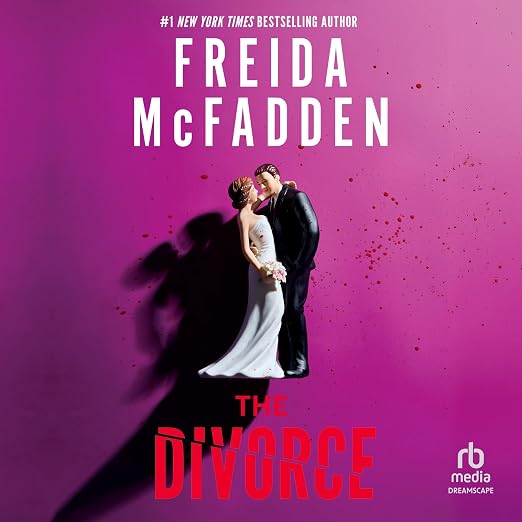
Clara’s Verdict
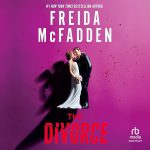
Over a hundred thousand ratings. I want to lead with that figure because it tells you something about Freida McFadden that no critical assessment can, which is that she has built an audience of a size most literary novelists will never see, and that this audience turns up on publication day. The Divorce arrived on 26 May 2026 and is holding firm in the Audible UK charts more than two months later.
So the interesting question is not whether it works, since a hundred thousand people have already answered that one. The interesting question is what McFadden is doing differently here, and the answer is that she has written a thriller in which your sympathy is the thing being manipulated. Naomi has been comprehensively wronged. Her husband kicked her out, hired the city’s best divorce lawyers, drained their accounts and took up with a woman in her twenties. Everything Naomi does afterwards flows from an injustice you cannot argue with, and McFadden uses that unarguable injustice as cover.
About the Audiobook
Dreamscape Media publish it: eight hours and one minute, narrated by January LaVoy. Naomi was living what the listing calls “the quintessential love story”. Boy meets girl, they fall in love, marry, buy the dream house, start a family. Then it ends, brutally and one-sidedly. The sensible response would be a small flat, a return to the workforce and the slow reconstruction of a life. Naomi asks why she should have to.
What follows begins as cynical curiosity about her husband’s new girlfriend and turns, by degrees the novel is careful to make gradual, into obsession and then into something a good deal darker. The mechanism McFadden is working with is the one that made her name: a first-person narrator whose account you accept because her grievance is legitimate. The listing promises secrets Naomi never imagined and a danger to her own life, and describes the result as a story in which love curdles into vengeance. That is accurate, though the curdling takes longer than some listeners expect it to.
At eight hours this is a single-weekend listen, and it is built in distinct parts rather than as one continuous ascent, which matters for how it plays in audio. It is also the source of the book’s most common complaint, and I will come to that below.
The Narration
January LaVoy’s defining instinct is that she reads thought as thought rather than performing it, and I cannot think of a book that needs that discipline more than this one. Eight hours of first-person obsession collapses the moment the narrator begins signalling. Had LaVoy leaned into Naomi’s fixation, added an edge, allowed a little relish into the voice, the entire misdirection would be visible by the second hour.
She does the opposite. Naomi is delivered as calm, reasonable and, above all, tired: a woman patiently explaining a sequence of perfectly logical decisions. The horror accumulates in the gap between how she sounds and what she is describing, and LaVoy leaves that gap entirely to the listener to notice. She is also very good on the girlfriend, who could easily have been played as a target and instead comes across as a person, which is essential to the book working at all. My one small reservation concerns pace. LaVoy reads at a measured, even clip throughout, and the slower opening section might have benefited from a fraction more urgency. Once the second part begins, that evenness turns from a drag into an asset.
What Readers Say
A 4.3 average across more than a hundred thousand ratings is, in context, an excellent number. Ratings at that volume regress towards the middle, and a book holding 4.3 with that many voices behind it is genuinely satisfying a very broad readership. Christine Clear describes the effect precisely: “You begin to believe one character then the other character, but it ends not as you expect.”
Part 1 was a slow burner, but from Part 2 onwards I flew through the rest of the book.
That is Ricky, at four stars, and it is the most useful sentence written about this book. It is also, in my experience, the single most common reaction to it. Ricky came to the novel through social media recommendations that had described the story as unhinged, and admits to “expecting it to be a little more unhinged as it actually was”, which is a fair correction to the online conversation around this title. It is a controlled, patient thriller wearing the marketing of a wild one. Paul Turner’s summary, that it is full of twists and turns and difficult to put down, represents the majority verdict.
Who Should Listen?
You already know whether McFadden is for you, and if she is, this is one of her better-constructed books. For anyone still deciding, her appeal is not prose but architecture. The sentences are plain and functional and get out of the way, and what you are there for is the shape of the deception and the moment it inverts. On that measure The Divorce delivers, and eight hours is exactly the right length for what it is doing.
Two things would make me steer somebody away. If you need a first act that grips immediately, be warned that the opening third is deliberate scene-setting and a substantial number of listeners find it slow going. And if you come to thrillers for psychological realism rather than for engineering, the final turn asks for a degree of credulity that McFadden’s regular readers give happily and others do not. Taken as the mechanism it is, it works beautifully.