Clara’s Verdict
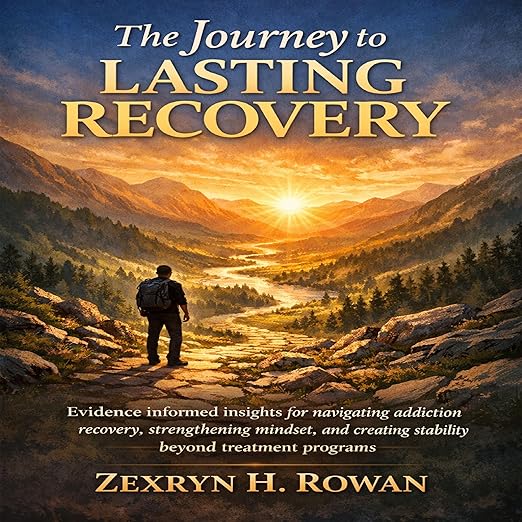
Recovery literature occupies a complicated position in the audiobook market. At its best, it offers something genuinely sustaining: a framework for understanding compulsive behaviour, a vocabulary for the experience of wanting to change and struggling to do so, a companion for the isolating process of becoming someone different from who you have been. At its least useful, it offers warmth without substance, encouragement without tools. The Journey to Lasting Recovery, written by Zexryn H. Rowan and published in March 2026, positions itself explicitly in the practical wing of the genre, with an emphasis on actionable strategies alongside emotional support.
No Audible UK ratings or reviews exist at the time of writing. The publisher is listed as Emmett Jackman, indicating independent publication. The narrator is Robyn Green, and the runtime is three hours. I will assess what I can from the available information and be honest about what I cannot.
Recovery as a Practice, Not a Destination
The synopsis’s most distinctive claim is its reframing of recovery: not as a destination to be reached, a state of having successfully recovered, but as a lifelong practice that acknowledges setbacks as intrinsic rather than catastrophic. That is a meaningfully different position from some recovery literature, which can inadvertently reinforce the notion that relapse represents failure rather than a common and workable part of the process. Rowan explicitly describes the goal as teaching “how to turn those moments into growth rather than defeat,” which suggests an approach informed by more recent psychological thinking about behaviour change than the older all-or-nothing frameworks.
The content range is broad for a three-hour listen. The synopsis covers the emotional and psychological foundations of addiction, trigger management, self-awareness development, relationship repair, routine building for physical and emotional wellbeing, and reflection on values, purpose, and identity. Covering all of these meaningfully within three hours requires a tight editorial hand and a willingness to provide frameworks and principles rather than comprehensive treatment of any single area. Whether the balance is right will depend on what individual listeners most need from the material.
The intended audience is described as “anyone seeking to move beyond addiction, compulsive behaviors, or self-destructive patterns,” which is a wider framing than purely substance addiction. This suggests the book may have more relevance across a range of compulsive patterns than the word “recovery” sometimes implies in the narrower twelve-step tradition.
Robyn Green’s Voice in This Context
Robyn Green narrates, and for material in this area the narrator’s register carries considerable weight. Recovery content requires a voice that conveys genuine warmth and credibility without the performative empathy that can feel hollow in self-help audio, a mode that listeners in difficult personal situations are often particularly alert to detecting. The tone must be matter-of-fact enough to feel honest and warm enough to feel genuinely compassionate, both simultaneously. Without listener reviews to assess the performance, this remains a reasonable expectation rather than a confirmed reality.
A three-hour commitment is low-risk in terms of time investment even if the narration turns out not to work for you personally. The Audible sample should give you sufficient indication within the first five minutes.
What Readers Say
No reviews are available at the time of writing. As an independently published title released in March 2026, the book has not yet accumulated listener response on Audible UK. Recovery and addiction titles in this independently published space often build their audiences through recommendation within specific communities, support groups, and therapeutic contexts rather than through general browse discovery on audiobook platforms. The absence of public reviews is not itself a negative signal; it is simply the reality of a very new title.
For readers who want established listener response in the recovery space, Russell Brand’s Recovery draws on twelve-step principles with extensive public reviews; Johann Hari’s Chasing the Scream offers a journalistic and policy-oriented perspective; and the work of Gabor Maté, particularly In the Realm of Hungry Ghosts, provides a clinical and compassionate framework for understanding addiction.
Three Hours: Enough or Insufficient?
The runtime of three hours for a book covering addiction, compulsive behaviour, trigger management, relationship repair, identity, values, and purpose raises a fair question about depth. The answer depends entirely on what you are looking for. If you want a comprehensive, clinically detailed treatment of the neuropsychology of addiction, the evidence base for specific therapeutic interventions, or the sociological dimensions of substance use and recovery, three hours is genuinely not enough. There are longer, more detailed books by credentialed clinicians and researchers that address those needs. But if you want a framework, a set of orienting principles, and the kind of practical language that helps you begin to name what you are experiencing and what you are working toward, a well-constructed three-hour guide can be exactly the right entry point. It can also be a companion for a moment of crisis when a 15-hour academic text is not what the situation calls for.
Who Should Listen?
This is for listeners navigating their own recovery, supporting someone who is, or exploring what the process of lasting change from addictive and compulsive patterns might genuinely look like. The three-hour runtime is accessible rather than demanding, appropriate for someone at the beginning of the process or returning to it after a setback. The non-judgmental framing suggested by the synopsis will matter to listeners who have encountered more prescriptive or shame-laden approaches elsewhere.
Consider pairing with longer, more established titles in the addiction and recovery space for greater depth on specific aspects of what this book introduces.