Clara’s Verdict
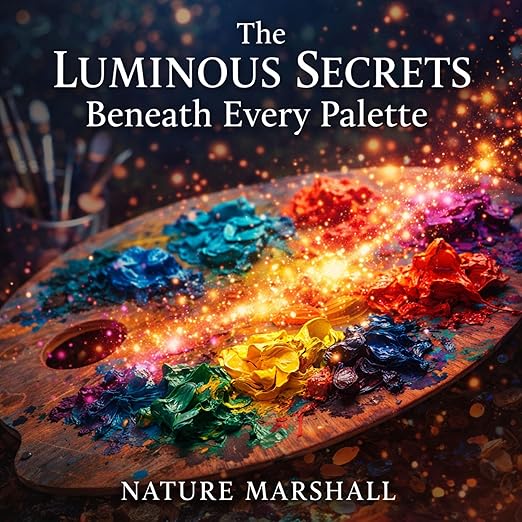
I came to The Luminous Secrets Beneath Every Palette with some scepticism. Art history delivered by audio has always struck me as a structurally awkward proposition: the discipline is so thoroughly visual that the medium seems to work against itself. But Nature Marshall, writing through the persona of the art historian Dr Elara Winslow, has made an interesting and intelligent choice. By treating colour as the subject rather than individual works or movements, she shifts the emphasis from the visual to the conceptual and experiential. You can discuss what ultramarine meant to Vermeer, or why vermilion carried the symbolic weight it did for centuries of European painters, entirely in language. And the argument is richer for being told rather than shown, because it forces the listener to actively construct the meaning rather than passively receiving it from an image.
The book comes with an accompanying PDF available in the Audible library alongside the audio, which presumably contains the visual material that cannot be delivered by sound. That companion document matters. Download it before you begin, and use it actively alongside the listen rather than treating it as optional supplementary material.
About the Audiobook
The framing conceit is a tour through the history of colour in art, presented as a series of encounters: with specific pigments, their origins and meanings, the chemistry of their production, and the cultural and symbolic weight they have accumulated over centuries of artistic and social use. Marshall moves from the symbolic significance of ultramarine in Renaissance devotional painting to the industrial transformation of the pigment industry in the nineteenth century, tracing a story about how artistic possibility is shaped by material availability. What painters could make and afford determined, in part, what painting could mean, and that intersection of chemistry and culture is the book’s most original contribution to a subject that is sometimes treated as purely aesthetic.
There are chapters on colour symbolism across different cultural traditions, on the economics and politics of pigment production, and on how the development of synthetic dyes and later digital colour has changed both the practice of painting and the way we experience it. The fiery passion of vermilion, the mourning of black, the royal implications of purple in the ancient world: each colour carries a history that is as much social and political as aesthetic, and Winslow traces these histories with the kind of engaged intelligence that makes a relatively specialist subject feel broadly relevant.
The breadth is significant for a five-hour listen, and some sections necessarily sacrifice depth for coverage. Listeners looking for comprehensive treatment of any single period or tradition should supplement this with more focused reading. But as an introduction to colour as a meeting point of chemistry, culture, emotion, and artistic practice, the overall argument is a genuinely interesting one that holds together across the runtime.
The Narration
Chip Newton delivers the material with an authority that suits the academic framing. There is a slight lecturing quality to the delivery that is appropriate for the content rather than at odds with it: this is, after all, a book that presents itself as the work of a scholar, and the narration matches that register. The challenge of narrating art history by audio is considerable. Newton has to make pigments, paintings, and visual experiences legible to a listener with nothing to look at, and he does so with deliberate pacing that gives unfamiliar names and concepts space to land. When he introduces a pigment or work the listener may not know, he takes the time to contextualise rather than assuming prior knowledge. A thoughtful performance that respects the intelligence of its audience throughout.
What Readers Say
Published in January 2026, The Luminous Secrets Beneath Every Palette has not yet received listener ratings on Audible UK, and is listed as not yet rated. Art history titles of this kind tend to find their audience through specialist communities, including art education, painting practice groups, and museum membership networks, rather than through general chart browsing. This can delay the accumulation of reviews even for genuinely good titles. The quality of the production, including the PDF companion, suggests it has been put together with care for an audience that will appreciate that investment.
Who Should Listen?
Painters, art history students, museum enthusiasts, and anyone interested in the material and cultural history of colour will find this an engaging and relatively accessible listen. Crucially, the PDF companion is not optional: download it before you begin and refer to it actively. This is not a listen to have on in the background; it rewards active attention and benefits from pausing to examine the visual references the companion document provides. At five hours, it makes an excellent companion to a painting project, a gallery visit in preparation or reflection, or a weekend afternoon of genuinely interested listening on a subject that rarely gets this kind of accessible treatment.