Clara’s Verdict
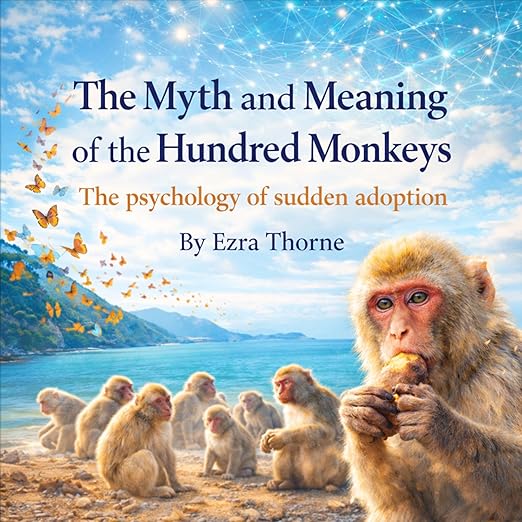
Part of the MindPlay: The Psychology of Everyday Power series, The Myth and Meaning of the Hundred Monkeys by Ezra Thorne is a short, sharp audiobook – 3 hours and 31 minutes – that takes one of the most persistently repeated stories in popular psychology and dismantles it with considerable care and intellectual honesty. The “hundred monkeys” phenomenon, in which a behaviour supposedly leaps spontaneously between isolated populations once enough individuals have adopted it, has been cited to support claims ranging from spiritual awakening to social media virality to the power of collective consciousness. Thorne’s contribution is to ask what actually happened, and to follow that question wherever it leads. Narrated by Michael Bridges, this is the kind of rigorously honest book that popular psychology desperately needs more of.
About the Audiobook
Thorne opens by taking the emotional appeal of the story seriously – the “slow weather” of cultural change, the sense that ideas accumulate invisibly until, suddenly, they are everywhere. He traces the hundred monkeys parable to its origins in Lyall Watson’s 1979 book Lifetide, where it was presented as documented scientific fact observed by Japanese primatologists studying macaques on the island of Koshima. Thorne then examines what those primatologists actually observed, how Watson interpreted and embellished those observations, and how a story that was already questionable at source transformed across decades of uncritical retelling into apparent proof of collective consciousness and morphic fields.
The broader argument is where the book becomes genuinely important beyond its immediate subject. Thorne is not merely debunking an interesting myth but using it as a case study in how motivated reasoning and narrative appeal can substitute for evidence in popular discourse. The sociology and psychology of viral belief are substantive subjects with real consequences, and the hundred monkeys story turns out to be a remarkably clean illustration of how appealing ideas spread – not through mysterious resonance but through very ordinary human mechanisms of repetition and social trust. The book belongs to the same tradition as Ben Goldacre’s Bad Science: rigorous, readable, and genuinely valuable.
Thorne also examines the broader phenomenon of how debunked ideas resist correction. The hundred monkeys story has been thoroughly discredited by the primatologists whose work Watson misrepresented, and that debunking has been widely published. Yet the story continues to circulate with the same confident authority it had in 1979. This resilience is itself a more interesting phenomenon than the original story, and Thorne explores it with the same methodical care he brings to the original debunking. The answer has something to do with the emotional appeal of the idea – the suggestion that collective human consciousness is connected in ways that transcend ordinary communication is deeply attractive – and something to do with the social networks through which certain ideas preferentially travel.
The Narration
Michael Bridges narrates with the measured, intelligent delivery the material requires. This is an essay audiobook rather than a narrative one, and Bridges’s reading is suited to the discursive, analytical mode – clear, unhurried, and genuinely engaged with the ideas without becoming didactic or condescending. The 3.5-hour runtime is efficiently paced: Thorne has not padded his argument with unnecessary examples, and Bridges does not pad his delivery. This is a listen for commutes, walks, or quiet evenings – something that leaves the mind active rather than passively entertained.
What Readers Say
This is a recent release building its readership, but the MindPlay series is designed for readers with a genuine appetite for rigorous popular psychology – the audience that has made books like Thinking, Fast and Slow and Bad Science perennial bestsellers. Thorne’s approach – taking a familiar and beloved story and examining what it actually reveals about how we construct and transmit belief – is precisely what that readership wants, and delivers it with the intellectual honesty that the subject requires.
Who Should Listen?
Anyone with a professional or personal interest in how ideas spread, how social change happens, or how popular science distorts evidence for narrative convenience. Marketers, sociologists, journalists, scientists, and anyone who has ever cited the hundred monkeys story in a professional context will find this both illuminating and slightly uncomfortable. At just 3.5 hours, the investment of time is minimal relative to the intellectual return on offer. Listen on Audible UK: get The Myth and Meaning of the Hundred Monkeys on Audible UK. It is also an excellent companion piece to other works of popular science scepticism, and would pair particularly well with Stuart Ritchie’s Science Fictions or Ben Goldacre’s Bad Science for anyone building a working understanding of how scientific evidence is distorted in public discourse. Available on Audible UK and Kobo. The MindPlay series appears designed to build into a comprehensive popular psychology resource, and if subsequent volumes maintain the standard set here, it will become an essential reference for anyone thinking seriously about social influence and belief formation.