Clara’s Verdict
The Nanny audiobook does something I always respect in domestic suspense, which is to start the trouble absurdly small. Not a threat, not a note pushed under a door, not a figure at the window. An appliance switched off. The coffee moved to the wrong shelf. Heather Burnside understands that the genre’s real subject is not danger but doubt, and for the first third of these seven hours and twenty-one minutes she keeps Amanda Fitzroy, and us, in the excruciating position of being unable to prove that anything is happening at all.
It is not a subtle book and it has no interest in being one. Burnside is writing squarely for the readership that has worked through Freida McFadden, Rona Halsall and Valerie Keogh, and the publisher says as much on the listing. What she does better than most of that field is the psychology of the woman being undermined. Amanda is not a passive victim who becomes competent in the final chapter. She is someone whose confidence is dismantled piece by piece inside a house she is supposed to run, and the recovery of that confidence is the actual plot rather than the resolution of it.
About the Audiobook
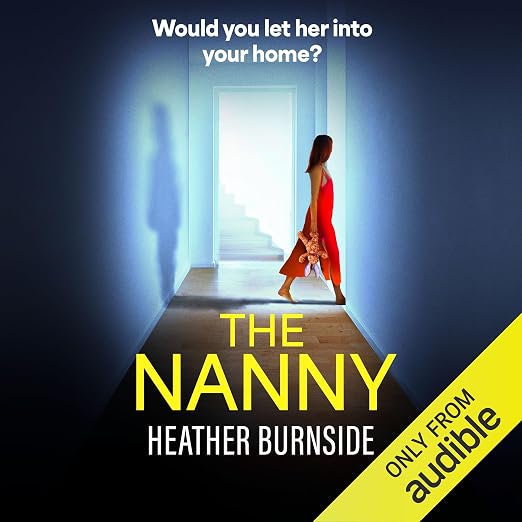
Amanda has the life the opening pages of a hundred thrillers describe: a successful husband, a beautiful home, a small son she adores. The pressure of managing work and motherhood becomes unmanageable, so she hires Katelyn, who is capable, attentive and adored by the boy. For several weeks life is simply easier, and Burnside is careful to let that relief be genuine rather than sinister, which is the right decision because it makes what follows land harder.
Then the small changes begin, and her son does not come back from the playground when he should, and her husband starts behaving strangely around the nanny. Secrets, obsession and manipulation are the stated ingredients, but the one giving the book its charge is control. Amanda’s world is described on the listing as carefully controlled, and the horror on offer is not violence so much as the slow transfer of authority inside her own home. Who decides where things are kept. Who the child runs to. Whose account of the afternoon the husband believes.
Burnside stages that transfer with real patience, and by the midpoint the question of whether Katelyn is dangerous has been overtaken by the more uncomfortable question of whether anybody would take Amanda’s side if she said so out loud. Seven hours and twenty-one minutes is exactly the right length for this shape of story. Audible Studios released it on 23 June 2026 and it is riding high in the Audible UK charts right now, which for a book barely a month old is a considerable showing. It stands alone, with no series attached.
The Narration
Sara Griffiths carries the entire recording alone, and the choice she makes is restraint. She reads Amanda close and quiet, with the slightly flattened affect of a woman trying very hard to sound reasonable, and that decision does an enormous amount of the book’s work. When Amanda is doubting herself, Griffiths does not signal it with tremor or breathiness. She simply lets the sentences run a fraction too smoothly, in the way people do when they are performing calm rather than feeling it.
Katelyn is the harder assignment and Griffiths handles her cleanly. The nanny has to remain plausible as the warm, competent young woman everyone else can see, while leaving just enough room for the listener to be uneasy, and the temptation for any narrator is to tip the hand early with a chill in the voice. Griffiths resists it for a long stretch. When she finally does let the temperature drop, it registers properly, because she has not been spending that effect in advance.
The men are the weakest element of the performance, which is a common limitation in single-voice domestic suspense and not a serious one here. The husband in particular sits a little close to Amanda in pitch, and a few exchanges had me tracking dialogue tags rather than voices. Given how much of this book consists of two women in a kitchen negotiating who is in charge, it costs the recording very little.
What Readers Say
The listing carries a 4.4 average from 226 ratings, a healthy figure for a title this new and broadly in line with where the genre settles. The written reviews are warm, and two of them repay careful reading because they pull in slightly different directions.
I loved how the wife moved from irritating me with her naivety to being so harmed by the emotional abuse that she retaliated in the most unexpected plot twist.
That is Janey, and it is the most useful sentence anyone has written about this book, because it names the arc precisely. Amanda is irritating early on. That is deliberate, and readers who abandon her in the first two hours will miss the point of her entirely. Another reviewer, chrissie keirle, was more qualified, describing the book as full of twists and turns while noting that she found the end a bit hurried. I agree with both halves of that assessment. The resolution does arrive at speed.
One thing worth flagging honestly. Several of the written reviews come from people who read the book in print rather than listened to it, including one who thanks the publisher for an advance copy and describes getting through it in three days. Their enthusiasm is real and their observations about character are sound, but none of it is feedback on Sara Griffiths or on this recording, so weight it accordingly when you are deciding whether the audio edition is the right way in. A third reviewer, meanwhile, wanted a continuation badly enough to ask for one in her review, which tells you how completely the ending landed for some listeners even as others found it rushed.
Who Should Listen?
If you have worked your way through the McFadden shelf and want something in the same register with a stronger emotional spine underneath it, this is a straightforward recommendation. It also suits a fragmented listening life unusually well. The chapters are short, the plot advances in clear increments, and you can put it down for two days and pick it up again without needing to reconstruct anything.
Approach with caution if depictions of coercive control in a domestic setting are difficult for you, because the emotional abuse is the substance of this book rather than a background detail. Approach with caution too if you need your thrillers plausible at every turn, since this one asks for latitude in its final hour. And if a hurried ending would sour the whole experience, go in knowing that several listeners felt exactly that, so you can adjust your expectations rather than be caught out by it.