Clara’s Verdict
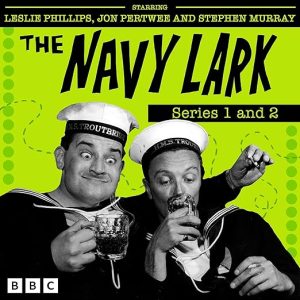
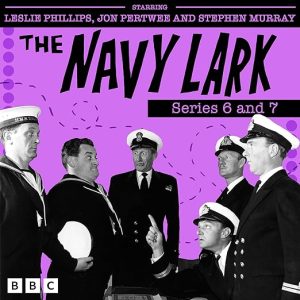
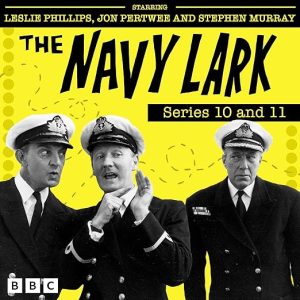
My grandmother listened to The Navy Lark on BBC Radio. I know this because she mentioned it with the particular fondness that people reserve for things they associate with being young and temporarily free from responsibility – she was in her twenties when the original series ran, and the programme was the kind of thing you listened to on Saturday evenings before going out. When this collection appeared in my review queue, I put it on with a mixture of curiosity and sentimental proxy. Nearly thirty hours of nautical comedy from 1960 to 1963: HMS Troutbridge, the incompetent crew, the long-suffering Captain Povey, the endlessly scheming Petty Officer Pertwee. It is exactly what it was always supposed to be.
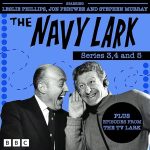
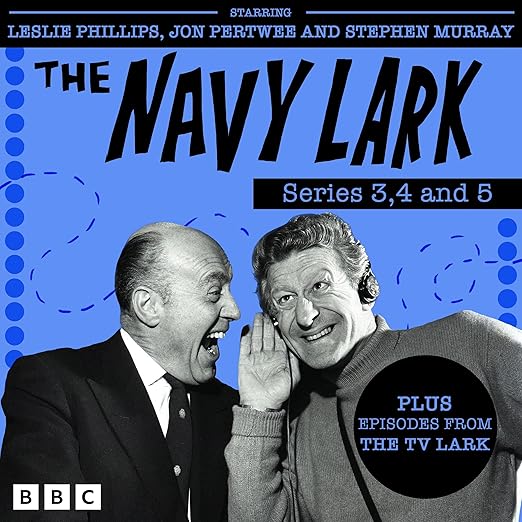
The Navy Lark ran on BBC Radio from 1959 to 1977, making it one of the longest-running comedy series in British broadcasting history. This collection – Series 3, 4, and 5, plus the Christmas Special and all nine existing episodes of the spin-off The TV Lark – represents a significant chunk of the programme’s middle period, when it had found its rhythms and its audience but had not yet outstayed its welcome. It is, by any contemporary standard, very dated. It is also very funny, if you meet it on its own terms.
About the Audiobook
The collection was published by BBC Digital Audio in April 2024 and runs to 29 hours and 42 minutes. The production credits are formidable: Leslie Phillips, Jon Pertwee, Stephen Murray, Richard Caldicot, Michael Bates, Heather Chasen, Ronnie Barker, Tenniel Evans, Judy Cornwell, and Janet Brown in the main cast, with guest appearances from Richard Murdoch, Wilfrid Hyde-White, Ted Ray, Kenneth Horne, Betty Marsden, and Kenneth Williams across the run. This is a catalogue of British comedy royalty, and hearing them all in the same production is its own form of entertainment history.
The premise is simple and does not deviate much: the crew of HMS Troutbridge, a Royal Navy minesweeper perpetually based at Pompey, conspires to avoid work, frustrate authority, and survive the increasing exasperation of Captain Povey. Pertwee’s Chief Petty Officer Pertwee is the engine of most of the chaos; Phillips’s Sub-Lieutenant Phillips is the hapless, aristocratically useless officer who perpetually fails to navigate correctly; Murray’s Chief Petty Officer Murry is the amiable core of the ensemble. The comedy is rooted in class, in incompetence elevated to an art form, and in the very specific cultural assumptions of early-1960s Britain.
The BBC’s own note acknowledges that some of the language reflects the era, and it does – there are jokes here that would not survive a contemporary commissioning meeting. The sound quality, also acknowledged by the BBC, varies across the collection, particularly in the earlier recordings. Neither of these things is surprising for archival material from 1960 to 1963, and neither significantly diminishes the listening experience if you approach it as the historical document it also is.
The Narration
This is a radio production, not a narrated audiobook in the conventional sense, and the distinction matters. Leslie Phillips appears both as a performer within the ensemble and, on this release, credited as narrator – which reflects the fact that Phillips was associated with the programme throughout its run and was involved in the archival releases. The production values of the original BBC recordings are, within the constraints of period sound engineering, excellent. The cast chemistry is audible: these are performers who have found their rhythms with each other, and the comedy lands with the ease of well-rehearsed ensemble work.
What Readers Say
The collection holds a 5.0 rating from 3 listeners – a very small sample but an entirely consistent one. Wayne Catchpole described it as a good series that had him in stitches all the way through, which is the most one could reasonably ask of a comedy archive. Colin offered the brief but sufficient verdict of pleased, no complaints. The absence of negative reviews is partly a function of sample size and partly a function of the audience: people who seek out The Navy Lark at this point know what they are looking for.
Who Should Listen?
This is for listeners with an affection for mid-century British radio comedy, for the specific texture of early-1960s ensemble performance, and for the kind of comedy that operates through character consistency and accumulated absurdity rather than joke density. It is also a genuine piece of cultural history – you will hear Ronnie Barker in his pre-Porridge years, Kenneth Williams in a supporting role, and a cast that defined a generation of British comedy. For newcomers to The Navy Lark, it is worth noting that you can dip in at any episode – the format does not require serial engagement. Put it on in the background of a domestic Sunday afternoon and let it do its work.