Clara’s Verdict
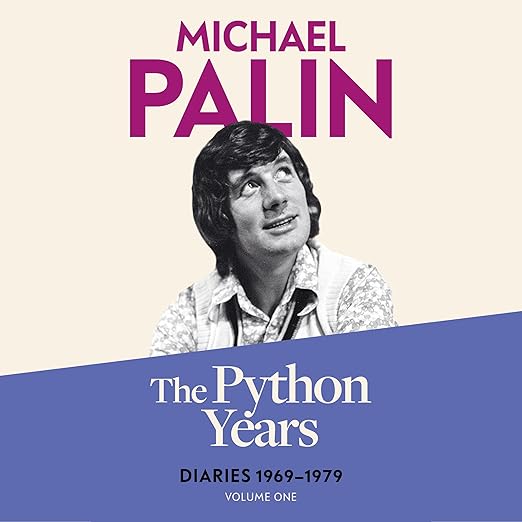
Nearly thirty hours of Michael Palin reading his own diaries should, in theory, be an indulgence reserved for the most committed Python devotee. In practice it becomes something far stranger and more compelling than a simple nostalgia exercise. I was a good hour in before I realised that what I was really listening to was a document of creative uncertainty, of a man who was newly married, struggling to establish himself in television comedy, and by no means certain that Monty Python would amount to anything at all. The famous years feel different when you hear them from inside the anxiety rather than from the vantage point of retrospect.
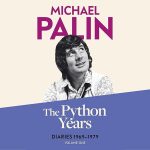
This is the first volume of Michael Palin’s published diaries, covering the period 1969 to 1979, which encompasses the entirety of Monty Python’s Flying Circus, the American and Canadian tours, Monty Python and the Holy Grail, and the making of Life of Brian. It is also a record of the three-day week, the miners’ strike, and the textures of a peripatetic life shared with a young family.
About the Audiobook
The production from Weidenfeld and Nicolson runs twenty-nine hours and forty-eight minutes, which is a significant commitment. It was released in August 2022. This is, in effect, a diary read at diary pace: individual entries accumulate rather than building to conventional narrative peaks, which means the experience rewards extended listening sessions over a period of days rather than marathon sittings. The diaries are listed as the first entry in the Michael Palin Diaries series, and those who find this absorbing will find subsequent volumes covering his travel writing career and later life.
The book’s texture is dense with period detail: references to friends and collaborators who became famous, to places in London that have changed or vanished, to films being made under conditions that now seem extraordinary. One reviewer notes the pleasure of spotting mentions of George Harrison, the Rolling Stones, and the broader cultural world in which the Pythons were embedded.
The Narration
Palin reads his own diaries, which for this kind of material is not optional. The intimacy of the form demands the author’s own voice; anyone else would be an impersonation. What is interesting is that Palin at this stage of his life brings a quality of gentle retrospection to words written by a much younger, more anxious version of himself, and the gap between the two registers is quietly moving. He does not editorialize or perform; he simply reads, and the material does the rest. His voice is well known from decades of television, and it carries a warmth that makes even the more mundane diary entries feel companionable.
What Readers Say
Reviewers consistently describe this as absorbing rather than breezy. The five-star ratings dominate, and the praise centres on two things: the human portrait of a man navigating fame and family simultaneously, and the incidental historical record of a particular moment in British cultural life. One reviewer emphasises that what makes the book engrossing is not the Python mythology but the ordinary texture of the life around it. Another notes the pleasure of reading the diaries and then returning to the films mentioned within them. A dissenting four-star review observes that at this length, some sections are inevitably slower than others, which is the honest truth about any diary of this scope.
Who Should Listen?
Python enthusiasts are the obvious primary audience, but this rewards anyone interested in British comedy history, the creative culture of the 1970s, or the experience of navigating early career uncertainty alongside domestic life. The runtime is a genuine commitment, and those who prefer tightly structured narratives may find the diary format frustrating. For those who settle into it, though, the cumulative portrait is remarkable. The self-narration is non-negotiable: this is one of those cases where the author’s own voice is the entire point.