Clara’s Verdict
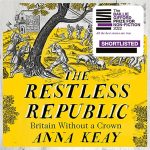
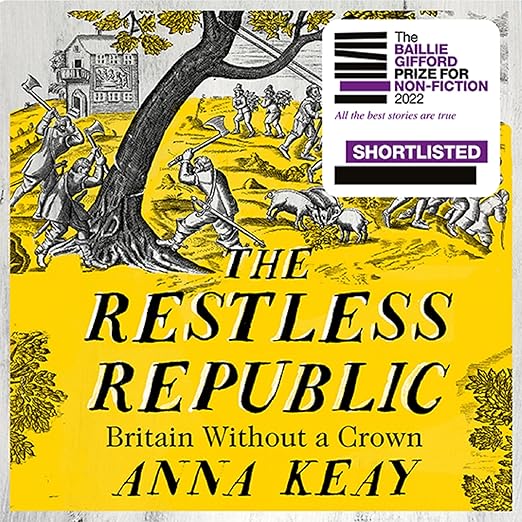
History books can be written in two ways: from above, tracing the grand movements of power and ideology, or from below, through the lives of those who were caught up in events they could barely comprehend. Anna Keay does something rarer and more difficult – she holds both perspectives simultaneously, never losing the individual in the panorama, nor the panorama in the individual. The Restless Republic won the Sunday Times History Book of the Year in 2022, the Pol Roger Duff Cooper Prize for Non-Fiction, and was shortlisted for the Baillie Gifford Prize. It deserves every accolade. After fourteen hours in the company of Lucy Tregear’s narration, I found myself genuinely reluctant to leave Keay’s extraordinary cast of characters behind.
What Keay has accomplished is essentially what Hilary Mantel did for the Tudor court – except non-fiction, and therefore, in its way, more extraordinary. She has made a period that British history tends to treat as an embarrassing interlude feel urgent, strange, and entirely, uncomfortably contemporary.
About the Audiobook
The subject is the eleven years between the execution of Charles I in January 1649 and the Restoration of the monarchy in 1660 – the English Republic, also called the Commonwealth and later the Protectorate, a period when Britain genuinely did not know what it was or where it was going. Keay’s approach is to tell the story through nine individuals whose lives intersected with these convulsive years: Anna Trapnel, a visionary from Deptford whose prophetic trances drew crowds across the country; John Bradshaw, the Cheshire lawyer who found himself presiding over the trial of a king; the propagandist and newspaper impresario Marchamont Nedham, who served every side in turn; the radical agrarian Gerrard Winstanley, who strove for a Utopia of common ownership; the precocious scientist William Petty, whose mapping of Ireland prefaced the dispossession of tens of thousands; and Charlotte, Countess of Derby, defending to the last the final Royalist stronghold on the Isle of Man.
What emerges is a portrait of a country in the grip of genuine revolutionary uncertainty – no one had a map for what came next, no precedent for a republic in this context, no agreed-upon destination. Keay is superb at conveying the texture of that uncertainty: the way ordinary people had to navigate extraordinary circumstances with incomplete information, incomplete ideologies, and often contradictory loyalties. The republic was not just a political episode but a lived experience, and she restores that lived quality with remarkable vividness. The range of the book is impressive: London, Leith, Cornwall, Connacht – the revolution rippled outwards in ways that are still underappreciated in conventional accounts that focus on Westminster and Whitehall.
Keay’s prose is a particular pleasure. It is scholarly without being dry, vivid without being sensationalised. She has a gift for the concrete detail – the document, the letter, the overheard conversation – that makes the past feel inhabited rather than reconstructed.
The Narration
Lucy Tregear is an excellent match for this material. She reads with clarity and conviction, bringing out the drama of Keay’s prose without over-playing it. The variety of characters – visionaries, lawyers, soldiers, aristocrats, scientists, countesses – might have been a challenge, but Tregear navigates the shifts in register and temperament with ease. At fourteen hours, this is a substantial commitment, but the narration makes it feel shorter. Tregear has the ability to make even dense historical exposition feel propulsive, which is no small thing in a book covering eleven years of complex political and social upheaval.
What Readers Say
The book carries a 4.5-star rating from 718 listeners on Amazon – an unusually strong result for serious narrative history. UK reviewers are particularly effusive. One, who had read over 200 books on the English Civil War, called it “one of the best books I have read on the subject.” Another described it as “thrillingly alive” and said it demolished any lingering tendency to think in terms of simple Cavalier versus Roundhead dichotomies. A third reviewer – an admitted sceptic of history-through-biography – admitted being unable to put it down. The phrase “this is how history should be written” appears more than once in the reviews, which is as high a compliment as the genre receives.
Who Should Listen?
The Restless Republic is essential listening for anyone interested in British history, but it would be a mistake to confine it to specialists. Keay writes with novelistic flair and a genuine understanding of how power, faith, ambition, survival, and sheer bewilderment play out in real human lives under revolutionary pressure. Readers who have been captivated by Hilary Mantel’s approach to historical fiction, or who have enjoyed Sarah Bakewell’s ability to make philosophy feel urgent and personal, will find something familiar and deeply satisfying here. It is also a book that speaks, obliquely but forcefully, to the present: a record of what happens when a society tries to reinvent itself from scratch, discovers the task is harder than anticipated, and yet – somehow – comes through changed.
Listen on Audible UK: Get The Restless Republic on Audible UK. Also available on Kobo, Scribd, and Storytel.