Clara’s Verdict
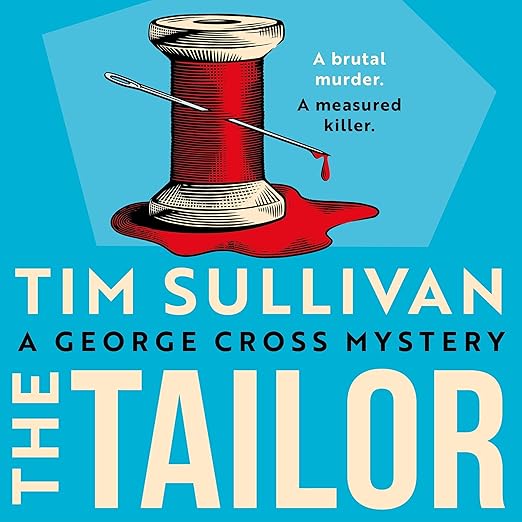
A bespoke tailor takes his seat on the ten o’clock service out of Bristol, bound for London. He never reaches Bath. He is found in the lavatory with his throat cut and a plastic bag over his head. Tim Sullivan opens The Tailor with an image so precise and so wrong that DS George Cross reaches the correct conclusion well before the reader does. This was not a robbery, and nothing about it was random. It was an execution.
Eight books in, the George Cross Mysteries have settled into being one of the more distinctive propositions in British crime fiction, and this entry has become a fixture among the Audible UK bestsellers within a fortnight of release. Nine hours and fifty-one minutes, narrated by Finlay Robertson, with a case that takes Cross a good deal further from his usual Bristol territory than he tends to go.
About the Audiobook
Released on 16 July 2026, running just under ten hours, read by Finlay Robertson, whose name the listing places front and centre alongside Sullivan’s. This is book eight in the George Cross Mysteries, and the investigation carries Cross into what the listing calls a cold and merciless world. He also begins to suspect he is being followed, which in this series is a far bigger deal than it would be elsewhere, because Cross is emphatically not a detective given to imagining things.
The ingredients one reviewer lists give a fair sense of the range on offer: spies, tailors, police and codes, with Chinese and Korean characters woven through the case. Sullivan has always been good at professional worlds, and the tailoring material is not decoration. The listing’s own tagline, “Measure twice. Cut once.”, does double duty as a description of Cross’s method, which is the joke and the thesis at the same time. No officer in the force convicts at a higher rate than Cross does, and somebody would very much prefer he did not add to the tally.
On reading order: this is the eighth investigation and Sullivan writes them to be entered at any point. The cases resolve. What accumulates instead is your relationship with Cross himself, whose manner takes some acclimatising to and repays the effort. Newcomers will manage perfectly well; regular listeners will get considerably more from the personal thread, particularly the growing sense that somebody has taken an interest in him.
The Narration
Here is the interesting technical problem. George Cross is a detective whose defining quality is that he does not perform. He is direct to the point of rudeness, entirely literal, uninterested in the social lubricant everyone else relies on, and his conviction rate is the direct result. On the page that reads as fascinating. Read aloud badly, a character with deliberately restricted affect becomes ten hours of unbroken flatness.
Finlay Robertson understands the difference between restricted and empty. His Cross is precise rather than monotone, with the emphasis falling in slightly the wrong places, which is exactly how the character lands in a room. The consequence is that you can hear everybody else recalibrating around him. Robertson is just as good on those other people: the colleagues who admire Cross without quite knowing what to do with him, and who supply all the warmth that Cross himself withholds. One reviewer captures the dynamic neatly, saying that “Everyone admires him though they don’t always know how to take him.” That is a difficult thing to convey through voice alone, and this recording achieves it in the pauses more than in the lines.
What Readers Say
Just over nine hundred ratings, averaging 4.7, put this among the better-received entries in a series whose readers are fiercely loyal. The written responses have the flavour of people greeting an old friend. PJ, who notes “I’ve read them all and looking forward to the next story”, finds Cross entirely himself here and enjoys the mixture of espionage and craftsmanship. Another five-star reviewer offers the pleasingly counterintuitive observation that “George Cross had a swagger!”, which will amuse anybody who knows the character.
The four-star response from Scandalous represents the mild dissent, describing “a complex crime to be solved” alongside Cross’s interactions with everyone around him. That complexity is the one thing I would flag. This is a busier plot than the series usually attempts, and there is a stretch in the middle where the strands multiply faster than they resolve. The blurbs, incidentally, are unusually starry. The Daily Mail calls Cross “One of the most iconic British fictional detectives of the 21st century.” and Elly Griffiths, no slouch at this herself, calls him “One of my favourite detectives.”
Who Should Listen?
Procedural purists will find a great deal to like. Sullivan builds cases that reward attention, the police work is methodical rather than intuitive, and the solution is genuinely available to a listener who is paying attention. Anyone who enjoys crime fiction organised around a detective’s particular way of seeing, rather than around jeopardy, should try this series, and the listing’s own comparisons to MW Craven and Ann Cleeves point in roughly the right direction.
Two reservations. Cross’s manner is genuinely abrasive and a small number of readers never warm to him at all, so if a protagonist who does not do charm is a dealbreaker for you, no amount of good narration will fix that. And the international strand introduces more moving parts than usual, meaning this is not the entry to take in five-minute fragments. Given a proper run at it, book eight stands among the strongest in the series.