Clara’s Verdict
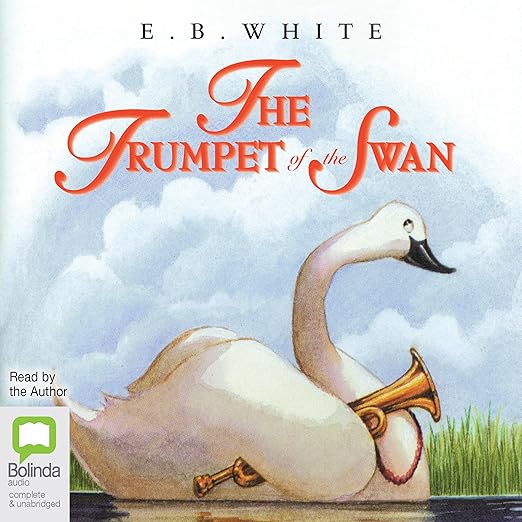
I was given Charlotte’s Web as a child by a teacher who had a gift for knowing which books would ambush you. The Trumpet of the Swan arrived in my life much later, by accident, when I was looking for something to read aloud to a nephew who was going through a difficult patch and needed a story with a quiet kind of courage in it. E. B. White’s third major children’s novel is less celebrated than Charlotte’s Web and Stuart Little, but reviewer Jack Chakotay on Audible has it right: it is his lesser known work but no less powerful. What makes it distinctive within the tradition of children’s literature is the absence of a villain. There is no evil here, only obstacle and determination and the strange, undemonstrative grace of working around what you have been given.
Louis is a trumpeter swan born without a voice. His father explains what this means with a gentleness that does not disguise the difficulty of the situation. Louis responds not with despair but with the methodical, quietly heroic decision to find another way. A human friend, Sam Beaver, helps him learn to read and write. When he returns to his lake, he discovers that his education is not enough: the swan he loves, Serena, cannot read his declarations of love, and he cannot trumpet them. White’s prose is characteristically clean and spare, and the emotional weight of the story rests in what is not said as much as what is. The adventures that follow, taking Louis far from his Montana lake and into the wider human world, are handled with the same restraint: incidents that would become melodrama in other hands remain simply true.
About the Audiobook
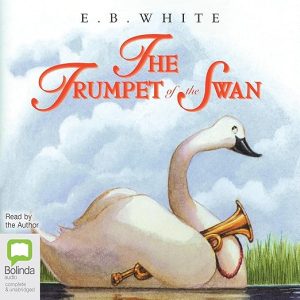
This Bolinda Publishing edition, released in March 2015, runs 4 hours and 21 minutes and has the remarkable distinction of being narrated by E. B. White himself. White, who died in 1985, recorded readings of his own work that have been preserved and released across various editions. Hearing the author of Charlotte’s Web read his own prose is an archival experience as much as an audio one. The recording quality reflects its origin and era, but the voice is unmistakably the right one for this material: measured, warm, carrying the quiet satisfaction of a man who took words seriously and trusted them to do their work without assistance.
With only two Audible ratings, the sample is too small to carry statistical weight, but both are five stars, and the reviews available are specific and affectionate. The limited review count is a reflection of the audiobook’s niche positioning and archival nature rather than any signal about quality.
The Narration
White’s self-narration is not the polished performance of a professional narrator trained in audiobook production. It is the reading of a writer who trusts his own prose, delivers it at the pace it was written to be received, and does not oversell the emotional moments. This is the correct approach for material that is already doing its work without assistance from performance. The recording has the texture of an earlier era of audio production, which some listeners will find charming and others may find distracting if they are used to contemporary production standards. Reviewer G. Kay, who bought the recording partly to encourage a grandchild named Louis to read, describes being enchanted with the original story, which suggests the recording works as a shared-listening experience for families as well as solo adult listeners.
What Readers Say
Jack Chakotay’s review is the most developed in the pool and the most useful for adults considering this for themselves rather than for a child. He identifies what makes the book unusual in its genre: the absence of a bad guy or even a protagonist in the conventional sense, the central focus on a disability navigated through love and resourcefulness, and White’s use of the American natural landscape as backdrop for Louis’s growing up and finding love. E. Roberts, who reads it to second-grade students, reports genuine engagement from young listeners, which confirms that the book’s target audience connects with the material in audio form as well as in print. Elizabeth M. describes reading it weekly to a granddaughter, which speaks to the rhythm the book creates for shared listening over time.
Who Should Listen?
For families looking for a read-aloud that does not require a villain and does not condescend to younger listeners, this is a genuinely lovely option. For adult listeners who know Charlotte’s Web well and have not encountered this novel, it is a quiet pleasure that repays the modest time investment of just over four hours. The archival quality of White’s narration makes this a different kind of listening experience than a contemporary production, and anyone who values that kind of direct line to an author, hearing the prose in the voice that wrote it, will appreciate it. Not ideal for listeners who need high production values or a contemporary narrative pace.