Clara’s Verdict
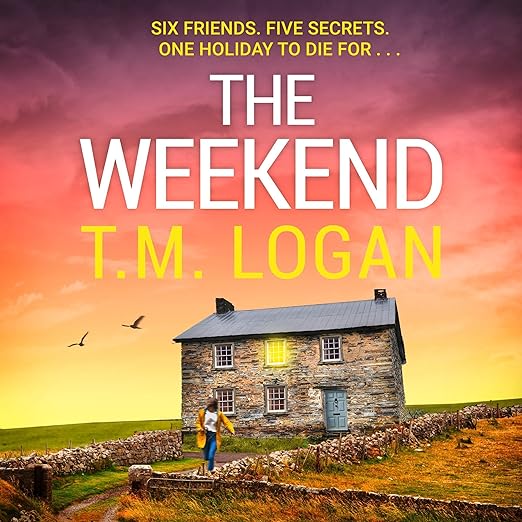
Six friends. Five secrets. One holiday. T M Logan’s publisher has boiled the book down to a handful of words and I cannot improve on it, because the pleasure of The Weekend is almost entirely structural. Put a group of people who believe they know each other in a converted farmhouse in the Yorkshire Dales, have them shelter from a storm in the mouth of an old lead mine, and let them find a backpack containing more money than any of them has ever seen.
Everything after that is the slow disintegration of an agreement. Of course they will hand it to the police at the first opportunity. Of course they will. And then the storm continues, and time passes, and one by one they begin to reconsider, because there are debts and obsessions and a career on the brink among them, and an unexpected windfall solves every one of those instantly.
Eleven hours and forty one minutes, narrated by Nicola Walker, currently well placed in the Audible UK charts and carrying a 4.3 average from over thirteen hundred ratings. This is a moral trap rather than a mystery, and it is very effective indeed at what it sets out to do.
About the Audiobook
What makes the premise work is that Logan never requires anybody to be wicked. The money is unclaimed, its owner is presumably a criminal, nobody visible would be harmed by keeping it, and every single person in the group has a reason to want it that any listener will recognise as thoroughly ordinary. That is the snare. The book invites you to work out what you would do while showing you people reaching a series of individually defensible conclusions which add up to a catastrophe.
The setting earns its keep. A converted farmhouse in the Dales is remote by design, and the storm that drives them into the mine also keeps them there, cut off from the ordinary friction that would normally stop a bad idea becoming a plan. The enclosed group is a durable thriller structure, and this is about as enclosed as the form gets.
Lucy Clarke called it a fiendishly gripping what would I do thriller, and that is the correct genre label. This is not a whodunnit. It is a book about six people who do not know each other nearly as well as they thought, sliding into deceit, treachery and eventually murder across a few days. The secrets that surface are the entire point, and Logan releases them at a rate calculated to keep reordering your sympathies.
The Narration
Nicola Walker is a shrewd choice here, and the reason is arithmetic. Six central characters, a compressed span of days, and a listener required to track not merely who is speaking but what each of them is currently concealing. That is a differentiation problem before it is anything else. If Walker’s screen work means anything to you, you will already have a sense of what she does with a room full of people who are not saying everything, and that is exactly the demand this book makes.
Her particular gift is understatement. Walker does not signal. When a character is lying she declines to lean on it, which is essential in a book where the listener is meant to be gradually reassessing people rather than being told when to distrust them. A more theatrical reader would flag every deception and drain the tension straight out of the moral question, because the whole point is that these are decent people making choices you can follow.
The six-way differentiation is handled through placement and rhythm rather than broad accent work, which is the right instinct with a group of friends who are meant to be of a type. The risk is that at high playback speeds those distinctions compress, and this is not a book I would run at one and a half times. The runtime is a fair length for the material, and I would give it its natural pace.
What Readers Say
A 4.3 average drawn from more than thirteen hundred ratings puts this in solid rather than spectacular territory, and the written feedback is interesting because it arrives from two quite different constituencies, long-standing Logan readers and complete newcomers, both satisfied for different reasons.
“I particularly enjoyed the moral dilemmas that each of the six central characters faced.”
That is Ruth Owen, for whom this was a first T M Logan book and will not be the last. She praises the initial plot for developing unexpected tangents that constantly kept her guessing, and describes the whole as thoroughly enjoyable and satisfying with a final surprise. The committed readers are more emphatic still. One reviewer who has read all his books calls this the best by far and reports never having anticipated the ending. Another, an eighty year old reader from Nottingham, notes with evident affection that Logan comes from the same city and asks him to keep going.
I will add the usual honest note. Almost all of this feedback concerns the novel rather than Nicola Walker’s reading, with reviewers referring throughout to reading rather than to listening. The 4.3 average is a verdict on T M Logan, not on the audio production, and you should weigh it accordingly.
Who Should Listen?
The premise sells this one, so the honest question is whether you enjoy a moral trap. If the words what would I do make you lean forward rather than sigh, you will have a very good time. It is also a strong choice for shared listening on a long car journey, because the entire book is an argument waiting to be had.
Two caveats. If you want a puzzle to solve, this is not really that. The tension comes from watching decisions rather than from working out a concealed fact, and readers who like to out think an author may find the shape too straightforward. And if you struggle to stay with characters behaving badly, six of them doing so in sequence across eleven hours is a lot to sit with. Otherwise, Logan and Walker are a good match and the Dales have rarely felt less hospitable.