Clara’s Verdict
The best thing about Twist of Fate arrives about a third of the way in, when Sebastian Clifford stops being a private investigator working a case and becomes a father watching his daughter walk towards it. Sally Rigby has spent seven previous books building the Clifford and Birdie partnership, and here she does the thing long-running series exist to make possible. She puts the professional plot and the personal one on a collision course and then refuses to let her detective have both.
At six hours and thirteen minutes this is the shortest listen in a fairly crowded field of British procedurals, and Rigby uses the compression well. It is riding high in the Audible UK charts, narrated by Jonathan Keeble, and it goes down in two evenings without ever feeling thin.
About the Audiobook
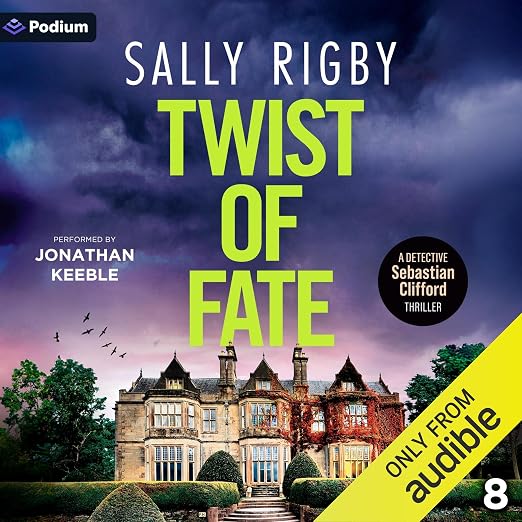
Twist of Fate is the eighth book in the Detective Sebastian Clifford series, published in audio by Podium Audio on 10 July 2026 and running six hours and thirteen minutes. Seb and his partner Lucinda Bird, universally known as Birdie, work as private investigators rather than serving officers, and they are tracking an unusually sophisticated theft ring working through Leicestershire’s wealthiest estates. Antiques and collectables of real value simply disappear, leaving nothing behind, and the thieves stay a step ahead throughout.
The complication is domestic. Seb’s daughter Keira picks up a friendship from her schooldays, which pleases him, right up until the coincidences begin stacking in a direction he does not want to look. When she ignores his instruction and goes to a very public event anyway, the case and the family collapse into one another and he is left with a choice no amount of professional competence can help him make. The listing offers Joy Ellis, Michael Connelly and Angela Marsons as points of comparison, and the first and third of those are about right. This is British, county-scale, relationship-driven crime rather than anything hard-boiled.
On sequence: Rigby writes each investigation to stand alone, and you could begin here without being lost by the plot. You would, though, be starting with a book whose entire emotional argument depends on knowing Seb and Birdie well enough to feel the strain between them, and on having watched Keira grow up across the series. Book one is the better door.
The Narration
Jonathan Keeble is a narrator I associate with gravity, and the interesting question with this recording is what he does with material considerably lighter than that. The answer is that he dials the weight down without abandoning it, which turns out to be right for Rigby’s tone. Clifford is a serious man in a series that is not relentlessly grim, and Keeble finds the line and stays on it.
The more valuable thing he does is solve a problem the text has. One listener’s chief complaint about Twist of Fate is that there are, in her words, “too many characters”, and that this made it slower going than usual at the start. On the page, a large cast of Leicestershire landowners, dealers, police contacts and old school friends is genuinely hard to track. In audio, Keeble gives each of them a consistent vocal signature, so you can identify a returning character from a single line of dialogue without stopping to work out who is speaking. Birdie in particular is well handled: brisk and slightly combative without being played for comedy, and audibly from a different background to Seb without the difference becoming a running joke. This is one of those cases where the recording is measurably easier to follow than the printed page.
What Readers Say
A 4.7 average from just under six hundred ratings is a strong showing, and the written responses explain where it comes from. Andy puts the series appeal plainly: “I love a series of books that allow you to get to know the main characters properly and this is a perfect example of this.” Julian Tremayne, who clearly knows these books well, singles out the mechanics of the crime, noting that the team uncovers a very sophisticated method of making the robberies appear undetectable, and that not everyone involved is who they seem to be.
The dissent is worth taking seriously because it is specific rather than sour. Linda gave it four stars, said it “took a bit longer than usual to get into the storyline”, blamed the size of the cast, and concluded that it does not rank among Rigby’s best. That is a fair, unspiteful criticism from somebody who read on anyway because she wanted to know how it ended, which is the most honest kind of four-star review there is. My own view sits between the two camps. The first ninety minutes are busier than they need to be, and the last two hours are as good as anything Rigby has written.
Who Should Listen?
Anyone who reads British crime for the partnership rather than the pathology should be here already. Clifford and Birdie are one of the more likeable double acts in contemporary series crime, and the pleasure of book eight lies in watching a stable relationship destabilised by something neither of them can investigate their way out of. Parents of teenagers may find the central dilemma lands harder than they expect it to.
Two cautions. If a busy opening irritates you, the first act asks you to hold a great many names at once, and even Keeble’s differentiation cannot make that effortless. And if you want the case to be the whole book, note that Rigby gives roughly equal weight to the family thread, which is the entire point but will not suit every listener. For anyone already invested in this series, book eight moves its characters somewhere they cannot easily come back from.