Clara’s Verdict
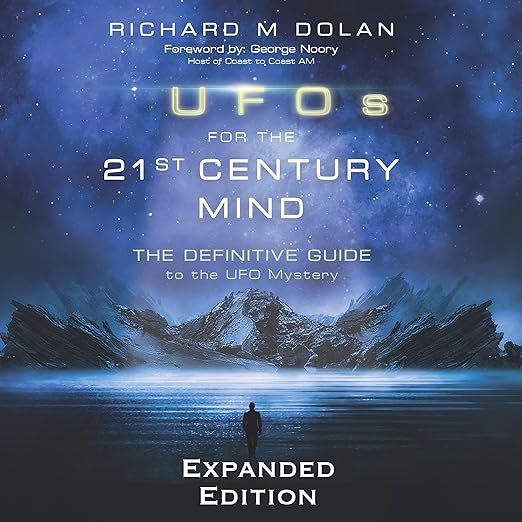
Whatever one’s prior position on the UFO and UAP subject – credulous, sceptical, or, most honestly, genuinely uncertain in the face of a body of documented evidence that does not resolve neatly into any available framework – Richard Dolan is the researcher who forces you to take the question seriously as a historical and political matter, regardless of where you ultimately land on the metaphysical ones. UFOs for the 21st Century Mind, his revised and expanded edition covering the subject through the early 2020s, runs to eighteen hours and fifty-five minutes and is one of the most comprehensive and rigorously argued audiobooks in a field that produces more noise than signal. With 310 ratings averaging 4.5 stars, it has found an audience well beyond the committed UFO community, and the reasons are immediately apparent: Dolan is genuinely good at what he does, and what he does is apply the tools of serious historiography to a subject that most serious historians have preferred to ignore.
About the Audiobook
Dolan’s central contention is that the UFO phenomenon – whatever its ultimate explanation – has had a demonstrable and largely unacknowledged influence on modern history: on military doctrine and spending, on intelligence community structure and culture, on the politics of state secrecy, and potentially on the direction of scientific and technological development. His approach is historical rather than sensationalist: he assembles documented cases, declassified government materials, congressional testimony, and first-hand witness accounts, then asks the kind of systematic questions that the subject usually avoids. What are the likely intentions of any non-human intelligence involved, if one exists? What is the structural relationship between UAP secrecy and the broader national security state? What would genuine disclosure actually require politically, institutionally, and socially?
The revised edition extends the treatment through the significant developments since 2017, when a series of official disclosures and subsequent congressional hearings shifted the public conversation about UAPs substantially and irreversibly. Dolan provides critical context for those developments, analysing what they mean and where they are likely to lead rather than simply narrating what occurred. He also covers the broader landscape of the subject across its full historical span: ancient-alien theories (treated with appropriate scepticism), modern encounter cases, abduction reports, channelling phenomena, the black budget world, and the genuinely strange science at the edges of what the evidence suggests. The result is a roadmap through a field filled with uncertainty and deliberate obfuscation – which is, as Dolan argues, itself a significant historical fact.
The Narration
The audiobook is narrated by the author, a detail noted approvingly in several reviews. Listeners driving long distances found the combination of Dolan’s authority and his evident investment in the material particularly effective. His voice has the measured quality of a researcher rather than a performer, which suits the subject: this is not material that benefits from theatrical narration, and Dolan’s deliberate delivery keeps the focus on the arguments and the evidence rather than the atmosphere.
What Readers Say
With 310 ratings at 4.5 stars, this is among the more extensively reviewed titles in its category. Reviewers consistently praise Dolan’s ability to make “a difficult subject easy to read and absorb for anyone new to the subject” while providing depth and “links to further information” for readers already familiar with the field. One listener described him simply as “the GOAT” – “superbly written and well researched.” Another praised the latter sections on government and the future of UAP disclosure as “a mammoth achievement.” A reader who found the book particularly valuable for first-time explorers of the subject noted that Dolan “never shies away from incorporating a big picture analysis” – something that makes him genuinely distinctive among researchers in this space. One early review noted some editorial inconsistencies in the text, worth being aware of for a seventeen-plus-hour listen.
Who Should Listen?
Anyone with a serious interest in the politics of secrecy, the structural history of American intelligence, or the growing body of government-acknowledged evidence around UAPs will find this an essential resource. Newcomers get a comprehensive and carefully structured introduction; researchers with existing knowledge of the cases will find Dolan’s contextual and analytical framing valuable. This is not a credulous “true believers” book – it is a careful, documented historical argument, and it deserves to be evaluated on those terms.
Dolan’s value to this subject – and the reason he has attracted an audience well beyond the committed UFO community – is his insistence on treating it as a legitimate historical and political question rather than a matter of personal belief. He does not ask the listener to decide whether extraterrestrial craft have visited Earth; he asks the listener to examine the documented evidence, consider the implications of government secrecy patterns, and form their own conclusions based on what can actually be established. That methodological discipline is unusual in this field and is the primary reason UFOs for the 21st Century Mind stands apart from the vast majority of books on the subject.